Justplainbill's Weblog

September 17, 2022

Jabs vs Jobs, Mises Wire

Filed under: Political Commentary — justplainbill @ 2:52 pm

MISES WIRE

GET NEWS AND ARTICLES IN YOUR INBOXPrint

A

A

Home | Wire | Mandatory Vaccines vs. Logic and Kantian Ethics

Mandatory Vaccines vs. Logic and Kantian Ethics

  • jab

106 COMMENTS

TAGS LawProgressivismThe Police State

09/07/2022Patrick Barron

Listen to the Audio Mises Wire version of this article.

The case in favor of mandatory vaccines rests upon faulty logic and violates ethical principles. A vaccinated person protects himself to the extent of the vaccine’s capability, which may be close to 100 percent, as in the case of polio and smallpox vaccines, or much less, as in the case of the covid-19 vaccines. One may take the vaccine and enjoy its full protection even if one is the only person so vaccinated. If everyone else takes the vaccine, one’s protection is NOT increased. And if everyone else refuses to take the vaccine, one’s protection is not diminished.

So, why insist that “society” must be allowed to force you to take a vaccine? If you refuse to take it, you are not a threat to anyone who does take it. And those like you who refuse to take it assume the risk.

One argument is that the more people who take the vaccine, the less chance the disease has to spread and, it is hoped, will die out before it has a chance to mutate into something else against which the current vaccine will not provide protection. This is what the epidemiologists call “herd immunity.”

Kant’s Humanity Principle

The problem with this argument is that it violates Emmanuel Kant’s “humanity principle”; i.e., that man is an end in himself and may not be used solely as a means to some other end. The advocates of mandatory vaccine want to force individuals, against their will, to take a vaccine to protect unknown and perhaps nonexistent others against something that may or may not happen. Not only is this very thin soup, smacking of totalitarianism, but is a clear violation of Kantian ethics.

So, what’s so important about Kantian ethics? Well, we see the problem all around us. It is so ubiquitous that that we take it for granted. The state has expanded from one organized for the protection of life, liberty, and property to one of coercion to attain societal engineering on both a domestic and international scale. I refer to the warfare/welfare state.

On the thinnest of pretenses man becomes cannon fodder for continuous wars, not to protect our lives, liberty, and property in the present, but to stop some supposed attack in the future. If we don’t stop those terrible “fill in the blank” over there, they will be at our doorstep as sure as night follows day, say the warmongers.

Domestically we are used to pursue a theoretical ideal called the welfare state, where our property is confiscated in ever-increasing amounts to uplift others. Most often the failure of these programs becomes prima facie reason to expand them, never to end them.

The welfare state has pushed aside voluntary private charities and benevolent associations, who must continually show their financial supporters that they are effective and efficient to retain their voluntary funding. Such organizations do not violate Kantian ethics. Not so with government welfare, where the public are used as means and not ends.

The mandatory vaccinations are both illogical and ethical failures. But they are just one manifestation of a wider problem, that being the expansion of state power at the expense of individual liberty.

Author:

Contact Patrick Barron

Patrick Barron is a private consultant to the banking industry. He has taught an introductory course in Austrian economics for several years at the University of Iowa. He has also taught at the Graduate School of Banking at the University of Wisconsin for over twenty-five years, and has delivered many presentations at the European Parliament.

September 7, 2022

mRNA vaccines & blood clots; study in Italy

Filed under: Political Commentary — justplainbill @ 2:05 pm
These photos are at 40x magnification. At the left side, (a) shows the blood condition of the patient before the inoculation. The right side image, (b) shows the same person’s blood one month after the first dose of Pfizer mRNA “vaccine.” Particles can be seen among the red blood cells which are strongly conglobated around the exogenous particles; the agglomeration is believed to reflect a reduction in zeta potential adversely affecting the normal colloidal distribution of erythrocytes as see at the left. The red blood cells at the right (b) are no longer spherical and are clumping as in coagulation and clotting. (Courtesy of IJVTPR)

These photos are at 40x magnification. At the left side, (a) shows the blood condition of the patient before the inoculation. The right side image, (b) shows the same person’s blood one month after the first dose of Pfizer mRNA “vaccine.” Particles can be seen among the red blood cells which are strongly conglobated around the exogenous particles; the agglomeration is believed to reflect a reduction in zeta potential adversely affecting the normal colloidal distribution of erythrocytes as see at the left. The red blood cells at the right (b) are no longer spherical and are clumping as in coagulation and clotting. (Courtesy of IJVTPR)

VACCINES & SAFETY

Study Found ‘Foreign Metal-Like Objects’ in 94 Percent of Sample Group of Symptomatic People Who Took mRNA Vaccines: Italian Doctors

Among a study sample of over 1,000 people who developed symptoms, researchers found ‘graphene-family super-structures’

By Enrico Trigoso

September 6, 2022 Updated: September 7, 2022

biggersmaller 

Print

0:0011:061 

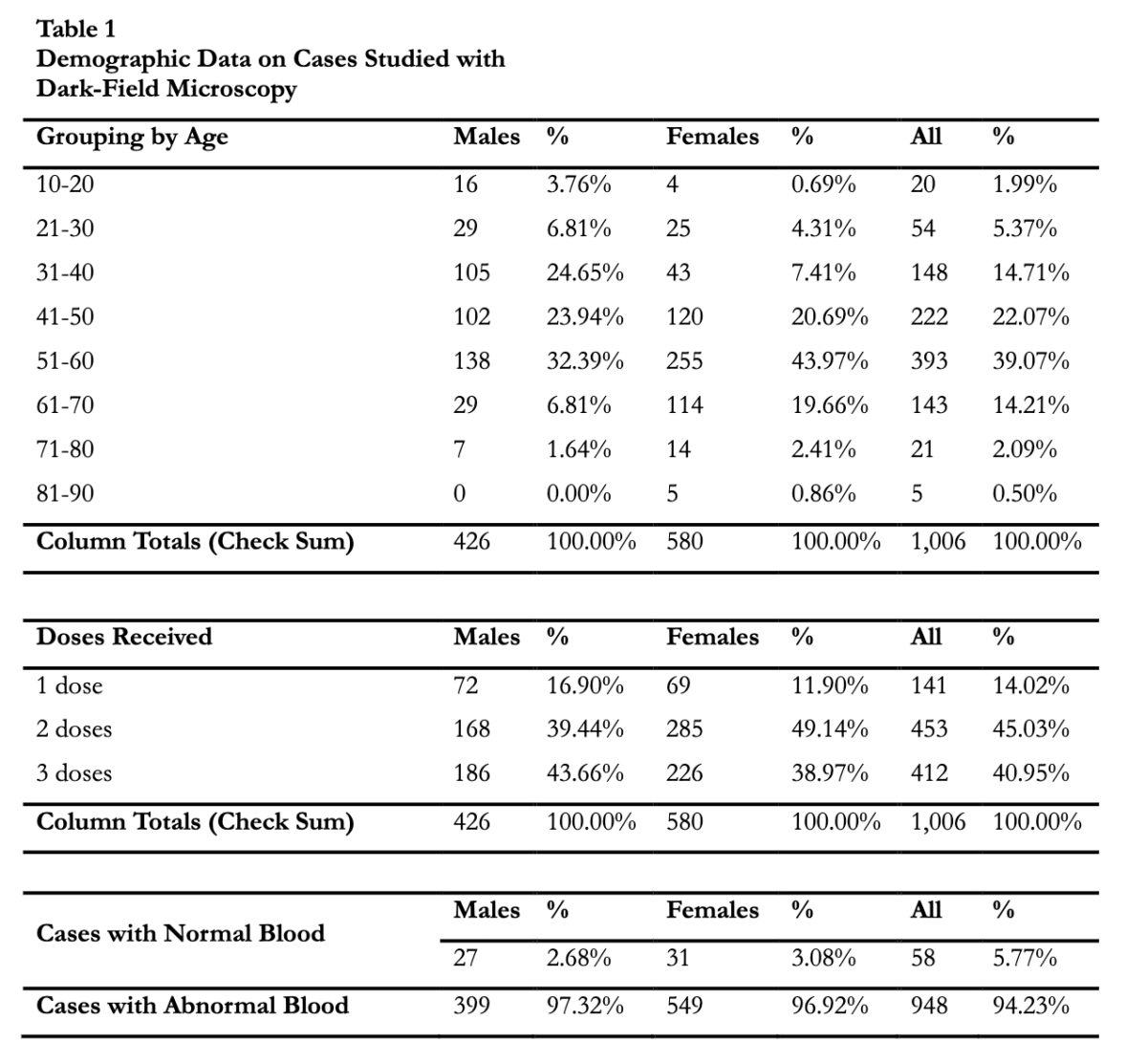
Three Italian surgeons conducted a study analyzing blood from 1,006 people who developed symptoms after they got a Pfizer/BioNTech or Moderna mRNA injection and found 94 percent of them to have “aggregation of erythrocytes and the presence of particles of various shapes and sizes of unclear origin,” one month after inoculation.

Erythrocytes are a type of red blood cell that carries oxygen and carbon dioxide.

“What seems plain enough is that metallic particles resembling graphene oxide and possibly other metallic compounds … have been included in the cocktail of whatever the manufacturers have seen fit to put in the so-called mRNA ‘vaccines,’” the authors wrote in the study’s discussion and conclusions.

Epoch Times Photo
An example of the complex and structured crystal/lamellar organization at 120x magnification. In the picture on the right side a “module” from the morphology and recurrent structuring occurring with great frequency. The aggregating forces are guided by the negative entropic context. (Courtesy of IJVTPR)
Epoch Times Photo
Here at 120x magnification (3xmagnification digitally produced) (a) and (b) show tubular formations that seem to be in different aggregative stages. (Courtesy of IJVTPR)

Franco Giovannini, Riccardo Benzi Cipelli, and Gianpaolo Pisano, are the surgeons who authored the study (pdf), which was published on Aug. 12 in the International Journal of Vaccine Theory, practice, and Research (IJVTPR).

Epoch Times Photo
Details of studied cases. (Courtesy of IJVTPR)

They said their results are very similar to the findings of Korean doctors Young Mi Lee, Sunyoung Park, and Ki-Yeob Jeon, titled “Foreign Materials in Blood Samples of Recipients of COVID-19 Vaccines,” but that their 1,006 subjects represent “a much larger sample.”

“It could be claimed that, except for our innovative application of dark-field microscopy to mark the foreign metal-like objects in the blood of mRNA injections from Pfizer or Moderna, we have replicated the blood work of the Korean doctors with a much larger sample,” the Italian surgeons wrote.

“Our findings, however, are bolstered by their parallel analysis of the fluids in vials of the mRNA concoctions alongside centrifuged plasma samples from the cases they studied intensively,” they added.

Epoch Times Photo
Images of crystalline aggregation, regular and modular, with apparent “self-similar attitudes of fractal nature.” (Courtesy of IJVTPR)
Epoch Times Photo
This image at 120x magnification (3x magnification digitally produced)highlights a typical self-aggregating structuring in fibro/tubular mode. (Courtesy of IJVTPR)

Further studies are needed to define the exact nature of the particles found in the blood and to identify possible solutions to the problems they are evidently causing.

Out of the 1,006 cases, only 58 people showed a completely normal hematological picture via microscopic analysis.

Epoch Times Photo
Evident tubular formations at 120x magnification in the aggregative phase showing their complex morphology. (Courtesy of IJVTPR)

The researchers cited numerous studies to back up their findings, including the “well-known” tendency of fibrin to cluster, vascular toxicity of the spike protein, and other adverse effects.

They picked four cases and analyzed their pre and post-vaccination health status, while showing dark field microscopic images.

“We assert unequivocally that the 4 cases described in this series are representative of the 948 cases in which extraordinarily anomalous structures and substances were found,” the researchers wrote.

Epoch Times Photo
In this case, the assembly of particles takes on crystalline features; furthermore, there is an area of close influence, butterfly wings, in the context of which a crystalline-type organization occurs. (Courtesy of IJVTPR)

“In conclusion, such abrupt changes as we have documented in the peripheral blood profile of 948 patients have never been observed after inoculation by any vaccines in the past according to our clinical experience. The sudden transition, usually at the time of a second mRNA injection, from a state of perfect normalcy to a pathological one, with accompanying hemolysis, visible packing and stacking of red blood cells in conjunction with the formation of gigantic conglomerate foreign structures, some of them appearing as graphene-family super-structures, is unprecedented. Such phenomena have never been seen before after any ‘vaccination’ of the past,” the researchers stated.

“In our experience as clinicians, these mRNA injections are very unlike traditional ‘vaccines’ and their manufacturers need, in our opinions, to come clean about what is in the injections and why it is there.”

Epoch Times Photo
Again, at 120x magnification, geometric figures tend to take shape in extremely complex aggregates. (Courtesy of IJVTPR)
Epoch Times Photo
A highly structured fibro-tubular configuration of structures that can coalesce together, reaching dimensions ten times their initial size. In (a) and (b) at 40x magnification, we see what appears to be a laminar linkage. In (c), at 120x magnification (3x magnification digitally produced), there is a composite which is 166.54 μm (DeltaPix Software) in length. (Courtesy of IJVTPR)

“In our collective experience, and in our shared professional opinion, the large quantity of particles in the blood of mRNA injection recipients is incompatible with normal blood flow especially at the level of the capillaries,” the authors wrote. “As far as we know, such self-aggregation phenomena have only been documented after the COVID-19 mRNA injections were first authorized, then, mandated in some countries.”

Graphene?

Graphene oxide is a type of material “considered two dimensional” and also considered “to be the strongest material in the world,” and the most conductive to electricity and heat, according to graphene-info.com.

Sherri Tenpenny, who has been ahead of the curve in vaccine adverse reactions, believes that these structures could be related to the strange clots embalmers have been finding in the corpses they treat since around the pandemic.

“Whatever is actually found to be in the shots, whether the components are graphene, aluminum, crystalline amyloid, disintegrated fibrin, highly charged nanotech particles, or something else, the disruption in the blood demonstrated on these slides is devastating and irrefutable, as are the corresponding histories of the patients involved,” Tenpenny told The Epoch Times.

“The rouleaux formations seen, for example, in figures 8, 16, and 22, represent widespread ‘sticky red blood cells’ which can lead to clots anywhere in the body. Figure 22 is especially frightening as this sample was taken only two days after the second Moderna jab,” she added.

Epoch Times Photo
Figure 8. (a) Deformation and erythrocyte aggregation with signs of hemolysis at 40x magnification. (b) A foreign crystallized tubular structure at 120x magnification. (Courtesy of IJVTPR)
Epoch Times Photo
Figure 16. This image, at 40x magnification, is extremely representative of the “Z potential” disorders, with aggregation and “rouleaux stacking” of red blood cells. (Courtesy of IJVTPR)
Epoch Times Photo
Figure 22. Image at 40x magnification showing aggregation and morphological modification of the erythrocytes two days after the second dose of a Moderna mRNA injection. (Courtesy of IJVTPR)

James Thorp, who has been analyzing the adverse effects of COVID vaccines, thinks that this study could answer some questions about the contents in the vaccines, he shared some of his findings and theories with The Epoch Times.

“Graphene oxide is an artificial, highly magnetic substance with widespread utilization. … While first discovered in 1859, graphene oxide has extensive commercial application, especially in the field of pharmacologic nanotech delivery systems in medicine. It has the potential of self-assembly within the blood by a variety of potential energetic mechanisms,” Thorp told The Epoch Times.

But Thorp thinks that the phenomenon involving metallic objects sticking to people’s bodies, apparently magnetically, is not related to the vaccines, as some have claimed.

“Last year many social media posts alleged that the COVID-19 vaccine contained substances that caused attraction to magnets and non-magnetized metals. We conclusively demonstrated that this was a false narrative. The neodymium magnets and non-magnetized paperclips attached to the human body in about 50 percent of testing subjects unrelated to the COVID-19 vaccines,” Thorp said.

“Interestingly no other medical study could be found in the medical literature that describes human magnetism prior to this manuscript. Magnets and paperclips have been around for centuries, and it would be quite peculiar had they stuck to the human body in the past and not be the focus of intense scrutiny and investigation. One might speculate that graphene oxide in our bodies was not present 30 years ago but slowly accumulated over decades of exposure resulting in attachment of magnets and paperclips to the human body. It is speculated the electromagnetic energy possibly even from cell towers and/or WIFI could stimulate the assembly of graphene oxide and interfere with the body’s own energetics fields,” he went on.

Potential Explanation of Abnormal Assemblies

Thorp, his brother Kenneth Thorp, a radiologist, and Paul Walker, a mechanical and electric engineer, published a three part study (part IPart II, and Part III.) named “Aether, fields & energy dynamics in living bodies” on the Gazette of Medical Sciences.

Thorp is also of the opinion that the metallic-like objects could be the cause of the strange clots that embalmers have been finding.

“The basis of most illnesses, including COVID-19, and the basis of the COVID-19 vaccine complications are directly related to energy deficiencies. The vaccine causes disruption and diversion of energy away from the water, molecular and cellular levels, away from basic physiologic processes and toward the pathologic production of spike protein. This potentially explains many of the abnormal assembly of substances within the intravascular space including the substances noted by Cipelli et al. as well as the misfolded proteins resulting in blood clots, prion disease, Creutzfeldt-Jacob disease, amyloidosis, and countless other diseases,” Thorp said.

Felipe Reitz, a biologist from Brazil, also did peripheral live blood analysis on vaccinated vs unvaccinated people’s blood using computerized thermographic imaging.

“I have observed that vaccinated individuals present some particular changes in their blood and in their peripheral circulation with more frequency than non-vaccinated,” Reitz told The Epoch Times.

Epoch Times Photo
Dark field Microscopic photo of blood samples. (Courtesy of Felipe Reitz)

“I am observing individuals with one jab, two jabs, three jabs, and four jabs. Individuals that were vaccinated 18 months ago, 12 months ago, and 6 months ago. This probability permutation is very important to determine the number of injections per time as I noticed it determines the degree of severity of reaction in the person’s body. That could explain why some researchers using the same tools and technics are differing in their results. That is because they are not considering the individuality here, time of exposure, and jab content. All these variables only create difficulties for the scientific community to reach a consensus although we are all correct in what we are finding, but our findings alone do not represent the total truth,” Reitz said.

“My comparison is based on signs of compromised immune system, indications of radiation exposure, blood electrostatic changes, size and number of platelets, fibrins, infections, chemicals and crystallization structures in the blood samples, and indications of graphene.”

Official Statements

Pfizer told Reuters in July of 2021 that their COVID vaccines do not contain graphene oxide.

“Graphene oxide is not used in the manufacture of the Pfizer-BioNTech COVID-19 vaccine,” Pfizer’s senior associate of Global Media Relations told the outlet.

James Smith, the President and Chief Executive Officer of Thomson Reuters is a board member of Pfizer.

According to a fact sheet issued by the FDA, the Moderna vaccine does not contain graphene oxide.

Moderna and Pfizer did not respond to a request for comment.

Correction: The previous headline on this article omitted important context. It was only symptomatic people who were vaccinated that developed the symptoms. The Epoch Times regrets the error.


Enrico Trigoso

REPORTER

Follow

Enrico Trigoso is an Epoch Times reporter focusing on U.S. politics, health news, social issues, and a wide range of topics.

September 6, 2022

WSJ 9/6/22

Filed under: Political Commentary — justplainbill @ 3:02 pm

Biden’s Speech Had It All Backward

Biden’s Democrats seek a one-party state. Trump’s followers want freedom from government power.

By Lance Morrow

Sept. 4, 2022 9:08 am ETSAVEPRINTTEXT

4104

President Joe Biden delivers a speech in front of the Historic Independence Hall in Philadelphia, Sept. 1.PHOTO: BASTIAAN SLABBERS/ZUMA PRESS

Listen to article

Length(6 minutes)Queue

The Democrats have the “fascist” business wrong.

Donald Trump isn’t a fascist, or even a semi-fascist, in President Biden’s term. Mr. Trump is an opportunist. His ideology is coextensive with his temperament: In both, he is an anarcho-narcissist. He is Elmer Gantry, or the Music Man, if Harold Hill had been trained in the black arts by Roy Cohn. He is what you might get by crossing the Wizard of Oz with Willie Sutton, who explained that he robbed banks because “that’s where the money is.”

As for Mr. Trump’s followers, they belong to the Church of American Nostalgia. They are Norman Rockwellians, or Eisenhowerites. They regard themselves, not without reason, as the last sane Americans. You might think of them as American masculinity in exile; like James Fenimore Cooper’s Natty Bumppo, living in the forest has made their manners rough.

If there are fascists in America these days, they are apt to be found among the tribes of the left. They are Mr. Biden and his people (including the lion’s share of the media), whose opinions have, since Jan. 6, 2021, hardened into absolute faith that any party or political belief system except their own is illegitimate—impermissible, inhuman, monstrous and (a nice touch) a threat to democracy. The evolution of their overprivileged emotions—their sentimentality gone fanatic—has led them, in 2022, to embrace Mussolini’s formula: “All within the state, nothing outside the state, nothing against the state.” Or against the party. (People forget, if they ever knew it, that both Hitler and Mussolini began as socialists). The state and the Democratic Party must speak and act as one, suppressing all dissent. America must conform to the orthodoxy—to the Chinese finger-traps of diversity-or-else and open borders—and rejoice in mandatory drag shows and all such theater of “gender.” Meantime, their man in the White House invokes emergency powers to forgive student debt and their thinkers wonder whether the Constitution and the separation of powers are all they’re cracked up to be.

Mr. Trump and his followers, believe it or not, are essentially antifascists: They want the state to stand aside, to impose the least possible interference and allow market forces and entrepreneurial energies to work. Freedom isn’t fascism. Mr. Biden and his vast tribe are essentially enemies of freedom, although most of them haven’t thought the matter through. Freedom, the essential American value, isn’t on their minds. They desire maximum—that is, total—state or party control of all aspects of American life, including what people say and think. Seventy-four years after George Orwell wrote “1984,” such control (by way of surveillance cameras, social-media companies and the Internal Revenue Service, now to be shockingly augmented by 87,000 new employees) is entirely feasible. The left yearns for power and authoritarian order. It is Faust’s bargain; freedom is forfeit.

Mr. Trump, the canniest showman in the White House since Franklin D. Roosevelt, introduced into 21st-century politics what seemed to be new idioms of hatred, a freestyle candor of the id. Doing so, he provoked his enemies—and finally Mr. Biden—to respond in kind: a big mistake. In the early 1950s, when Sen. Joseph McCarthy was loose in the land, and roughly half the country supported his anticommunist inquisition, President Eisenhower wisely decided, “I will not get into the gutter with this guy.” It took a while for McCarthy to implode.

When Mr. Biden spoke in Philadelphia the other night, he might have been thinking of FDR’s speech at Madison Square Garden on the night of Oct. 31, 1936, at the end of his presidential campaign against Alf Landon—and, by the way, three months before he tried to pack the Supreme Court. That night, Roosevelt boasted that his enemies (Republicans, plutocrats, et al.) “are unanimous in their hate for me.” With a flourish, he added, “I welcome their hatred!”

Americans, lamenting the divisions of 2022 and, some of them, entertaining fantasies of a new civil war, should refresh their historical memories. The country has been bitterly divided against itself any number of times. The hatreds and convulsions of the 1930s (the era of Huey Long and Father Charles Coughlin and the Silver Shirts, of homegrown tribes of Trotskyists and Stalinists) culminated in the ferocious battle between isolationists and internationalists that lasted until the Sunday morning of Pearl Harbor.

The motif of political hatred returned to America almost as soon as World War II ended. The Alger Hiss case of 1948 warmed up the enmities, and McCarthy blew on the coals and turned half of the country against the other half. Such hatred seems cyclical. The 1960s (assassinations, civil rights battles, urban riots, the Vietnam War) had Americans at one another’s throats again. Those eruptions of political rage occurred in the years when the baby boomers and Joe Biden (who was a few years older) came of age and acquired their idea of what America is all about.

That night in 1936, Roosevelt, warming to the language of hatred, suggested that his enemies should get out of the country: “Let them emigrate and try their lot under some foreign flag.” Mr. Biden—who, as he spoke in Philadelphia, was bathed in a lurid red light that seemed, as it were, ineptly theological—was content to cast his foes into outer darkness.

Mr. Morrow is a senior fellow at the Ethics and Public Policy Center. His latest book is “The Noise of Typewriters: Remembering Journalism,” forthcoming in January.

[Pay attention: NAZI stands for National Socialist. Historically, this is EXACTLY how Hitler behaved just before the take over of the Reichstag in 1933.]

August 31, 2022

Dems directly violate First Amendment re Religion

Filed under: Political Commentary — justplainbill @ 3:46 pm

ADVOCACY / ADVOCATING FOR YOU / AMAC ACTION ON CAPITOL HILL

AMAC Opposes House Resolution that Violates the First Amendment

Posted Tuesday, August 30, 2022   |   By AMAC Action   |  7 Comments

 Share

 Tweet

 Email

H.Res.1305 proposes to place a special designation on a religion. As the House of Representatives has never placed a favored status on any religion, this bill would constitute a violation of our Constitution.

August 30, 2022
The Honorable Al Green
9th Congressional District of Texas
2347 Rayburn House Office Building
Washington, DC 20515

CC: Speaker Nancy Pelosi, Minority Leader Kevin McCarthy, Minority Whip Steve Scalise

Dear Representative Green,

On behalf of the 2.3 million members of AMAC – the Association of Mature American Citizens, including over 1,200 residing in TX-09, I write to express our opposition to H.Res.1305.

H.Res.1305 proposes to place a special designation on a religion. As the House of Representatives has never placed a favored status on any religion, this bill would constitute a violation of our Constitution.
The First Amendment of the Constitution of the United States prohibits the House from advancing this kind of resolution, see the text below:

First Amendment:
Congress shall make no law respecting an establishment of religion, or prohibiting the free exercise thereof; or abridging the freedom of speech, or of the press; or the right of the people peaceably to assemble, and to petition the Government for a redress of grievances.

If the House of Representatives were to recognize any religion as “one of the great religions of the world” that action would constitute a violation of the First Amendment “Establishment Clause”.
The Establishment Clause prohibits the government from instituting a national religion, but it also prohibits government from favoring, or promoting one religion over another.

For your reference, a letter regarding Federal Law Protections for Religious Liberty from the Attorney General of the United States, posted in the Federal Register (82 FR 49668), addresses this specifically in the following excerpt:

Government may not officially favor or disfavor particular religious groups. Together, the Free Exercise Clause and the Establishment Clause prohibit government from officially preferring one religious group to another.

We respectfully ask you, Representative Green, and your cosponsors, to honor the intent of our founders, to support and defend our Constitution, and to remember that the First Amendment protects all Americans, practicing any religion, from government interference in the free exercise of their faith; by withdrawing H.Res.1305.

Sincerely,
Bob Carlstrom
President
AMAC Action

There is one version of the bill.

Text available as:

Shown Here:
Introduced in House (07/29/2022)

117th CONGRESS
2d Session

H. RES. 1305

Recognizing Islam as one of the great religions of the world.


IN THE HOUSE OF REPRESENTATIVES

July 29, 2022

Mr. Green of Texas (for himself, Mr. Carson, Ms. Omar, and Ms. Tlaib) submitted the following resolution; which was referred to the Committee on Foreign Affairs


RESOLUTION

Recognizing Islam as one of the great religions of the world.

Whereas this resolution may be cited as the “Original Resolution Recognizing Islam as One of the Great Religions of the World”;

Whereas the word “Islam” means “submission to the will of God” and “peace”;

Whereas the primary scripture of Islam is the Holy Quran, which has over 6,000 verses, or 114 chapters;

Whereas Muslims consider the Holy Quran to be the book of divine guidance;

Whereas Muslims frame their way of life around the Hadith, a collection of traditions and quotes of the Prophet Muhammad (may peace be upon him);

Whereas although its roots go back further, the religion began to spread rapidly in A.D. 622 when the Prophet Muhammad (may peace be upon him) began his travels from Mecca to Medina, the first day of which began the Islamic calendar;

Whereas the Quran states that “the ink of the scholar is more holy than the blood of the martyr”, leading to a focus on science, astronomy, chemistry, mathematics, medicine, and philosophy throughout Islamic culture;

Whereas Islam is the second largest and fastest growing religion of the world;

Whereas it is estimated that there are approximately 1,800,000,000 Muslims worldwide;

Whereas Islam is a monotheistic religion, and Allah (meaning God in Arabic) is the central deity;

Whereas Islam teaches Allah has 99 names, with each one having a different meaning;

Whereas Islam is a complete system of strong moral convictions that promotes peace, equality, and social justice;

Whereas Islam charges that governments should always be focused on equity, justice, and compassion;

Whereas Islam teaches and upholds the equality of all people, regardless of race or social status, abolishing systems that are against it, including the caste system;

Whereas the Quran speaks about tolerance between Muslims and non-Muslims;

Whereas the fundamental Muslim practices are known as the Five Pillars of Islam;

Whereas the five pillars are shahadah (declaration of faith), salat (prayer 5 times daily), zakat (give 2.5 percent of all earnings to charity), sawm (fasting in the month of Ramadan), and Hajj (pilgrimage to Mecca, Saudi Arabia);

Whereas the 5 daily prayers are designed to remove any barriers between believers praying in congregations and help one refrain from committing sins;

Whereas the obligatory charity is designed to purify a person from selfishness and encourages empathy to the poor;

Whereas fasting in Ramadan promotes self-restraint and spiritual renewal for Muslims worldwide;

Whereas the pilgrimage to Mecca serves as a unifying force in Islam by bringing followers of diverse backgrounds together in religious celebration;

Whereas Islam explicitly teaches that there is no compulsion in religion, and one is free to practice or reject any religion;

Whereas Muslims consider Islam to be a way of life; and

Whereas carrying out these obligations provides the framework of a Muslim’s life, and weaves their everyday activities and their beliefs into a single cloth of religious devotion: Now, therefore, be it

Resolved, To demonstrate solidarity with and support for members of the community of Islam in the United States and throughout the world, the House of Representatives recognizes the Islamic faith as one of the great religions of the world.

[As I have pointed out numerous times in the past, y’all should read Q’Ran 8:12-15, a summary of my read of The Q’Ran is posted on www.justplainbill.wordpress.com . This is BLATANTLY unconstitutional as a direct violation of The First Amendment!!!]

Article II unconstitutional standing army

Filed under: Political Commentary — justplainbill @ 2:10 pm

Translate toSpanishArabicDutchFrenchGermanGreekItalianJapaneseKoreanPortugueseRussian

Toggle to Graphic display.
Hold for 2 seconds to lock graphic mode

America’s Standing Army

JOHN W. WHITEHEAD & NISHA WHITEHEAD

“A standing military force, with an overgrown Executive will not long be safe companions to liberty.” —James Madison The IRS has stockpiled 4,500 guns and 5 million rounds of ammunition in recent years, including 621 shotguns, 539 long-barrel rifles, and 15 submachine guns, according to the in-depth report “The Militarization of the U.S. Executive Agencies.”

The Department of Veterans Affairs has purchased 11 million rounds of ammunition (equivalent to 2,800 rounds for each of their officers), along with camouflage uniforms, riot helmets and shields, specialized image enhancement devices, and tactical lighting.

The Department of Health and Human Services (HHS) has acquired 4 million rounds of ammunition, in addition to 1,300 guns, including five submachine guns and 189 automatic firearms, for its Office of Inspector General.

The Social Security Administration (SSA) has secured 800,000 rounds of ammunition for their special agents, as well as armor and guns.

The Environmental Protection Agency (EPA) owns 600 guns. And the Smithsonian now employs 620 armed “special agents.”

This is how it begins. We have what the Founders feared most: a “standing,” or permanent, army on U.S. soil.

This de facto standing army is made up of weaponized, militarized, civilian forces that look like, dress like, and act like the military; are armed with guns, ammunition, and military-style equipment; are authorized to make arrests; and are trained in military tactics.

Mind you, this de facto standing army of bureaucratic, administrative, nonmilitary, paper-pushing, nontraditional law enforcement agencies may look and act like the military, but they aren’t the military.

Rather, they’re foot soldiers of the police state’s standing army, and they’re growing in number at an alarming rate.

According to The Wall Street Journal, the number of federal agents armed with guns, ammunition, and militarystyle equipment, authorized to make arrests, and trained in military tactics has nearly tripled over the past several decades.

There are now more bureaucratic (nonmilitary) government agents armed with weapons than there are U.S. Marines. As Forbes reports, “The federal government has become one neverending gun show.” While Americans have to jump through an increasing number of hoops in order to own a gun, federal agencies have been placing orders for hundreds of millions of rounds of hollow-point bullets and military gear. Among the agencies being supplied with night vision equipment, body armor, hollow point bullets, shotguns, drones, assault rifles, and liquid propane gas cannons are the Smithsonian, U.S. Mint, HHS, IRS, Food and Drug Administration, Small Business Administration, SSA, National Oceanic and Atmospheric Administration, Education Department, Energy Department, Bureau of Engraving and Printing, and an assortment of public universities.

Add in the Biden administration’s plans to grow the nation’s police forces by 100,000 more cops and to swell the ranks of the IRS by 87,000 new employees (some of whom will have arrest and firearm authority), and you’ve got a nation in the throes of martial law.

The militarization of the United States’ police forces in recent decades has merely sped up the timeline by which the nation is transformed into an authoritarian regime.

What began with the militarization of the police in the 1980s during the government’s war on drugs has snowballed into a full-fledged integration of military weaponry, technology, and tactics into police protocol. To our detriment, local police—clad in jackboots, helmets, and shields, and wielding batons, pepper spray, stun guns, and assault rifles— have increasingly come to resemble occupying forces in our communities.

As Andrew Becker and G.W. Schulz report, more than $34 billion in federal government grants made available to local police agencies in the wake of 9/11 “[have] fueled a rapid, broad transformation of police operations … across the country. More than ever before, police rely on quasi-military tactics and equipment. … Police departments around the U.S. have transformed into small armylike forces.”

This standing army has been imposed on the American people in clear violation of the spirit—if not the letter—of the Posse Comitatus Act, which restricts the government’s ability to use the U.S. military as a police force.

A standing army—something that propelled the early colonists into revolution— strips the American people of any vestige of freedom.

It was for this reason that those who established the United States vested control of the military in a civilian government, with a civilian commanderin- chief. They didn’t want a military government, ruled by force.

Rather, they opted for a republic bound by the rule of law: the U.S. Constitution.

Unfortunately, with the Constitution under constant attack, the military’s power, influence, and authority have grown dramatically. Even the Posse Comitatus Act, which makes it a crime for the government to use the military to carry out arrests, searches, seizures of evidence,

and other activities normally handled by a civilian police force, has been greatly weakened by exemptions allowing troops to deploy domestically and arrest civilians in the wake of alleged terrorist acts.

When a government disregards constitutional freedoms and imposes its will through military force, only this is martial law without any government body having to declare it.

The increasing militarization of the police, the use of sophisticated weaponry against Americans, and the government’s increasing tendency to employ military personnel domestically have all but eviscerated historic prohibitions such as the Posse Comitatus Act.

Indeed, there are a growing number of exceptions to which Posse Comitatus doesn’t apply. These exceptions serve to further acclimate the nation to the sights and sounds of military personnel on U.S. soil and the imposition of martial law.

Now, we find ourselves struggling to retain some semblance of freedom in the face of administrative, police, and law enforcement agencies that look and act like the military with little to no regard for the Fourth Amendment, laws such as the National Defense Authorization Act that allow the military to arrest and indefinitely detain U.S. citizens, and military drills that acclimate the American people to the sight of armored tanks in the streets, military encampments in cities, and combat aircraft patrolling overhead.

The menace of a national police force—also known as a standing army—that’s vested with the power to completely disregard the Constitution, can’t be overstated, nor can its danger be ignored.

Historically, the establishment of a national police force accelerates a nation’s transformation into a police state, serving as the fundamental and final building block for every totalitarian regime that has ever wreaked havoc on humanity.

Then again, for all intents and purposes, the American police state is already governed by martial law: Battlefield tactics. Militarized police. Riot and camouflage gear. Armored vehicles. Mass arrests. Pepper spray. Tear gas. Batons. Strip searches. Drones. Less-than-lethal weapons unleashed with deadly force. Rubber bullets. Water cannons. Concussion grenades. Intimidation tactics. Brute force. Laws conveniently discarded when it suits the government’s purpose.

This is what martial law looks like, when a government disregards constitutional freedoms and imposes its will through military force, only this is martial law without any government body having to declare it.

The ease with which Americans are prepared to welcome boots on the ground, regional lockdowns, routine invasions of their privacy, and the dismantling of every constitutional right intended to serve as a bulwark against government abuses is beyond unnerving.

We’re sliding fast down a slippery slope to a Constitution-free United States.

This quasi-state of martial law has been helped along by government policies and court rulings that have made it easier for the police to shoot unarmed citizens, for law enforcement agencies to seize cash and other valuable private property under the guise of asset forfeiture, for military weapons and tactics to be deployed on U.S. soil, for government agencies to carry out round-theclock surveillance, for legislatures to render otherwise lawful activities as extremist if they appear to be antigovernment, for profit-driven private prisons to lock up greater numbers of Americans, for homes to be raided and searched under the pretext of national security, for U.S. citizens to be labeled terrorists and stripped of their rights merely on the say-so of a government bureaucrat, and for pre-crime tactics to be adopted nationwide that strip Americans of the right to be assumed innocent until proven guilty and create a suspect society in which we’re all guilty until proven otherwise.

All of these assaults on the constitutional framework of the nation have been sold to the public as necessary for national security.

Time and again, the public has fallen for the ploy.

From the Brownstone Institute Constitutional attorney and author John W. Whitehead is founder and president of The Rutherford Institute. His latest books are “The Erik Blair Diaries” and “Battlefield America: The War on the American People.” Nisha Whitehead is the executive director of The Rutherford Institute.

WIN MCNAMEE/GETTY IMAGES

A police officer in riot gear near the U.S. Capitol in Washington on Sept. 18, 

Climate update, 8/31/22,

Filed under: Political Commentary — justplainbill @ 2:04 pm

[go read the first post on this blog for more!]

Translate toSpanishArabicDutchFrenchGermanGreekItalianJapaneseKoreanPortugueseRussian

Toggle to Graphic display.
Hold for 2 seconds to lock graphic mode

SCIENCE

1,100 Scientists and Professionals Declare: ‘There Is No Climate Emergency’

‘Climate science should be less political, while climate policies should be more scientific,’ scientists say

By ALLAN STEIN

More than 1,100 scientists and professionals worldwide have signed a World Climate Declaration (WCD) stating that there’s no climate emergency.

The independent foundation Climate Intelligence (CLINTEL) issued the one-page summary on June 27, garnering 1,152 total signatures in 15 countries as of Aug. 23.

“Climate science should be less political, while climate policies should be more scientific,” the summary reads. “Scientists should openly address uncertainties and exaggerations in their predictions of global warming.”

At the same time, “politicians should dispassionately count the real costs as well as the imagined


CLIMATE

1,100 Scientists and Professionals Declare: ‘There Is No Climate Emergency’

‘Climate science should be less political, while climate policies should be more scientific,’ scientists say

CONTINUED FROM A1

benefits of their policy measures,” the declaration states.

CLINTEL was founded in 2019 by emeritus professor of geophysics Guus Berkhout and science journalist Marcel Crok to promote knowledge and understanding of climate change in forming climate policy.

Crok said the WCD project began in 2019 and that the power is in its message, brevity, and accessibility.

“The message is plain and clear: There is no climate emergency. Very important: This is true, even if you accept that CO2 is the main driver of the current climate change,” he told The Epoch Times in an email.

“We simply state that all evidence so far indicates that the increase in CO2 and the increase in temperature [are] not harmful for us or for nature and therefore the climate hysteria surrounding the topic is totally unjustified [and] that the ‘cure’— getting rid of fossil fuels asap and replacing them with renewables— probably will be worse than the ‘disease’ [climate change].”

Crok said the CLINTEL document has produced significant pushback from climate activists.

He said the organization sent many open letters to organizations such as the Intergovernmental Panel on Climate Change (IPCC), the U.N., and the World Economic Forum asking for a high-level meeting with CLINTEL scientists.

“ We normally don’t even get a polite reply,” Crok said. “Activists don’t like our WCD for the simple reason that they always claim there is a 97 percent or 99 percent or 99.9 percent consensus.

“So, they have two general ways to attack the WCD. They say that only a few [signatories] are active climate scientists and many are retired. Both are true and very understandable.”

The WCD states that the science of climate change is far from settled and that the geological archive shows Earth’s climate has been in flux for as long as the planet has existed.

We simply state that all evidence so far indicates that the increase in CO2 and the increase in temperature [are] not harmful for us or for nature.

Marcel Crok, science journalist

He said if a working climate scientist dependent on government money signs the WCD, they face the risk of getting fired.

“We have some brave enough to speak out nevertheless, but that means you will have to face a lot of criticism and attempts to discredit you,” Crok said.

Direct engagements with the activists are rare, he said.

“They simply dominate the media, and if they feel our WCD has some impact, they will arrange that it gets discredited in the media and the social media.”

In recent weeks, CLINTEL has received increased attention and new signatories, many of whom have worked in academia.

The WCD states that the science of climate change is far from settled and that the geological archive shows Earth’s climate has been in flux for as long as the planet has existed.

“Therefore, it is no surprise that we are now experiencing a period of warming. Natural as well as anthropogenic factors cause warming. The world has warmed significantly less than predicted [based on] modeled anthropogenic forcing,” it reads. “The gap between the real world and the modeled world tells us that we are far from understanding climate change.”

The WCD also states that climate models have “many shortcomings” and are unsatisfactory policy tools.

“They do not only exaggerate the effect of greenhouse gases, [but] they also ignore that enriching the atmosphere with CO2 is beneficial,” it reads. “CO2 is not a pollutant. It is essential to all life on Earth. More CO2 is favorable for nature, greening our planet.

“Additional CO2 in the air has promoted growth in global plant biomass. It is also profitable for agriculture, increasing the yields of crops worldwide.”

The Texas-based company Navigator Heartland Greenway recently announced plans to build a carbon capture network across five states in the U.S. Midwest to reduce greenhouse gas emissions. The company held public meetings on potential land takings to make way for the project earlier this year.

The proposed Heartland Greenway pipeline would span 1,300 miles across South Dakota, Minnesota, Nebraska, Iowa, and Illinois to nearly 20 recipient points. CO2 would be converted into liquid form and buried underground.

“CO2 is plant food, the basis of all life on Earth,” the declaration reads. “There is no statistical evidence that global warming is intensifying hurricanes, floods, droughts, and suchlike natural disasters or making them more frequent. However, there is ample evidence that CO2 mitigation measures are as damaging as they are costly.

“There is no climate emergency. Therefore, there is no cause for panic and alarm. We strongly oppose the harmful and unrealistic net-zero CO2 policy proposed for 2050.”

The declaration states that European leaders that climate policy should “respect scientific and economic realities.” “To believe the outcome of a climate model is to believe what the model makers have put in,” the WCD reads. “This is precisely the problem of today’s climate discussion to which climate models are central.

“Climate science has degenerated into a discussion based on beliefs, not on sound self-critical science. Should not we free ourselves from the naive belief in immature climate models?”

Crok said the document’s main goal is to make clear that even if you accept most of the claims of the IPCC, you can still conclude there’s no climate emergency.

“In this respect, our WCD should be uncontroversial,” he said.

CHRISTOPHER FURLONG/GETTY IMAGES

A giant sand artwork on New Brighton Beach in Wirral, England, on May 31, 2021.

IDA GULDBAEK ARENTSEN/ RITZAU SCANPIX/AFP VIA GETTY IMAGES

A detail of the pilot CO2 capture plant at Amager Bakke waste incinerator in Copenhagen, Denmark, on Ju

August 26, 2022

Gov’t Over-reach; Power to the EPA! Life is poisoning the planet!

Filed under: Political Commentary — justplainbill @ 1:05 pm

US Government Imposes First-of-Its-Kind Fee on Greenhouse Gas Emissions

KATIE SPENCE

Hidden deep within the more than 700 pages of the recently enacted Inflation Reduction Act (IRA) is a provision that intends to boost the Environmental Protection Agency’s (EPA) power to regulate greenhouse gas emissions.

Specifically, the IRA establishes the “Methane Emission Reduction Program” under a new section in the Clean Air Act, allowing the EPA to impose a fee on certain “air pollutants.”

Importantly, this is the first time the federal government has ever imposed a fee on any greenhouse gas (GHG) emissions and is part of Congress’ effort to bolster the EPA’s power to address the “climate crisis.”

Congress Sends a Message

In June, the U.S. Supreme Court ruled in West Virginia v. Environmental Protection Agency that the EPA didn’t have the authority under the Clean Air Act or the Clean Power Plan to essentially force power plants to transition more toward wind and solar.

Moreover, the court determined that the interpretive question raised under the Clean Power Plan fell under the “major questions doctrine,” which states that Congress must make a “clear statement” if it wants to delegate authority “of this breadth to regulate a fundamental sector of the economy.”

Notably, the ruling expressly limited the EPA’s ability to regulate carbon emissions from power plants, which President Joe Biden called “devastating.”

Biden further added that he planned to “find ways that we can, under federal law, continue protecting Americans from harmful pollution, including pollution that causes climate change.”

Enter the IRA and Congress’ “clear statement” on what it wants the EPA to do.

Indeed, the Environmental Defense Fund (EDF) said Congress’ passing of the IRA “modernized” the Clean Air

The EPA now has the authority to impose charges on oil and gas power plants, fulfilling SCOTUS’s requirement.

Act and established the EPA’s authority “to protect American families from climate and air pollution.”

Additionally, via the IRA, Congress reaffirmed that GHGs are “air pollutants” and further specified that the term “greenhouse gas” includes the pollutants “carbon dioxide, hydrofluorocarbons, methane, nitrous oxide, perfluorocarbons, and sulfur hexafluoride.”

“These new Clean Air Act sections and the new provisions that rely on the Clean Air Act reinvigorate EPA’s responsibilities under the law addressing the climate crisis and longstanding inequities with new tools, new solutions, unprecedented investments, additional policies, and with great urgency,” EDF concludes.

Incentives and Penalties

The IRA includes several tax credits, incentives, and grants, totaling $369 billion for “Energy Security and Climate Change investments.”

And the investments include more than $1.5 billion to the EPA for “grants, rebates, contracts, loans” and “other activities” to reduce GHG emissions in the natural gas and oil sector.

But incentives aren’t the only tool the IRA utilizes regarding the oil and gas sector.

According to a report from the Congressional Research Service (CRS), the Methane Emissions Reduction Program applies to specific types of facilities that report their GHG

emissions to the EPA’s Greenhouse Gas Emission Reporting Program.

Specifically, the facilities that the charge applies to include: “Offshore and onshore petroleum and natural gas production, onshore natural gas processing and transmission compression, underground natural gas storage, liquified natural gas storage, liquified natural gas imports and exports, onshore petroleum and natural gas gathering and boosting, and finally, onshore natural gas transmission pipelines.”

In other words, the EPA now has the authority to impose charges on oil and gas power plants, fulfilling SCOTUS’s requirement.

More importantly, facilities that fall under one or more of the above categories and exceed a specific methane threshold (thresholds vary by facility type) will have to pay $900 per metric ton of methane starting in 2024.

In 2025, the charge increases to $1,200, and in 2026 and beyond, the cost is $1,500.

The Congressional Budget Office estimates, based on 2019 data, that the new fees will raise $1.1 billion in fiscal year 2026, and almost $1.9 billion by fiscal 2028. CBO projects revenues will decrease after that as facilities implement methane reduction strategies.

EPA Powers Up

Methane is the primary component of natural gas, and the EPA reports that methane emissions accounted for 11 percent of total U.S. GHG emissions in 2020. Carbon dioxide (CO2) accounted for 79 percent.

However, methane is considered more “potent” than CO2, with some experts putting its “climate change impact” at 25 to 72 times greater than the equivalent mass of CO2. Consequently, reducing methane emissions is “one of the best opportunities for reducing near term [global] warming,” CRS says.

Further, Biden made it clear that by 2030, he wants GHG emissions reduced by 40 percent compared to 2005 levels; reduction levels of that amount require significant transformation.

The IRA’s passage and its implementation of a methane charge put Biden’s goals within reach.

Indeed, the Department of Energy reports that because of the IRA, the United States will not only meet the 40 percent reduction goal but exceed it, as it now projects GHG emissions at 50 to 52 percent below 2005 levels.

According to the EPA, the primary source of methane emissions isn’t natural gas or oil—it’s livestock.

ANDREW CABALLERO-REYNOLDS/AFP VIA GETTY IMAGES

Steam rises from the Miller coal power plant in Adam

August 23, 2022

Gun Control? Knife Control!

Filed under: Political Commentary — justplainbill @ 3:10 pm

UK

UK Knife Crime Dipped During Pandemic, but Blades Still Causing Mayhem

By CHRIS SUMMERS

Heavyweight boxing champion Tyson Fury has called for “higher sentencing” for knife crime offenders in the UK after his cousin was stabbed to death over the weekend.

But is knife crime really getting worse, and would longer sentences work?

Rico Burton, 31, died

in Manchester Royal Infirmary on Aug. 21 after being stabbed in the early hours of the day outside a pub in Altrincham, Greater Manchester. A teenager was also injured in the incident.

Fury wrote on his Instagram account, which has 5.7 million followers:

Boxer Tyson Fury. ALEX DAVIDSON/ GETTY IMAGES


UK Knife Crime Dipped During Pandemic but Blades Still Causing Mayhem

CONTINUED FROM A1

“My cousin was murdered last night, stabbed in the neck this is becoming ridiculous. … Idiots carry knives. This needs to stop. Asap, UK government needs to bring higher sentencing for knife crime.”

Burton’s death came only days after 87-year-old Tom O’Halloran was stabbed to death as he rode a mobility scooter beside a busy road in west London.

O’Halloran’s was the 58th homicide in London, the vast majority of which were caused by bladed weapons.

Last week, the mayor of London, Sadiq Khan, blamed violent crime in the capital on long, hot sunny days.

Khan told LBC: “I’m afraid this summer we are seeing what we feared, which is an increase in violent crime. … There are longer daylight hours, school holidays, a heatwave, and so forth. We are working with the police to suppress that violence.”

The College of Policing stated that between 2014 and 2020, the number of violent crimes involving knives in England and Wales rose year-over-year but in the year ending in March 2021, the Office for National Statistics stated that it fell to 41,000 from 49,000 and the number of knife-related hospital admissions fell by 41 percent to 4,091.

The former chief constable of the Greater Manchester Police, Sir Peter Fahy, sought to blame violent crime on a backlog of court cases, which he said has led to offenders spending more time released on bail and reoffending.

Is This the ‘New Normal’?

Fahy told Sky News on Aug. 22: “The fact is that we saw a big reduction in knife crime and violence in general during the pandemic, and I think the police is still trying to work out what has happened since then. Have we seen a real increase in violent crime, or are we just coming to a new normal?”

But he doubted longer sentences would accomplish much.

“Often when you’re talking about a random offense like knife crime where somebody chooses suddenly to pull out a knife, and

Preventing young people from carrying knives is not something that police forces can do alone—it requires schools, charities, the health service, and community groups to work together. spokesman, UK National Police Chiefs’ Council

they stab someone in the artery causing them to die, really it’s not in their mind how long of a prison sentence [they are] going to get,” Fahy said.

Knife crime isn’t a new problem in Britain, nor are demands for longer sentences for offenders.

In 2006, John Reid, who was the home secretary in Tony Blair’s Labour government, proposed introducing mandatory jail sentences for anyone carrying knives, including a maximum of five years.

Reid was speaking in the wake of the murder of off-duty special constable Nisha Patel-Nasri in northwest London. Her husband, Fadi—who pretended to be distraught but was secretly having an affair—was later jailed for life for hiring a hitman to kill her.

Mandatory jail sentences were never introduced by the Labour government, but the sentencing guidelines in England and Wales for possession of a knife have increased to four years today from two years in 2006. There remains no minimum sentence, and some offenders escape with just a fine or a caution.

In 2016, the Scottish government allowed judges to jail people for up to five years for possessing knives. But in 2018, the Aberdeen Press and Journal reported that the maximum sentence had only been used once.

Last month, Craig Robson, 29, was jailed for 10 months for possessing a knife in the Scottish town of Hawick. Robson, who had been stabbed a fortnight before, claimed that he carried the knife for his own protection.

Between 2011 and 2018, the number of offenders who received an immediate prison sentence in England and Wales for carrying an offensive weapon rose to 38 percent from 23 percent, and it remained stable until it fell to 31 percent in 2021.

The Office for National Statistics stated that the decrease was likely owing to the pandemic-related lockdowns and their effect on the criminal justice system, which saw an increase in backlogs and therefore fewer cases being sentenced.

When judges sentence in murder cases, they’re also entitled to increase the minimum tariff based on aggravating factors, one of which would be that the offender was carrying a knife and hadn’t just grabbed a weapon on the spur of the moment.

“Tackling knife crime, reducing violence, and removing weapons from the streets are top priorities for policing,” a National Police Chiefs’ Council spokesman told The Epoch Times in an email. “Proactive policing, speaking to local communities, weapons sweeps, and effective targeting of habitual knife carriers have played a role in the number of offensive weapon offenses that are prosecuted. Every weapon removed from the streets is possibly a life saved.

“Preventing young people from carrying knives is not something that police forces can do alone—it requires schools, charities, the health service, and community groups to work together. Early intervention plays a vitally important role in stopping young people from getting involved in crime.”

OLI SCARFF/GETTY IMAGES

Junior Henry avoids being tripped by a member of the public as he runs down the road with a knife, having stabbed Rio Andre at the Notting Hill Carnival in London, England, on Aug. 29, 2011. METROPOLITAN POLICE

Thomas O’Halloran, 87, who was murdered on his mobility 

August 12, 2022

Maxine

Filed under: Political Commentary — justplainbill @ 2:05 pm

August 8, 2022

The Big Green Lie, by Patricia Adams & Lawrence Solomon PhD

Filed under: Political Commentary — justplainbill @ 2:45 pm

The Big Green Lie Almost Everyone Claims to Believe

PATRICIA ADAMS & LAWRENCE SOLOMON

Almost every member of Congress, Democrat or Republican, pays homage to the Big Green Lie. So do all the past and remaining Conservative candidates vying to be prime minister of the UK and every candidate currently vying for the leadership of the Conservative Party of Canada. So does virtually all of the mainstream press.

The Big Green Lie—that carbon dioxide is a pollutant—is so pervasive that even those considered skeptics—including right-wing NGOs and pundits—generally adhere to the orthodoxy, differing not in their stated belief that CO2 is a pollutant but only in how calamitous a pollutant it is.

Because everyone now participates in the “CO2 emissions are bad” lie, the debate over climate policy hasn’t been over whether a CO2 problem exists but over how urgently CO2 needs to be addressed, and how it should be addressed. Do we have eight years left before Armageddon becomes inevitable or decades? Do we get off fossil fuels by building nuclear plants or wind turbines? Should we change our lifestyles to need less of everything? Or should we mitigate this evil—the view of those deemed climate minimalists—by shielding our continents from a rising of the oceans by enclosing them behind sea walls?

With almost everyone across the political spectrum publicly agreeing that curbing CO2 is a good thing, the debate has been between those who want to do good quickly by reaching net-zero in 2040 and sticks in the mud who want to slow down the doing of a good thing.

With discourse careening down rabbit holes, almost everyone gets lost pursuing solutions to Alice-in-Wonderland delusions—and wasting trillions of dollars in the process.

Until the 2000s, when climate change was still called global warming and the mainstream media still noticed that none of the myriad predictions of a climate catastrophe were being borne out—the polar caps weren’t melting, Manhattan wasn’t about to be submerged, malaria wasn’t infecting the Northern Hemisphere—many exposed man-made climate change as a hoax.

The leaked Climategate emails revealed how scientists had conspired to “hide the decline” in temperatures that didn’t conform to their models.

The claim that 97 percent of scientists supported the global warming theory was exposed as a fraud, as was the claim that the 4,000 scientists associated with the U.N. Intergovernmental Panel on Climate Change (IPCC) endorsed its report—those 4,000 hadn’t endorsed it, and most hadn’t even read it but had merely reviewed parts of the report and often disagreed with what they read.

The claim that the “science was settled” on climate change never withstood scrutiny. Scientists around the world signed a series of petitions to dispute that claim.

The 2008 Oregon Petition, spearheaded by a former president of the National Academy of Science and championed by Freeman Dyson, Albert Einstein’s successor at Princeton and one of the world’s most preeminent scientists, was signed by more than 31,000 scientists and experts who agreed that “the proposed limits on greenhouse gases would harm the environment, hinder the advance of science and technology, and damage the health and welfare of mankind.… Moreover, there is substantial scientific evidence that increases in atmospheric carbon dioxide produce many beneficial effects upon the natural plant and animal environments of the Earth.”

What is settled is the abject failure of the three-decade-long attempt by the bureaucracies of the 195 countries of the IPCC to convince anyone other than themselves, a credulous media, and a relatively few gullible people that climate change represents an existential threat. Poll after poll over the decades shows the public gives climate change short shrift when asked to rank its importance.

A Gallup poll released last week that asked Americans, “What do you think is the most important problem facing this country today?” found that climate change didn’t meet its criteria of the many issues worth listing. As Gallup noted: “Many parts of the nation have suffered record heat in recent weeks, and other regions have received record flooding. But a low 3% of Americans mention the weather, the environment or climate change as the nation’s top problem.”

So, too, last month, where “just 1 percent of voters in a recent New York Times/Siena College poll named climate change as the most important issue facing the country

… [and] even among voters under 30, the group thought to be most energized by the issue, that figure was 3 percent.”

Although most elites continue to pay lip service to the urgency of curbing carbon dioxide, their actions belie their words, whether judged by their penchant for private jet travel or their disingenuous commitment to climate-related policies. According to an International Energy Agency (IEA) announcement last week, coal is once again king: Global coal demand this year will “match the annual record set in 2013, and coal demand is likely to increase further next year to a new all-time high.” The IEA’s assessment comports with a worldwide embrace of coal that includes the European Union, until recently the world’s most zealous climate scold. The EU is now walking back its net-zero commitments.

In some countries, governments aren’t so much walking back climate policies as unabashedly kicking them out. Calling wind turbines “fans” that harm the environment and cause “visual pollution” without providing much energy, Mexican President Andrés Manuel López Obrador said the government will end the subsidies and stop issuing permits for new wind projects. Israel also is set to pull the plug on the country’s wind industry, its environmental protection minister arguing that wind provides a “negligible contribution” to the country’s power system “compared to the potential for harm to nature, which is high.”

Recognizing renewables as economic and environmental boondoggles, as Mexico and Israel have done, is a step toward puncturing the lie that a fuel that emits carbon dioxide can be sensibly replaced. The other shoe to drop is the lie that carbon dioxide-emitting fuels should be replaced.

The fantastical claim that CO2 is a pollutant was cut out of whole cloth. The 2008 statement by the 31,000 experts— that “there is no convincing scientific evidence that human release of carbon dioxide, methane, or other greenhouse gases is causing or will, in the foreseeable future, cause catastrophic heating of the Earth’s atmosphere and disruption of the Earth’s climate” is as true today as it was then, and as it always has been. No scientist anywhere at any time has shown that manmade CO2 emissions— aka nature’s fertilizer—do any harm to anything.

Patricia Adams is an economist and the president of the Energy Probe Research Foundation and Probe International, an independent think tank in Canada and around the world. She is the publisher of internet news services Three Gorges Probe and Odious Debts Online and the author or editor of numerous books.

Lawrence Solomon is an Epoch Times columnist, a former National Post and Globe and Mail columnist, and the executive director of Toronto-based Energy Probe and Consumer Policy Institute.

He is the author of seven books, including “The Deniers,” a No. 1 environmental bestseller in both the United States and Canada.

LUKAS SCHULZE/GETTY IMAGES

A bucket excavator removes overburden to get to the lignite coal lying underneath, at the Hambach open cast coal mine near Elsdorf, Germany, on Feb. 11, 2021. SEAN GALLUP/GETTY IMAGES

An elderly woman looks at the Jaenschwalde lignite coal-fired power plant in Peitz, Germany, on Oct. 29, 2021.

August 5, 2022

Whom does AARP serve? Kimberly Strassel, WSJ 8/5/22

Filed under: Political Commentary — justplainbill @ 3:09 pm

Whom Does AARP Serve?

The group advances its own interests by backing the Schumer-Manchin bill.

By Kimberley A. StrasselFollow

Aug. 4, 2022 6:32 pm ETSAVEPRINTTEXT

473

PHOTO: JEFFREY GREENBERG/UNIVERSAL IMAGES GROUP VIA GETTY IMAGES

Listen to article

Length(5 minutes)Queue

It’s been a decade since that infamous liberal ad showing then vice-presidential nominee Paul Ryan pushing granny off a cliff. Don’t expect a similar accusation today against the conflict-of-interest known as the AARP, no matter that the seniors’ group deserves it.

OPINION: POTOMAC WATCH

Arizona’s GOP Race for Governor is Too Close to Call

00:001xSUBSCRIBE

The AARP, which claims to advocate policies that serve the interests of tens of millions of retirees, has gone all in for the giant tax-and-spend deal announced last week by Sen. Joe Manchin and Majority Leader Chuck Schumer. The group’s particular focus is the provision that would allow the federal government to “negotiate” Medicare drug prices and cap annual increases to inflation—though it is more than happy to also swallow the legislation’s tax hikes and climate spending.

The lobby has fanned out across Washington to pressure Congress for passage and called on its members to blitz their representatives and senators. It’s been running expensive ads that defend Mr. Manchin and demagogue the drug industry, which just worked miracles in the pandemic. “Congress has a historic opportunity to deliver relief” from “inflation” and “Big Pharma,” one spot says. By negotiating prices it will “put money back in the pockets of seniors.”

Left unsaid is that it may also put money in the pocket of AARP. Ask yourself why a group that claims to represent older Americans is plumping for a provision that will take the greatest toll on seniors. The bill would empower the secretary of health and human services to single out 10 to 20 of Medicare’s priciest drugs each year and to penalize any pharmaceutical company that doesn’t accept the government’s proposed price. That’s not a “negotiation”; it’s a gun to the head. The proper term is “price controls.”


NEWSLETTER SIGN-UP

Morning Editorial Report

All the day’s Opinion headlines.PREVIEW

SUBSCRIBE


A University of Chicago study late last year analyzed a House price-control plan and found it would reduce research dollars by $663 billion over the next 17 years, resulting in 135 fewer drugs. It estimates a loss of 331 million years of life—31 times the hit from Covid at the time of the study. A newer study from consultancy Vital Transformation finds that if this scheme had been in effect over the past decade, only six of 110 currently approved therapies would have made it to market.

Most devastated would be the people AARP claims to represent. Nearly 90% of adults 65 and older take at least one prescription medication. More than half report taking four or more. The AARP’s price controls would mean horrific hits to research in cancer, Alzheimer’s, Parkinson’s, you name it. This isn’t the Inflation Reduction Act. It’s the Lowering Life Expectancy Act.

READ MORE POTOMAC WATCH

See more…

The AARP and Democrats are bragging that “negotiations” will result in $288 billion in “savings”—another brazen bit of deceptive language. The money won’t be “saved” but rather siphoned from drug research and used to cover other spending in the bill. That includes climate dollars, but also $64 billion to extend ObamaCare insurance-premium subsidies.

That’s a huge boost for insurers, including UnitedHealth Group, for which AARP is now essentially a marketing arm. The seniors group for years has been selling AARP-branded Medicare Advantage and Medigap plans, for which they get royalty payouts. According to public filings, AARP took in more than $1 billion from royalty payments in 2020, and past disclosures suggest at least 65% of that comes from its United Health relationship. These royalty amounts now significantly dwarf what AARP receives from membership dues.

To the extent inflation price caps on drugs pad insurers’ profits, that’s a win for UnitedHealthcare. To the extent ObamaCare subsidies keep those insurance plans rolling, that’s a win for UnitedHealthcare. To the extent the drug companies are taking a hit, thereby sparing for some further time funding decreases to Medicare Advantage, that’s a win for UnitedHealthcare. Anything that’s a win for UnitedHealthcare is good for its partner, AARP.

AARP will insist it is working purely for its members’ interests, but this conflict makes it impossible to know its true motives. That conflict is front and center every single time the lobby engages in a Washington healthcare fight. Yet the media uniformly closes its eyes to the problem, and treats the AARP’s endorsement of legislation as a gold seal of approval.

Add in that it’s increasingly unclear how motivated the group is by partisan politics. AARP was caught a decade ago operating as an extension of the Obama White House, toiling to help pass ObamaCare over the opposition of most members. Now it’s laboring to land the country with another inflationary spending blowout, paid for by research dollars tapped from future medicines for those same senior citizens. Is this for the benefit of older Americans? Or for the benefit of Democrats?

AARP may be too attached to its royalty dollars to give up its financial conflict. But its refusal to do so strips it of any authority on the question of what is best for seniors. Keep that in mind next time one of those pricey AARP ads pops up on the television.

Write to kim@wsj.com.

August 4, 2022

Aestimare #002, Habitat

Filed under: Political Commentary — justplainbill @ 8:20 pm

Habitat: Lessons Learned Over 70 Years

Anthropologists claim that we started in the trees in an arboreal region in Western Africa.[1] Our cousins show that we slept in the branches with the leafy canopy above, branches around, and gravity pulling us toward a debris strewn ground patrolled by, mostly, feline carnivores. In order to preserve ourselves, about half-way through the night, we woke up and moved, so that the Big Cats wouldn’t gather beneath us to await our awakening, of falling out of the trees in search of breakfast.

Fires, started by lightning, forced us out. We then started moving and evolving (see Heying & Weinstein, A Hunter-Gatherers’ Guide to the 21st Century, a truly enlightening book[2]), forming into nomadic groups of Hunter-Gathers, and then when we learned that certain fertile areas offered recurring food sources, so then we moved into caves, and actually started building shelters.

Shelters. What were we sheltering from? We were sheltering not only from carnivores and inclement weather, but from isolation from other humans and more importantly, sheltering into companionable families. Think about that for a moment. Away from inclement weather and into multi-generational familial, loving, relationships. A calm and protected environment within which to cogitate and produce without distractions.

I have lived in government/military housing, rental houses, rental apartments, and our own owned houses. Because we are a loving, intimate family, all of these abodes have been homes. However, some have been more livable than others. In point of fact, the only habitat that even approached livable, has been the one which my brother Joe and I renovated, and still, it was a long way from being enjoyably livable, at least as much as I wanted.

Looking back on the last 70+ years, I have now concluded that neither architects nor builders know nor care about the resident of whatever it is that they construct. It doesn’t matter whether or not it is a housing habitat, a business habitat, or an institutional habitat, e.g. school, prison, hospital, &c.

Black’s[3] does not have a definition for habitat but it does have one for habitability, p 779 9th Edition:

                                    habitability, (1890) The condition of a building

                                    in which inhabitants can live free of serious de-

fects that might harm health and safety.

Zillow, and the Idiot’s Guide franchise, are truly inadequate to this issue. Realtors are not interested in your comfort, just their commissions. So, I’m gonna throw in my tuppence, and write what I have learned from not being pleased with any place where I have lived, and with having actually rebuilt most of the last house where Genny and I lived, and, keeping in mind that we had the assistance and guidance of a certified Civil Engineer and Naval Academy graduate in upgrading our last house to almost livable conditions.

Heating, Ventilation, Air Conditioning aka HVAC

Internal atmospheric conditions, commonly referred to as air conditioning and heating or HVAC, are an item that most people think of as ‘is there any?’ Central air has an outside AC compressor which sucks air into a set of coils filled with a coolant and pushes the cooled air through conduits or ducts, and not those that one sees on TV or in the movies through which crooks +/or heroes crawl to accomplish their nefarious/heroic deeds. Depending upon the structure, it may be located on the roof or in a separate utility shed. In housing, they are relatively narrow, aluminum tubes held open by plastic (Dear Greta, plastic is a petroleum product, try living without plastic), and very flexible.

Heating may be air heated by, LNG (liquid natural gas), oil, or electricity, and pumped through the very same tubing. In offices, they are rectangular modules, mostly of the same size, and when a building requires more air flow than one set of modules can supply, then they join several modules together, BTW, that in most, but not all, cases, means that no person larger than a normal 2 year old, may fit through them.

In the house where I grew up there was a coal bin, where coal was stored and my grandfather had to shovel coal into the basement furnace, which heated the water, and, since the house was built in 1880, there was no AC. The water not only went into the plumbing, but, which allows me to put this into this section, heated water into steam which went through pipes into radiators in each room in the house, which purpose was to heat the house in the winter. As time went on, the coal furnace was replaced by an oil furnace, then an efficient oil furnace, and the oil[4] is stored in a 500 gallon underground tank with oil delivered by truck by the Dietz Oil Co. AC for this house is provided by electrically powered window units. There was no electricity until the 1920’s and although adequate for the time, I’m told 50 amps, neither the wiring nor the, when last I looked, 80 amps is adequate for today.

Air delivery into the habitat, that is, the area in which you live +/or work, is through these conduits which end at vents, which is why it is called ventilation and not conduition.The placement of these vents is something that every person who is looking at a habitat, needs to be aware. If the vents are improperly placed, you do NOT want to rent or buy this property. Hot air rises, cold air sinks, if the habitat that you are looking into to buy or rent has the vents at the top of the wall or in the ceiling, it means that you will never be warm in winter, and never be cool in summer. The hot air will stay at the ceiling and build down to where the thermostat nestles on the wall which will then shut off the heat, leaving everything below and a foot or two above the thermostat, cold. In summer, it means that the cool air will sink down until it hits the thermostat, and again, the thermostat will shut off the AC leaving everything below the thermostat and about two feet above it, to fry. Look for vents at or in the floor.

Conduits along walls need to be insulated. If they are not insulated, whatever conditions are on the other side of the wall, or around them, will impact the air that flows through the conduits, they being aluminum. Builders of apartments and Middle Class housing, do not care if the air flow is seasonally appropriate. With no insulation, heating in Winter becomes extra expensive as you are heating both your habitat and the area surrounding the conduit. You could be heating both the outside, truly wasteful as well as expensive, +/or your attic or basement/crawl space. The same holds true for cooling in Summer. Interior insulation, especially in apartment/condominium building, is as, if not more, important as exterior insulation. Unless you witness the building or renovation personally, it is almost impossible to determine whether or not it is properly insulated. The best that you can do is ask to see at least two years of heating/cooling costs, and to know what is usual for similar buildings. Good luck with that, you may be able to make an educated guess by looking closely at the windows. If the windows are weather appropriate, meaning no cracks/breaks around the seating, double or triple paned, insulated with argon, &c, odds are that the rest of the house was properly insulated.

Another word on insulation. Most building codes now require that multi-family buildings have fire retardation insulation between modules, this does not mean that the unit that you are looking at is properly insulated at the interior walls, but probably is at the common walls, floors, or ceilings.

A word on windows: windows are usually the most expensive single item in new construction. Because of this, builders do NOT use the best quality window. They use ‘new’ windows whose life expectancy is between 15 and 25 years. After that, the property owner needs to buy replacement windows, oddly enough, called, ‘replacement’ windows. Although costly, replacement windows have a much higher life expectancy and, as a matter of technological advancement, are usually of a better weather appropriate quality than the windows that they are replacing. More on windows, later.

A word of caution: the Green codes that have been coming out of California and Colorado do nothing to enhance your habitat. One example, and there are many more, is the requirement that new and renovation building permits have as an electrical requirement, EV[5] charging stations.

Be warned, the reason that building codes require that garages have cement floors is because prior to that, parking a car in the garage before the exhaust system had cooled, would start the garage’s wooden floor, and hence, the house, on fire, usually at night, killing the inhabitants. Currently, as shown by the over 3.3 million recalls of electric vehicles over the last two years,[6] EV Lithium batteries are inherently unstable and spontaneously burst into high intensity fires. Beware of these Green building codes.[7]

Plumbing

Old structures used lead, a toxic substance that leaches[8] into the water, steel, or copper. Really old buildings even used wood. Of the three commonly used, copper is best. Current construction and renovation use copper or plastic in the form of PVC pipe. (Yes, Greta, the plumbing in your home country is an oil/petroleum product), I do not see one having an advantage over the other as far as habitability is concerned, but it does have an impact on future costs of maintenance or replacement.

Both still react to atmospheric conditions of cold and heat. If too close to walls or the exterior, temperatures below freezing will still freeze the water into ice, bursting the pipes. Exterior in- ground pipes should be at least four feet below the surface in order to be below the frost line. Pipes above the frost line will, if you have winter in your area, freeze and burst at some time, or shift do to earth’s natural fluidity which is exacerbated by water in the form of rain or simple gravity flow.

Governments have abrogated their responsibility for the piping in their water systems so that from the system connection to the house is the property owner’s responsibility. Over-heated water will expand the pipes and cause the joins to separate causing slow leaks or floods, depending. Water cannot be compressed, it expands as ice when frozen and it expands into steam when heated.

The major purpose of plumbing is to bring potable water into the structure and to take waste out. Some structures still use steam as the main heating source using pipes and radiators. Look closely at the wall board panels, if any, and look inside as to whether there are pipes within or heat induction lines. The same holds if there are independent floor units, check to see if steam or electric. Which is used will impact your utility costs as well as the probability of black/brown outs.

Water may be the most destructive of all forces. Water leeches out all sorts of chemicals from just about everything or wears it down to particles that are easily washed away. When inspecting a habitat, always be looking for discoloration of any kind, and in all locations. Ceilings, walls, floors, windows, vents, shelves, everywhere should be closely looked at. Moisture on a shelf may mean that there is a temperature gradient causing internal precipitation, or a leak from a pipe. Water rusts all metals, including over time stainless steel,[9] and softens and rots almost all woods. Paint peeling or bubbling up may mean water underneath and failed wooden supports, either studs or joins.

Heat dries everything, thus check for a system humidifier. Most heating systems have one on the main air pump near the air filter. The ones that I have seen take the humidity from the surrounding air as the system is usually housed in the basement. If there is a reservoir, it must be checked regularly, we did it quarterly when we changed the air filter.

Changing the filter is a matter of geographic discretion. When living in Kansas City, we changed the filter quarterly, used the expensive 3M fine filters, and our humidifier simply used local air as the system was in the basement which was always humid. In Denver, we used a coarse Wal-Mart Best Choice filter and a reservoir system as Denver is in a desert, the air always filled with sand and dirt grains and 11% humidity is considered high.

At one point we had to have the reservoir system blown out as the sand particles had clumped and blocked the flow causing a minor flooding problem. We changed filters monthly with the least expensive store brand. Done with your location in mind, you will reduce the dust and dirt in your inside air, and be pleasantly surprised at the reduction in sneezing, eye redness, and overall respiratory health, if you notice it at all.

If in a multi-unit building, do NOT rely on maintenance or building management to do this for you. Our experiences with facility’s maintenance & management is poor at best, and down-hill from there.

A consideration few note is that of the corrosive nature of dust and dirt. If you have ever had a door-to-door vacuum cleaner salesman stop by, you are always impressed by how he will always take your vacuum, Hoover if British, and vacuum a specific spot. Then, he will vacuum over that spot with his new super-duper vacuum. The new model will always pick up what is missed by the first sweep. What you are missing is that this dust and dirt are sitting on the floor and constantly sawing apart the threads and materials in your carpet.[10] The dirt and dust in the carpet is the major reason you have worn spots. Not only are you wearing out the carpet while walking on it, but you are sawing the small granules against the fiber thereby tearing it apart only to be vacuumed up later. The cleaner the air, the fewer granules, the longer your carpet will last.

Electric

Sigh, another kicker, mostly because it is hidden from sight except at the junction box.[11]

My limited knowledge in this area is mostly from doing renos, and from books. There is a National Electric Code available through all book outlets, mine is from 2008 and cost $125 + tx, and worth every penny. Still, take everything below with more than a dozen grains of salt.

There are two basic junction boxes: fuse and breaker. Normally located in the structure by the local building code, and it as close to the meter as possible, this is where you start. Now, once found, you should go outside to where the electric meter is as this is where the real start is.

First, is the lead from the company’s juncture to the meter in the ground or is it an aerial line?

An aerial line runs from the electric pole to your structure and by eye you can determine how close your juncture is to the nearest transformer. The stretch of line alongside your structure’s wall should be encased in a protective metal tube with a cap at the top to prevent fluids from entering. Keep in mind that there are two flows of electricity, Edison’s Direct Current, DC, used for long distances, and Tesla’s Alternating Current, AC, used for local power, hence the need for a transformer. If your structure is in a weather zone that has ice storms, even if only of the ‘100 year’ variety, aerial power lines will get covered in ice and at some point will break apart leaving ‘live’ wires on the ground.

Live wires kill.

If the line to your meter comes up from the ground, again this line should be encased in a protective tube leading into the bottom of the meter, it needs to be four feet down so as to be below the frost layer, and should then run to the utility’s junction box which supplies you and your neighbors’. It is highly unlikely that you will be able to determine where the nearest transformer is, but it won’t be too far away and is most likely on an aerial master line.

Go back to the junction box. Is it fuses or breakers? If fuses get rid of it and have it replaced with breakers. Also, if fuses, then the chances are that your structure is underserved and you should upgrade your line. Costly, when we did it, it was over $15,000, but we never had an electrical problem after that.

The junction box should have two or more rows of breakers. If you’ve never seen one, go to Lowe’s or Home Depot and have one explained to you. If you live in an area like New York City or California where all electrical equipment and tools are locked in a cage and available only to employees and licensed electricians, you can still ask to see one for educational purposes.

At the top of the box should be a printed note as to how much amperage the house takes. Pasted on the door should be a map of the board. Each breaker slot should be noted as to what electrical line the breaker breaks or that the line feeds or both, depending upon how professional the last and first electrician who worked on the house was. Notice that certain appliance breakers will have different amperages noted on them. (Somewhere on the appliances themselves should be UL[12] labels that tell you the same information, energy efficiency &c. Pay attention to what goes to what as mismatches may cause line failure or fire.) The box amperage at the top is the total amount of amperes that can run through the box at one time, hence what should to the total structure usage, AND what the appropriate wiring for the structure should be.

The amperage listed on the breaker is the maximum amount of amperage that may run through that breaker at one time. An overage will trip the breaker shutting off electric flow. Also, and this is very important, wiring is encased in a non-conducting substance and color coded so that you know what the maximum amperage the line is meant to carry. This is another clue as to the professionalism of the electrician. You don’t want the line to be able to carry more than the breaker will allow even though there is an argument that this will protect the line and the structure in the event that the breaker doesn’t fail when it should. My position here is that correct lineage indicates correct breaker placement. A 30 amp line with a 20 amp breaker is confusing. A 20 amp line and a 30 amp breaker means an electrical fire inside the wall when the line fails and sparks fly.

With two people and cell phones, if necessary, one person at the box should read the map and on/off the breakers while the other person goes to the location listed on the map to check whether or not that line is in fact that line. Care must be taken to make certain that you’re not turning something off, like the furnace, without it being turned back on. If you’re with a competent realtor or rental agent, this should not be a problem, if it is, be warned.

Electricians are professionals, look for certifications by well known authorities. My personal experience is that anyone certified as a Journeyman by the IBEW or CWA (International Brotherhood of Electrical Workers or Communications Workers of America. If your electrician learned his trade in the military, ask about his MOS[13]) should be your standard.

When looking a property over, look at all of the outlet plates. Some are in the floor, most are low on the walls. Check the plates for cracks, the screws for scratches, and does the plate and outlet fit together properly. Look for wall board patching around the plate, a sure sign of prior problems.

 Consider the number of outlets available in each room and apply that number to what the room is to be used for as a room used for an office, needs many more outlets than a typical bedroom, yet will probably not need additional amperage. If there are not enough built-in outlets, you will want to buy extension cords and multi-pliers. Also, in older houses there will not be enough outlets. When buying, consider paying a little more and get cords with USB and phone charging ports, but make sure that it is surge protected. [14]

Behind these plates is supposed to be a small junction box where the wires are spliced together and joined with plastic caps. Unless the plates are damaged, you won’t be able to get in there until you are doing your due diligence walk through. Until then, you will have to rely on the condition of the cover plates. Don’t be afraid to look behind the plates! If the electrician who ran the lines was cheap, he may have not allowed enough slack in the line to allow for expansion and contraction. An overly taught line may split, and, again, you will have an in wall electrical fire which will completely destroy the structure.

Switches are to be treated in the exact same manner as outlets, as, they are in fact, outlets.

Look at where the light switches are. In Denver, our ‘luxury’, and overly expensive, apartment complex has light switches in locations where when you opened the door to into the room, the light switch for the room was behind the door. Also, every room has switches where one of the switches turned off all of the outlets in the room, a reason for which I do not fathom.[15]

Windows & Doors

Windows and doors are the weakest parts of the structure, both internally and externally. Both come inside of frames that are seated, balanced, and sealed into a wall.[16]

Look for water and weather damage on all outside windows and doors. Bubbling and peeling of paint indicates water or sun damage. Replace or repair, simply scraping and painting over will not correct the underlying problem, it will simply recur. With our last house, we decided to go to Hardy Board, which is cement, which not only fixed the wood/weather problem, but defeated the local woodpeckers and the local insect, ant & termite, infestations. Fixing these things reduced our utility bill, but to be completely cost effective, it would have to have been amortized over 30 years, and the cost was not recovered in the sale of the house.

Look for where the hinges are located on doors, the ease of opening and closing windows & doors. Doors open into the space where the hinge is. In considering security, hinges, and hence doors, are easily removed and will allow anyone to enter, so consider where bedroom and bathroom hinges are. Consider same for all windows.

A special point on the ease of opening and closing of windows and doors. Difficulty will give you a clue as to the settling of the building and the condition of the foundation as well as structural integrity.

Look for cracks and drywall patches.

Buy a small level at Lowe’s or Home Depot. Use it on all surfaces, tops, sides of windows & doors, counters, door jams, pretty much all level surfaces. Finding out after you move in while carrying something in both hands that a door will close +/or hit you all by itself will become very annoying. Having eggs routinely fall off of the kitchen counter and break on the floor, is more than annoying.

When checking exterior windows & doors, look for awnings, and which direction they face. How effective are the drapes and shades? Working in a kitchen with a South-West facing window at sunset while fixing dinner or cleaning up afterward is a big challenge. The same applies to bedrooms and all other areas. Watching a sporting event and having a big play missed because you were blinded by sunlight hitting the screen is very annoying. Although, in more Northern climes, having your driveway facing South is a big plus when the sun melts the snow and ice so much that you don’t have to shovel!

Hardware should be checked on windows & doors. Is it loose? Is it easy to tighten, because they all become loose at some time or other. What kind of hinges do the cabinets have? Look to all of these things as they will require adjustment at some point in time. What kind of levers are the door handles on your doors? What kind of latches? Are they into a jam or a stud and how worn are they? In some locations, residents have simply attached bolts to the jam giving the impression of heightened security, but a jimmy, crowbar, or FUBAR will simply spread or broach the jam and allow easy entry.

Check to see how many panes make up the windows and if they have argon or nitrogen as an insulation buffer. Check all doors, exterior especially, to see if they are hollow or solid. These things make a difference in both security and utility expenses. The garage door and the door into the garage, if your garage is attached, should be checked as well. Having a secure structure but a cheap, easily breached garage door and a weak interior door, is an invitation to invaders. Treat the garage as if it should be a separate structure to your habitat.

Rooves

The first thing to know about rooves is that most of them are not attached to the structure. Single family, and most multi-unit housing structures, simple have the roof placed on them with eaves to keep out the vermin. A simple triangular structure, often built separately, is lifted up and placed on top of the top floor, often bolted or nailed to the ceiling joins of the upper floor, and then insulation is placed or blown into the space. Sometimes plywood is placed over some of the joins to allow the builders to move about “securing” the roof.

Usually, the roof is plywood with a waterproof skin placed on top and then a roofing material on top of that with gutters on the down slope to catch and move rainwater away from the structure.

Look to see if you’ve a chimney or a sun-roof breaching the integrity of the roof. If so, then you should go up and look to see if there is evidence of water damage or separation around the flashing. If so, you’ve got water damage inside, and possibly insect or varmint problems. Mice, rats, squirrels, and birds as well as all sorts of insects, can squeeze through some improbably small spaces.

Look for small dents and other evidence of hail damage, bird poop, hollows and dents. Most such indicators mean that the plywood underneath or the support beams themselves are damaged and will require replacement.

Placed over the waterproof membrane is the actual roofing material which is your major protection against the weather. Shingles are usually a petroleum product but may be wood, such as “shaker” shingles. Shakers are extremely flammable, composite shingles have fire retardant in them. (My last ‘Greta’, rooves are mostly a petroleum product, how about you go without a roof?)

Some more expensive houses have copper rooves. As far as my opinion goes on their habitability is that the noise of rain hitting them is mostly nice, but they conduct heat and cold, and are a conductive metal, so what does that mean re lightning?

Floors

Personal preference is my opinion. Except for those areas where I walk barefooted, I prefer the current technology that allows for wood. Current technology has wood that you can mop and clean without degrading either its beauty or integrity. Carpets or rugs for those very few places where I walk barefooted.

Why? Tile has grout that is impossible to clean and will change color unless you get the newer color impregnated grout. Dirt, spills, dust, &c., will accumulate in it. Tile breaks, cracks, splits, and shifts.

The tiles themselves can be cleaned by simply sweeping and moping. If you like Swiffer ™ that works, too. It also works on the wood. Vinyl will warp and peel, scratch and tear. Also, with a home office, your work chair moves sooo easily over the wood surface.

Technological advancements have made it possible to do all sorts of things, but, cleaning your floors should always be a consideration.

Personal Choices & Preferences

Firstly, don’t get trapped into the reno trap like we did.

We planned on staying in our last house until we were carried out in boxes. Didn’t happen. We redid almost everything except the exterior cement work, only to take a huge loss when Genny got transferred to Denver. Do not redo a building beyond what the going price in the neighborhood is. Take the last five sales and average them, then estimate how much it will cost you to do things, and go from there. And, consider that moving to a new location, even locally, will cost you at least $10,000.

Bathrooms: after many years of simply accepting tile, tight plumbing, and where the builder had put things, we reno-ed our bathrooms. We put in functional vanities and closets and best of all, got Bathfitters ™ to do the hard work. Commodes are modular so replacing an old high flow to low flows was simply a matter of turning off the water and unbolting the old ones, re-sealing, and bolting in new ones. And consider getting a good walk-in tub.

DIY stores have goodly selections of product if you want to do it yourself, otherwise, ask around for references. We’ve had very mixed results using Angi/Home Advisor, your preference. But, …

Your bathroom is a place where you will spend time doing very personal things. Look to see where the toilet paper roll is placed. A luxury apartment where the TP is behind the plane of the water tank means that you will be very uncomfortable every time that you reach for it. Is the commode truly accessible? If located in its own cubicle, can you move and turn around in there? Is it too open for comfort for you, as in, can the neighbors see in from their patio? Many people don’t like it when someone else is in there with you. Are the colors and styles to your liking, and if not, will you or someone else be changing them?

Most importantly in my opinion, can you reach everything that you want from where you are when you want it? Must you leave grooming[17] tools out on the counter/vanity or is there both ample and ready storage? Do the doors and drawers collide with other fixtures? Can you get in and out of the shower or bath easily?

Lighting: pet peeve of mine. Like light switches, our ‘luxury’ apartment has lighting in the ceiling in every room. Sounds good, ya? The apartment lighting is all in the center of the ceiling in the center of each room. Even standing under the light, there is always a shadow in front of you so that no matter where you look, you need additional light. The track lighting is the same. Even moving the lights means nothing because the light source is always from the center of the room. Working in the kitchen means that under-cabinet lighting is always on in addition to the overheads. Using free standing lights means space lost as well as an unnecessary expense.

Note also that this peeve is in the Personal Preference section. You may feel very differently about this issue than I, but it does need to be mentioned when considering habitability. Keep in mind that this habitat is for YOU and YOU should be most comfortable in it.

Windows are where you will get most of your light. In the Northern hemisphere, more light comes from the South; Southern hemisphere, the North. The light attitude is important to where you want your bedrooms to be, where you want your actual work space to be, and to where you want your entertainment area to be. And, if in a snow climate, your driveway!

The Kitchen: Gotta tell ya: As personal as the bathroom, more than the bedroom. Gotta be easy to keep clean, and don’t get cheap appliances. Don’t get a side-by-side refrigerator, get one whose freezer goes completely across, and don’t be distracted by electronic extras. If you can’t get your Home Run Inn ™ frozen pizza in it, keep your Tillamook ™ ice cream frozen, and milk & coffee creamer cold, what good is it? We like the modern glass-topped induction heating stoves. Not only are they electric, but once you get accustomed to them, easy to clean and keep clean. Professional chefs can prefer gas as much as they want, but, … . And, make sure that the micro-wave is NOT directly over the stove, if at all possible. Best to have as deep a sink as possible, a double with a food disposal of ample horse power, too. As large a pantry as your kitchen foot-print allows!

Tools: Yupper, y’er gonna need’m. Depending on how involved you want to get, you will need at least some screwdrivers, both flat head #2 and Philips #2, a small and medium vise grip, and a set of Allen wrenches. Personally, I suggest that you get an electric drill driver and screwdriver set with bits, lugs and wrenches. I personally have a Milwaukee ™ tool set, but de Walt ™ is as good, it was just that the Milwaukee set was on sale.

Exterior: Truly personal. Do you garden? Want a croquet pitch? A putting green? Flowers? Your house to stand out by painting it flat black or iridescent purple? Look for trees, bushes, cracks in cement or brick, and often overlooked, the condition of the grass and for mole tunnels.

In all of this, you want a place where YOU and YOUR FAMILY are comfortable and will function as both a physical and spiritual sanctuary. Truly, YOUR castle.


[1] Although, given discoveries in the PRC, especially in the Three Rivers area, and the fact that a carbon layer of burnt forest has not been found, it may be that Man started in China. With the PRC destroying so much of their own heritage, who knows?

[2] Although I recommend it, I do not agree with all of their conclusions, oh, so definitely not.

[3] Black’s Law Dictionary; regardless of the adequacy of Webster’s, New Collegiate, &c., if one becomes involved in a dispute and must go to court or arbitration, Black’s is the dictionary definition that the magistrate/arbitrator will use to come to a conclusion.

[4] Hey, Greta, this is known as ‘home heating fuel’ or, in the business, Diesel #2!

[5] Electric Vehicle

[6] See the recent blog post of the article from The Wall Street Journal. A further aside re EV’s, the business model is changing. You can ‘buy’ the car, but only ‘lease’ the battery. And, a recent article about buying a used EV had it that the used EV cost $14,000, a few months later the battery crapped out, and the replacement battery cost $17,000. Hmm. (Ya, in The Wall Street Journal!)

[7] Another point on this: these Green codes are designed to eliminate single family housing. They are designed to force all except the elites into large apartment complexes. Colorado passed such nonsense and now has no affordable housing for its people, and worse, as one of the results of the Marshall Wild Fire, those people burned out of their homes cannot rebuild or repair their housing, and further, none of them carried sufficient home-owner’s insurance that would cover all of the new Green requirements, much less anything close to any reasonable replacement cost.

[8] Isn’t it Detroit that has this problem and now loads of lawsuits and very ill taxpayers???? Incompetence, thy spawn is politician!

[9] Take two really old stainless steel knives, rubber band them together, and place them in a covered dish of tap water. Leave it on the counter-top at room temperature. Open after three months and separate the knives. Corrosion and rust, oh my.

[10] An interesting engineering point, here. All of that stuff sits either directly on your floor or in the weave of the carpet’s foundation. Your vacuum simple beats the carpet stirring up the dust and dirt where the vacuum can suck it in. Even the most powerful vacuum will leave something behind, either because the range of the vacuum isn’t a complete 1440 degrees, or the driver, ie, you, are missing spots or the wall or furniture is in the way. Regardless, there is always dirt and grit in your carpet.

[11] Ya, when was the last time that you actually went outside and looked at the meter? Never have, heh?

[12] Underwriters Laboratory. Like many private testing companies, the insurance industry does a lot of testing in order to determine risk and premiums. The Free Market, what a concept!

[13] Military Occupational Specialty. A listing may be found on-line, and an especially fine source is www.bls.gov for definitions, competencies and wages & compensation in your area.

[14] Also, for those of us considering the EMP problem, there is a producer of building and auto protection against electro-magnetic-pulses. www.empshield.com if memory serves.

[15] I was informed by the rental agent that this was done so that you could plug all of your lights, printers, &c into the outlets and turn them all off or on at once. Since turning off many devices this way is harmful to them, I do not understand. Just as an example, if you turn off your printers in this fashion, your printer will not cap the ink wells thereby leaving them open to dry out, and require you to replace them more frequently, and expensively.

[16] The BBC series, Fawlty Towers, has a bit in the first episode that so clearly shows the importance of the proper placing of doors and windows!

[17] I’ve gone to Manscaping ™ , so sue me! Or is this TMI?

August 2, 2022

New Jane’s PMESII rpts available

Filed under: Political Commentary — justplainbill @ 1:48 pm
Email_Banner
New Country Intelligence PMESII structured reports We’re delighted to announce that our enhanced Janes Country Intelligence capability is being rolled out today. Aligned to your needs and in our mission to deliver the assured open-source defense intelligence you rely on, our Country Intelligence content has been restructured and enhanced to align with the PMESII (Political, Military, Economic, Socio-demographic, Information and Infrastructure) framework. Covering 197 countries, Janes new Country Intelligence capability delivers key assured information and data on risks, structure, capabilities, and organizations in a familiar structure to deliver a deep understanding of your chosen country. For more information on Country Intelligence read our FAQs or if you are interested in adding Janes Country Intelligence to your existing subscription contact JanesCustomerSuccess@janes.com.

July 22, 2022

How the Climate Elite Spread Misery

Filed under: Political Commentary — justplainbill @ 3:40 pm

From the Wall Street Journal, July 22, 2022 p A 15:

How the Climate Elite Spread Misery

Most people are more worried about high gas and food prices, which green policies make worse.

By 

Bjorn Lomborg

July 21, 2022 6:36 pm ET

SAVE

PRINT

TEXT

541

A sidewalk in London, July 20.PHOTO: ANDY RAIN/SHUTTERSTOCK

Listen to article

Length(7 minutes)Queue

The chattering classes who jet to conferences at Davos or Aspen have for years been telling the rest of us that our biggest immediate threats are climate change, environmental disasters and biodiversity loss. They point to the current heat waves killing thousands across Europe as the latest reason to change our societies and economies radically by switching to renewables.

OPINION: POTOMAC WATCH

Biden Considers Declaring a Climate Emergency

00:001xSUBSCRIBE

Such arguments are misleading. It’s true that as temperatures rise the world will experience more heat waves, but humans also adapt to such things. In Spain, for example, rising temperatures have actually led to fewer heat deaths, because people have adapted faster than temperatures have gone up. It simply took air conditioning, public cooling centers and better treatment of maladies that are caused or aggravated by heat, such as heatstroke and heart disease.

The exclusive focus on heat deaths is also misleading. Across the world, low temperatures are much more dangerous than high ones: Half a million people die each year from heat, but more than 4.5 million die from cold. While rising temperatures will increase heat deaths, they will also decrease cold deaths. A recent Lancet study found that rising temperatures since 2000 have on net reduced the number of temperature-related deaths. Researchers concluded that by the end of the 2010s, rising temperatures globally were causing 116,000 more heat deaths annually, but also leading to 283,000 fewer cold deaths a year.

Moreover, politicians’ singular focus on climate change ignores that people are much more worried about rampant inflation, especially rising food and energy prices. And climate policies are making those problems worse.


NEWSLETTER SIGN-UP

Opinion

Morning Editorial Report

All the day’s Opinion headlines.PREVIEW

SUBSCRIBE


Much of the extreme energy-price increase that normal people are dealing with is caused by Russia’s war in Ukraine. But things wouldn’t be nearly as bad if the West hadn’t thrown up green roadblocks to its own energy security, such as President Biden’s moratorium on gas leases or Europe’s refusal to dig into its substantial shale gas reserves. Climate policies also increase energy prices by subsidizing renewables like solar and wind. That makes it even harder to adapt to the extreme temperatures climate activists bemoan. You need cheap and reliable energy to afford air conditioning in the summer and heating in the winter.

Rising fuel prices are also making food more expensive. Low-cost synthetic fertilizer is one of the greatest technologies humanity has invented for feeding the world, but it’s mostly made with natural gas. Even with almost a billion people at risk of starvation, climate-obsessed bureaucrats still object to producing more fertilizer because of the fossil fuels required.

The cost of green policies will become even harder to bear if politicians make good on their promises to hit net-zero emissions. Achieving this globally by 2050 would cost more than $5 trillion a year for the next three decades, according to McKinsey. That would be one-third of total global tax revenue. If every American were to shell out more than $5,000 a year, it would only get the U.S. 80% of the way there by midcentury. Hitting 100% would likely cost more than twice that. The European Union already pays €69 billion a year in subsidies to support its renewables. But if the EU persists with its even stauncher promises of net-zero, that annual climate policy cost is likely to exceed $1 trillion.

No wonder there’s political pushback to environmental grandstanding. The Netherlands has been roiled by protests since the government mandated in June that nitrogen-oxide and ammonia emissions, which are produced by livestock, must be slashed by 70% to 80% in some parts of the country. As many as 40,000 farmers demonstrated against the measure last month. Holland is among the world’s 10 largest food exporters, and these policies would decimate the country’s agriculture industry while global hunger is rising.

Sri Lanka is the epitome of elite environmentalism gone wrong. Pushed to go organic by activists and the World Economic Forum, the government banned synthetic fertilizers in April 2021. Food production collapsed and the currency defaulted. Hungry and outraged citizens launched protests, overran the presidential palace, and forced the government to resign en masse and the president to flee the country.

It’s entirely possible to help the climate and working families at the same time. The policies to do so are innovation-focused. Policy makers need to recognize that they simply can’t eliminate fossil fuels with current technologies. The world gets almost 80% of its energy from fossil fuels, and even if all current climate policies were fully implemented, by midcentury fossil fuels would still provide more than half of all energy used world-wide, according to the International Energy Agency. Instead of sending energy prices sky-high by trying to force a transition to renewables prematurely, policy makers should focus on funding research to develop clean energy sources that are actually affordable and reliable. And instead of badgering farmers to go organic, governments should invest in research to develop varieties of crops and agricultural practices that deliver higher yields with a smaller environmental footprint.

Some of these technologies are already in development. Greater funding could bring them to fruition more quickly and do a lot more to help limit emissions than the policies activists now hawk. These sorts of sensible measures would cost much less than policies like net-zero, leaving more money to meet the world’s many other challenges.

https://fea5e1911a48a7fb3c06fe1799f470b7.safeframe.googlesyndication.com/safeframe/1-0-38/html/container.html

It’s starting to dawn on some elites that their policies are creating political dangers. Frans Timmermans, the European Commission’s vice president, has said that many millions of Europeans may not be able to heat their homes this winter. This, he concludes, could lead to “very, very strong conflict and strife.”

He’s right. When people are cold, hungry and broke, they rebel. If the elites continue pushing incredibly expensive policies that are disconnected from the urgent challenges facing most people, we need to brace for chaos.

Mr. Lomborg is president of the Copenhagen Consensus and visiting fellow at Stanford University’s Hoover Institution. His latest book is “False Alarm: How Climate Change Panic Costs Us Trillions, Hurts the Poor, and Fails to Fix the Planet.”

July 19, 2022

Farmer protests in EU, Green policies portend global famine

Filed under: Political Commentary — justplainbill @ 3:12 pm


JOIN| RENEW
TOP STORIESBENEFITSMEMBERLOGINFollow

AdvocacyAMAC in the MediaPoliticsMedicareBenefitsGOVERNMENT WATCH / KEEPING AMERICA SAFE / POLITICS

Farmer Protests in Europe Should Be Warning Sign to ‘Green New Deal’ Advocates in U.S.

Posted Tuesday, July 19, 2022   |   By AMAC Newsline   |  3 Comments

facebook sharing button Share

twitter sharing button Tweet

email sharing button Email

AMAC Exclusive – By Shane Harris

In scenes reminiscent of the “freedom convoy” trucker protests in Canada earlier this year, in recent weeks, more than 30,000 farmers in the Netherlands have gathered on roadways in their tractors and farm equipment, effectively shutting down traffic across the country in response to stringent new government emissions policies. While recently-appointed Dutch minister for nature and nitrogen policy Christianne van der Wal has argued that the changes are necessary to fight “climate change,” that assertion has received pushback from ordinary Dutch citizens and climate experts on both sides of the political aisle – something which should be a warning sign to liberals eager to implement similar policies elsewhere in the West.

The farmer protests began in earnest in late June after van der Wal announced plans to cut nitrogen and ammonia emissions in half by 2030, ostensibly to protect nature preserves in the country and meet environmental standards set by the European Union. Fertilizers used in crop production and animal waste are by far the largest sources of nitrogen and ammonia emissions in the country, putting Dutch farmers squarely in the crosshairs of the new policy.

Under the new government plans, livestock herds in the country would have to be reduced by more than 30% in the next eight years, while farmers would be able to use only a fraction of the fertilizer they currently use on crops – inevitably leading to a dramatic decline in overall yields. According to one Dutch scientist, some farmers would have to reduce their emissions by up to 70%, meaning drastically lower production and thus lower revenue.

Many of the larger corporate-owned Dutch farms may be able to survive the increased costs imposed by these government demands, but smaller family farms – many of which have been passed down generation to generation for hundreds of years – stand little chance of staying afloat. While calling the move an “unavoidable transition,” a spokesperson for the Dutch government admitted last week that “the honest message … is that not all farmers can continue their business.” Dutch Prime Minister Mark Rutte has also acknowledged that the plan would hit farmers particularly hard, calling the consequences “enormous” and “terrible.”

But that sympathy is likely of little comfort to Dutch farmers, or to the millions of other people in the Netherlands and around the world affected by the decision. Despite being half the size of Indiana, the Netherlands is the world’s second largest exporter of food behind the United States, meaning that a threatened global food crisis as a result of the war in Ukraine may be set to get even worse.

While the ruling government in The Hague – a coalition that includes the D66 party, which has pushed for more aggressive climate policy – has showed no hesitation in plowing ahead with the plan, even some on the left who normally align with the liberal climate change agenda have questioned if the new policies are really driven by scientific data. Wim de Vries, a professor at Wageningen University who has previously warned about imminent “planetary boundaries,” expressed doubt that the government’s plan was realistic, calling the timeline “very fast.” Michael Shellenberger, a self-described liberal, wrote in an op-ed for the New York Post that “It’s hard not to conclude that politics and green ideology, more than science and reason, are driving the government’s decision.” Even music star Mick Jagger – normally an ally to any liberal cause – gave the farmers a shout out during a recent concert in the Netherlands.

While the Netherlands does produce four times the European average of nitrogen, it does so on a much smaller amount of land – meaning that replacing agricultural production in the Netherlands with production elsewhere would likely be a net negative on the environment in terms of greenhouse gases. “It is not very rational to curb the Dutch agriculture if you realize that they have the highest production per acre in the world and therefore the environmental load per kilogram food is lower than elsewhere,” Simon Rozendaal, a Dutch journalist and chemist, told Fox News.

Nonetheless, many in the media have attempted to slander the Dutch farmers and any who support them as “far-right extremists” and “climate deniers,” with one Salon article saying that the movement had been “adopted” by the alt-right and “grown into something larger and uglier.” However, as people throughout Europe have increasingly voiced their support for the Dutch farmers, the most common response from societal elites and the media has been silence, with the protests receiving relatively little coverage from mainstream outlets given their potential to dramatically impact European politics and the global food supply.

All of this should be a warning to climate change alarmists elsewhere in the West – particularly in the United States – who have pushed for similarly draconian policies. If Democrats like Rep. Alexandria Ocasio-Cortez and Sen. Ed Markey – the sponsors of the “Green New Deal” – have their way, U.S. climate policy would be even more severe than it is set to be in the Netherlands. Although the Dutch policy sets a goal of reducing nitrogen and ammonia emissions by 50% by 2030, the Green New Deal demands “net zero” emissions in just 10 years – an even more unrealistic and potentially devastating goal. During the debate over Biden’s “Build Back Better” bill last year, Democrats and liberal activist groups also called for more emissions regulations on farmers and ranchers, something which may well invite a similar response in agriculture-heavy states to what is taking place right now in the Netherlands.

The political fallout from the left’s growing war on agriculture is also beginning to come into focus. Despite the fact that the “Farmer-Citizen Movement,” or BBB party, currently holds just one seat in the Dutch parliament, one recent poll found that, if elections were held today, BBB would win 20 seats – vaulting it over D66 and placing it in contention with the dominant VVD party for control of the government. Already, Democrats in the United States are likely to face major losses in November’s midterm elections due in large part to the disastrous effects of their war on American energy, also driven by radical climate ideology. Should they continue advocating for even more extreme environmental policies driven by ideology and not science, they, along with their liberal compatriots around the world, may soon find themselves driven from power entirely.

Shane Harris is a writer and political consultant from Southwest Ohio. You can follow him on Twitter @Shane_Harris_

Buy an EV, burn down your house and neighborhood

Filed under: Political Commentary — justplainbill @ 2:52 pm

from the July 18, 2022 Wall Street Journal, p B 5 (Science wins again! The batteries are INHERENTLY UNSTABLE!):

Recent Surge in Car-Fire Recalls Frustrates Drivers

More auto companies ask drivers to park recalled cars outside and away from structures due to fire-risk concerns

Chrysler recalled some models of its Pacifica hybrid minivan after receiving a dozen fire incident reports.PHOTO: FREDERIC J. BROWN/AGENCE FRANCE-PRESSE/GETTY IMAGES

By Ryan FeltonFollow

July 17, 2022 8:03 am ETSAVEPRINTTEXT

300

Listen to article

Length(7 minutes)Queue

Sean Nemeth, the owner of a plug-in hybrid Chrysler Pacifica, was perplexed when earlier this year he received a rather surprising recall notice, advising him to park his vehicle outside and away from structures.

The notice informed him that his particular model is at risk of catching fire—even while stationary and turned off—and the cause is still unknown.

“What am I supposed to do with it then?” said Mr. Nemeth, recalling his reaction at the time. He eventually decided to park it across the street from his house in a low-traffic cul-de-sac.

His predicament has become more commonplace in recent years with the expansion of electric-vehicle sales and more car companies confronting incidents of parked cars suddenly bursting into flames, including those involving more-traditional gas-engine models such as the Ford Expedition.

As a precaution, auto makers are issuing “park outside” orders that instruct drivers to park in the open air and away from houses and structures that could be potentially damaged if a fire were to occur. In many cases, the remedy isn’t immediately available, leaving drivers to figure out what to do with the vehicle in the interim—sometimes for months.

At least 31 recall campaigns covering 3.3 million vehicles have been launched with park-outside orders in the past decade, according to the National Highway Traffic Safety Administration. The majority of those—18 campaigns, or about 60%—occurred within the past two years, NHTSA’s data show.

“It’s unusual to see several ‘park outside’ recalls in a row,” said William Wallace, associate director of safety policy at the nonprofit advocacy organization Consumer Reports. “But if there’s a fire risk, this is exactly the kind of guidance that people should get until a fix is available.”

The rise in these incidents is in part caused by problems that have emerged with some new batteries as the auto industry’s reliance on a still-maturing supply for the technology has grown, according to vehicle-safety advocates.

Car companies are trying to get ahead of fire risks in a different way, and auto-safety regulators are pushing the industry to take more precautions when these fire incidents are discovered, according to the advocates.

The all-electric Chevrolet Bolt was first recalled by GM after reports of several battery fires.PHOTO: WHITNEY CURTIS FOR THE WALL STREET JOURNAL

Chrysler recalled the Pacifica plug-in hybrid minivan after receiving a dozen fire incident reports, including some in which fires started while the vehicles were turned off. The recall covers nearly 17,000 plug-in hybrid Pacifica minivans, between the 2017 and 2018 model years.

Along with parking the vehicle outside, the company has also advised drivers to avoid recharging the minivan’s battery and operate the vehicle on gasoline only.

A spokesman for Stellantis NV, STLA 6.32%▲ the owner of Chrysler, declined to comment on specific customer cases such as Mr. Nemeth’s. He said that while the company’s advisory might pose an inconvenience, it is done in the interests of safety, and that the auto maker has reimbursed some customers for rental cars. Stellantis said it is still investigating the cause.

Advertisement – Scroll to Continue

https://67e0c6c2edb24d568a4e2816c3402d7f.safeframe.googlesyndication.com/safeframe/1-0-38/html/container.html

Mr. Nemeth, who lives in California, said he has received an $85 a day reimbursement from Stellantis to rent a vehicle, but it is tough to find a battery-powered one at that rate. He has been waiting months for a fix and is frustrated because he can’t use the minivan’s battery at a time of high gasoline prices.

SHARE YOUR THOUGHTS

If you have received an unusual auto-safety recall notice, what did it mean for you? Join the conversation below.

Courtney Fong, an Illinois resident, has had to deal with park-outside orders on two vehicles he has owned: the Pacifica plug-in minivan and the all-electric Chevrolet Bolt, which was first recalled by General Motors Co. GM 4.86%▲ in 2020 after receiving reports of several battery fires.

GM has since remedied the problem, blaming it on a defect in some battery cells, and began replacing batteries in recalled Bolts. Some owners said the problem was vexing because they were also told not to fully charge their all-electric vehicles. Some parking facilities banned drivers from parking Chevy Bolts in their structures.

“Extended trips were impossible,” Mr. Fong said, regarding the limited charging range. He said he got rid of the Bolt because of these hassles.

A GM spokesman said that safety is a priority and that it issues the recall recommendations to do the right thing for the customer. The spokesman declined to comment on specific customer incidents.

Now Mr. Fong is facing a similar problem with the Pacifica plug-in hybrid, which his family purchased in part because it could drive the vehicle for short trips around town on electricity only. He has avoided charging because of the recall, requiring him to rely solely on gas.

Parking, too, has been at times difficult. At home, there is room in his driveway, he said, but he has to make accommodations in public settings. At a recent sporting event, he parked the Pacifica on the roof to be safe. “People can live with that for a short period of time,” he said. “But it’s been several months.”

A recall by Ford included certain model year Lincoln Navigators after some incidents in which a fire originated under the hood.PHOTO: DAVID ZALUBOWSKI/ASSOCIATED PRESS

Other drivers are puzzled over what to do when at home.

Rick Rezko, who also lives in Illinois, in May got a notice for his Ford Expedition, indicating that the vehicle is being recalled for a fire risk and that owners should park it in an isolated area.

Ford Motor Co. F 5.31%▲ said it initiated the recall, which also includes certain model year Lincoln Navigators, after learning of 16 incidents in which a fire originated under the hood, including some cases where the vehicles were parked and the ignition was off.

Mr. Rezko is trying to take precautions, but he said that he has limited options for on-street parking and that his driveway is a tight squeeze. Right now, the Expedition is parked there, as far away from the other car as possible, but the family still feels on edge, he said.

“It’s very concerning,” Mr. Rezko said. “There aren’t a lot of practical places, lawful places, to park this hazard.” Mr. Rezko is a plaintiff in a lawsuit seeking class-action status that alleges Ford should have known about the fire risk before launching the SUVs and took too long to warn customers. Ford said it doesn’t comment on pending litigation.

If customers have a unique circumstance that makes them unable to abide by the advisory, they should contact their dealer and might be eligible for a rental car at no cost, a Ford spokesman said.

Earlier this month, Ford said it had identified the safety problem, attributing it to printed circuit boards that are uniquely susceptible to a high-current short and the risk of catching fire. The auto maker expanded the scope of the May recall to include about 27,000 more Expeditions and Navigators, adding that it expects parts for the repair to be available in September.

Write to Ryan Felton at ryan.felton@wsj.com

Appeared in the July 18, 2022, print edition as ‘‘Park Outside’ Recalls Are Rising’.

June 8, 2022

Conundrums 6/8/22

Filed under: Political Commentary — justplainbill @ 2:11 pm

Conundrum

 The definition of the word Conundrum is: something that is puzzling or confusing.

Free people are not equal. Equal people are not free. 

(Think this one over and over… makes sense!) 

“A gun is like a parachute. If you need one, and don’t have one, you’ll probably never need one again.” 

 Here are six Conundrums of socialism in the United States of America: 

1. America is capitalist and greedy – yet half of the population is subsidized. 

 2. Half of the population is subsidized – yet they think they are victims. 

 3. They think they are victims – yet their representatives run the government.

 4. Their representatives run the government – yet the poor keep getting poorer. 

 5. The poor keep getting poorer – yet they have things that people in other countries only dream about.

 6. They have things that people in other countries only dream about – yet they want America to be more like those other countries.

Think about it! And that, my friends, pretty much sums up the USA in the 21st Century.  Makes you wonder who is doing the math. 

These three, short sentences tell you a lot about the direction of our current government and cultural environment: 

1. We are advised to NOT judge ALL Muslims by the actions of a few lunatics, 

but we are encouraged to judge ALL gun owners by the actions of a few lunatics. 

 Funny how that works. And here’s another one worth considering…

 2. Seems we constantly hear about how Social Security is going to run out of money.

   But we never hear about welfare or food stamps running out of money!  

   What’s interesting is the first group “worked for” their money, but the second didn’t. 

 Think about it… and Last but not least : 

 3. Why are we cutting benefits for our veterans, no pay raises for our military and cutting our army to a level lower than before WWII, 

     but we are not stopping the payments or benefits to illegal aliens. 

Am I the only one missing something? 

“If you do not take an interest in the affairs of your government, then you are doomed to live under the rule of fools.” – Plato

June 1, 2022

too true to be funny 5/31/22

Filed under: Political Commentary — justplainbill @ 3:33 am

May 31, 2022

? 5/31/22

Filed under: Political Commentary — justplainbill @ 3:16 pm

May 26, 2022

Too True!

Filed under: Political Commentary — justplainbill @ 11:25 pm
« Newer PostsOlder Posts »

Blog at WordPress.com.