Justplainbill's Weblog

December 24, 2021

In Hoc Anno Domini, by Vermont Royster

Filed under: Political Commentary — justplainbill @ 6:06 pm

In Hoc Anno Domini

by: Vermont Royster

When Saul of Tarsus set out on his journey to Damascus the whole of the known world lay in bondage. There was one state, and it was Rome. There was one master for it all, and he was Tiberius Caesar.

Everywhere there was civil order, for the arm of the Roman law was long. Everywhere there was stability, in government and in society, for the centurions saw that it was so.

But everywhere there was something else, too. There was oppression – for those who were not the friends of Tiberius Caesar. There was the tax gatherer to take the grain from the fields and the flax from the spindle to feed the legions or to fill the hungry treasury from which divine Caesar gave largesse to the people. There was the impressor to find recruits for the circuses. There were executioners to quiet those whom the Emperor proscribed. What was a man for but to serve Caesar?

There was the persecution of men who dared think differently, who heard strange voices or read strange manuscripts. There was enslavement of men whose tribes came not from Rome, disdain for those who did not have the familiar visage. And most of all, there was everywhere a contempt for human life. What, to the strong, was one man more or less in a crowded world?

Then, of a sudden, there was a light in the world, and a man from Galilee saying, Render unto Caesar the things which are Caesar’s and unto God the things that are God’s.

And the voice from Galilee, which would defy Caesar, offered a new Kingdom in which each man could walk upright and bow to none but his God. Inasmuch as ye have done it unto one of the least of these my brethren, ye have done it unto me. And he sent this gospel of the Kingdom of Man into the uttermost ends of the earth.

So the light came into the world and the men who lived in darkness were afraid, and they tried to lower a curtain so that man would still believe salvation lay with the leaders.

But it came to pass for a while in divers places that the truth did set man free, although the men of darkness were offended and they tried to put out the light. The voice said, Haste ye. Walk while you have the light, lest darkness come upon you, for he that walketh in darkness knoweth not whither he goeth.

Along the road to Damascus the light shone brightly. But afterward Paul of Tarsus, too, was sore afraid. He feared that other Caesars, other prophets, might one day persuade men that man was nothing save a servant unto them, that men might yield up their birthright from God for pottage, and walk no more in freedom.

Then might it come to pass that darkness would settle again over the lands and there would be a burning of books and men would think only of what they should eat and what they should wear, and would give heed only to new Caesars and to false prophets. Then might it come to pass that men would not look upward to see even a winter’s star in the East, and once more, there would be no light at all in the darkness.

And so Paul, the apostle of the Son of Man spoke to his brethren, the Galatians, the words he would have us remember afterward in each of the years of his Lord:

Stand fast therefore in the liberty wherewith Christ has made us free and be not entangled again with the yoke of bondage.

Response to Blockchain lttrs, wsj 12/24/2021

Filed under: Political Commentary — justplainbill @ 5:28 pm

The Wall Street Journal

wsj.ltrs@wsj.com

Re: Blockchain, Garlinghouse/Simon Dec. 24th, 2021

Sirs,

Just curious. The next conflict with China, or the Russian Federation, or Iran, or the Peoples’ Democratic Republic of Korea, or the Taliban, or the Jihadis, will include numerous detonations of Directed High Energy weapons (DHE +/or EMP aka Electro Magnetic Pulse) over many of U.S., NATO, and SEATO cities. And, what if the Greens get their way with their elimination of electricity? Notice the rolling black/brown-outs in CA, OR, WA, and India. What will that do to crypto-currencies? Will they still have value if the lights go back on?

Will farmers exchange produce for crypto-currencies?

When the lights go out, cryptos will go out with the lights, gold, silver, and copper, will still shine, and every farmer that I know in Hays KS and Milan MO, will gladly take silver rounds in exchange for their produce, while driving their gasoline powered tractors and pick-up trucks, cheerfully fueled by Texas gas and oil.

Respectfully submitted,

/s/ justplainbill J.D., U.S.M.C.

December 22, 2021

Tactical Wisdom, by J.D.

Filed under: Political Commentary — justplainbill @ 7:41 pm

Tactical Wisdom

Tactical Training with a Biblical foundation

Indicators: New Military Training

Posted byJDPosted inPreparednessTactical Wisdom From the BibleTags:PreparednessPreppingTacticalTactical Wisdom From the Bible

Marines learn survival skills in mountainous terrain > United States Marine  Corps Flagship > News Display
USMC MWTC Survival Class

We can learn a lot by taking a look at a couple of the emergency training changes that the US Military in general are making, and one that the US Marine Corps specifically has made in preparation for the next conflict, which seems to be rushing closer every single day. The next conflict appears to be either a general world conflict with Russia-China-Iran, or a Pacific clash between China and the “Quad”, which is the US, India, Japan, and Australia.

You will hear of wars and rumors of wars, but see to it that you are not alarmed.

Matthew 24:6a

First, the US Army, Air Force, and Navy have begun a crash training course to learn to operate without GPS (the Marines already operate this way, for the most part). The US Armed Forces are so technologically tied that it’s difficult for them to maintain their advantage without GPS, which is exactly why any conflict with either China or Russia would involve a strike against our GPS system.

As I pointed out in an earlier post, if the US government is planning on having to operate without GPS, you should too. Learn to use a map and compass. Obtain high-quality topographical maps of your planned Area of Operations and the surrounding area. Get quality road maps.

A good middle of the road option is a “State Atlas” or “Gazetteer” publication. It’s a combination topographical and road map, generally in a 1:100,000 scale for your entire state. I have them for my state and surrounding states.

Amazon Link: https://amzn.to/3J3WRdj

However, if you’ve got a quality GPS, it’s not useless even in a GPS denied environment. Mine still has topographical maps of 1/4 of the United States loaded on it, and it can still be used to plan routes and as a map. You can also use any stored off-line mapping on your tablet or phone that you may have set up.

The prudent see danger and take refuge, the simple keep going and pay the penalty.

Proverbs 22:3

Heed the warning and prepare to operate in a GPS-denied environment.

More interesting, however, is the USMC’s newest training plan. According to the Commandant, officers have been trained and now enlisted will be trained in this method ASAP.

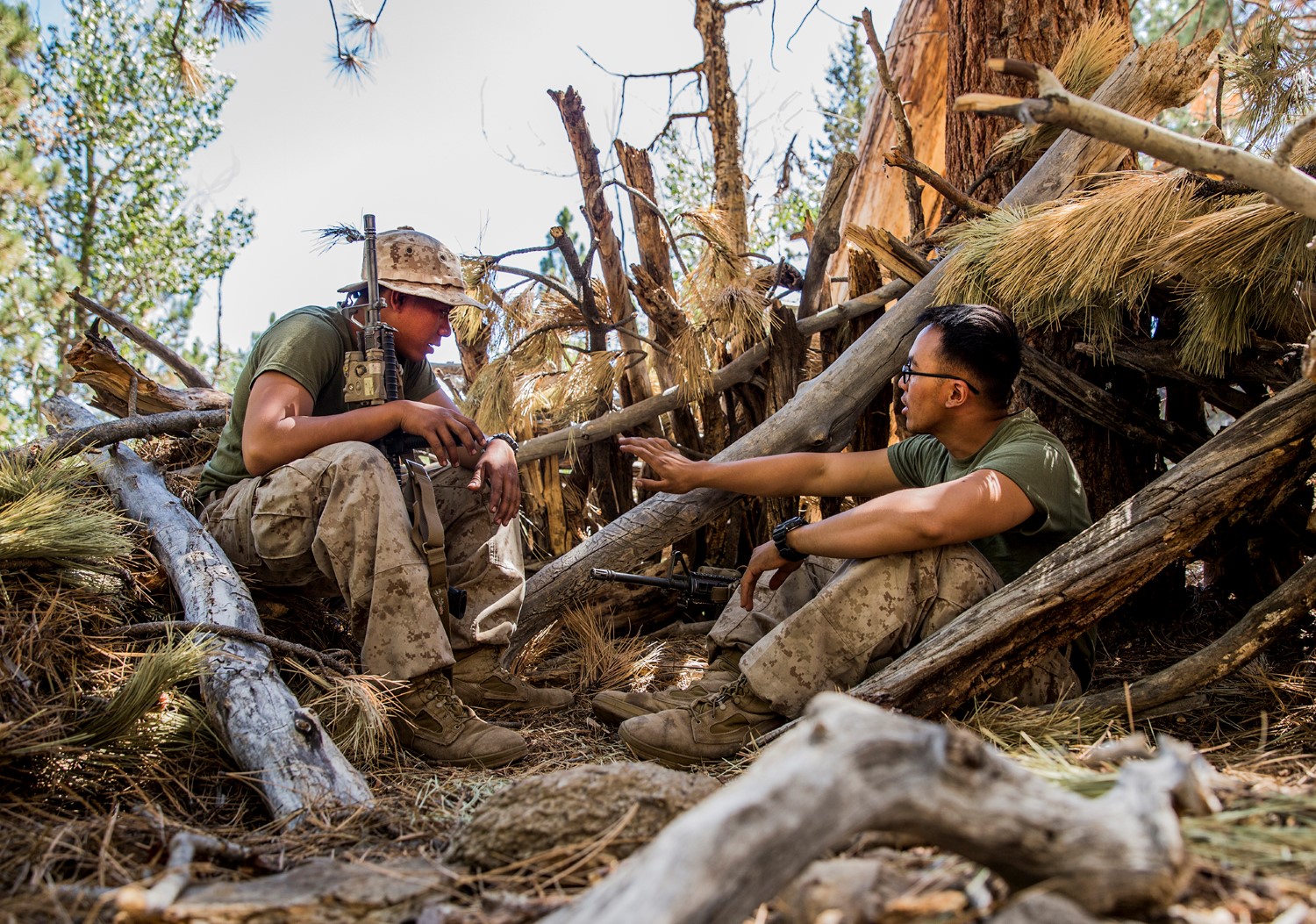
The plan is to train Marine units to operate at platoon-level as small units with absolutely no logistical support, except airdrops of ammunition and medical supplies. Marines will be learning to forage and feed themselves, living off the land.

Historically, this dates back to the institutional memory of the Battle of Guadalcanal, as I have mentioned before. Marines were still off-loading from Naval shipping when the Imperial Japanese Navy arrived and attacked the invasion fleet. The US Navy was driven off, leaving the First and Second Marine Divisions on the island with only the supplies they had on their backs. Marines had to forage for food or eat captured Japanese rations. Marines quickly learned to ally with the Solomon Islanders to find food and locate the enemy forces. This memory has been burned into the USMC and it’s why Marines have better field gear and carry more water and food on them personally than the Army does.

0140165614
Amazon Affiliate Link: https://amzn.to/33D8mrL

This new program focuses on partnering with locals and establishing hidden patrol bases to conduct small unit operations in a denied and austere environment against a numerically superior opponent. Some might say, it’s returning to their roots, and making every Marine a Raider, similar to the Army’s one-time campaign to try and get every infantry unit led by Ranger-tabbed personnel.

But it also points to a bigger issue that affects us in preparedness. It points to the fact the US Naval Establishment is openly admitting that we will be fighting guerilla actions in China’s rear area. That means they are admitting that we likely will NOT be pushing China back to her territorial waters and acknowledges that we’ve let them already take control of the Western Pacific.

What does that mean for us? It means then, that we will be restricted to defending the coasts, as Hawaii and a few South American island chains are the only things in the Near Pacific. It increases the risk of Chinese action actually on or just off our Pacific Coast if we are planning on not being able to support Marine units deep in the western and southern Pacific.

We, in the homeland, will face the risk of cruise missile strikes and bombing raids, despite how impenetrable you think our air defenses are. Hint: They really aren’t.

Any conflict in the Pacific, against either China or Russia, and especially both, will involve at least conventional missile strikes against coastal bases and infrastructure. Some of these strikes will impact civilians more than military units, and many will miss their intended targets. You have to at least consider this possibility.

You also have to consider how dire they think our situation will be that the Marines are planning to operate WITHOUT food and water being delivered to them. Now, the Commandant says that not tying up logistics assets with sustainment items will allow them to be able to focus on lethality, but that’s really just him saying that he plans on not being able to get that many flights through.

Again, if the US Marines are planning on us fighting a guerilla war mostly on the losing end, shouldn’t you? Forces that are WINNING a war don’t have to rely on guerilla warfare, the side on the defense does.

This philosophy has major implications for the supply chain, since most of the world’s shipping headed to the US transits what will be the war zone. You have to prepare for almost no supplies reaching the mainland US. The second and third effects of that are food and critical supply shortages and rioting that we won’t be able to control. Prepare to deal with that.

The other possibility, and I say this with no evidence whatsoever, other than my faith in my beloved Corps, is that the Corps is training to operate independently of the rest of the military in any coming potential internal conflict, but I don’t want to draw Feds to the site by discussing that possibility.

B0842BXQJK
Happens on Christmas Eve: https://amzn.to/3Jf5bHk

As we get closer to some critical dates and Russia-Ukraine heats up, please keep your head on a swivel and pay attention to world events. I’d also like to remind you all that last Christmas, whether the media wants to admit it or not, we had a rather significant terror attack in Nashville, which disrupted communications for days; have a comms plan.

Volume 3 of the Tactical Wisdom Series is now available here on this site, as well as at Amazon. Check the Books tab.

8 Levels of Control, by Saul Alinsky

Filed under: Political Commentary — justplainbill @ 4:53 pm


8 levels of control:

THE BEST SLAVE IS ONE WHO THINKS HE IS FREE…

Saul Alinsky died about 43 years ago, but his writings influenced those in political control of our nation today…….    

Recall that Hillary did her college thesis on his writings and Obama writes about him in his Faux books.

Died: June 12, 1972, Carmel-by-the-Sea, CA

Education: University of Chicago

Spouse: Irene Alinsky

Books: Rules for Radicals, Reveille for Radicals

Anyone out there think that this stuff isn’t happening today in the U.S.?

All eight rules are currently in play.

How to create a social state by Saul Alinsky:

There are eight levels of control that must be obtained before you are able to create a social state. The first is the most important.

1) Healthcare – Control healthcare and you control the people.

2) Poverty – Increase the Poverty level as high as possible, poor people are easier to control and will not fight back if you are providing  everything for them to live.

3) Debt – Increase the debt to an unsustainable level. That way you are able to increase taxes, and this will produce more poverty.

4) Gun Control – Remove the ability to defend themselves from the Government. That way you are able to create a police state.

5) Welfare – Take control of every aspect of their lives (Food, Housing, and Income).

6) Education – Take control of what people read and listen to – take control of what children learn in school.

7) Religion – Remove the belief in the God from the Government and schools.

8) Class Warfare – Divide the people into the wealthy and the poor. This will cause more discontent and it will be easier to take (Tax) the wealthy with the support of the poor.

Does any of this sound like what is happening to the United States?

Alinsky merely simplified Vladimir Lenin’s original scheme for world conquest by communism, under Russian rule.  Stalin described his converts as “Useful Idiots.” 

The Useful Idiots have destroyed every nation in which they have seized power and control.

It is presently happening at an alarming rate in the U.S.

  If   people   can read this and still say everything is just fine…   they are “useful idiots.

“It is difficult to free fools from the chains they revere.” 

ELECTION INTEGRITY REFORM!  ONE LEGAL VOTE FOR ONE LEGAL VOTER!  STOP BALLOT HARVESTING AND DEAD PEOPLE VOTING!  REQUIRE VOTER ID!  SUPREME COURT VOTES 6 TO 3 IN FAVOR OF ARIZONA GOP ELECTION REFORM! 

December 9, 2021

Bob May and Rudolph the red nosed reindeer

Filed under: Political Commentary — justplainbill @ 2:49 pm

True Story of Rudolph. The True Story of Rudolph shared by Nola Starke of Sun City.

A man named Bob May, depressed and brokenhearted, stared out his drafty apartment window into the chilling December night.

His 4-year-old daughter Barbara sat on his lap quietly sobbing. Bob’s wife, Evelyn, was dying of cancer Little Barbara couldn’t understand why her mommy could never come home. Barbara looked up into her dad’s eyes and asked, “Why isn’t Mommy just like everybody else’s Mommy?” Bob’s jaw tightened and his eyes welled with tears. Her question brought waves of grief, but also of anger. It had been the story of Bob’s life. Life always had to be different for Bob.

Small when he was a kid, Bob was often bullied by other boys. He was too little at the time to compete in sports. He was often called names he’d rather not remember. From childhood, Bob was different and never seemed to fit in. Bob did complete college, married his loving wife and was grateful to get his job as a copywriter at Montgomery Ward during the Great Depression. Then he was blessed with his little girl. But it was all short-lived. Evelyn’s bout with cancer stripped them of all their savings and now Bob and his daughter were forced to live in a two-room apartment in the Chicago slums. Evelyn died just days before Christmas in 1938.

Bob struggled to give hope to his child, for whom he couldn’t even afford to buy a Christmas gift. But if he couldn’t buy a gift, he was determined to make one – a storybook! Bob had created an animal character in his own mind and told the animal’s story to little Barbara to give her comfort and hope. Again and again Bob told the story, embellishing it more with each telling. Who was the character? What was the story all about? The story Bob May created was his own autobiography in fable form. The character he created was a misfit outcast like he was. The name of the character? A little reindeer named Rudolph, with a big shiny nose. Bob finished the book just in time to give it to his little girl on Christmas Day. But the story doesn’t end there.

The general manager of Montgomery Ward caught wind of the little storybook and offered Bob May a nominal fee to purchase the rights to print the book. Wards went on to print, Rudolph, the Red-Nosed Reindeer_ and distribute it to children visiting Santa Claus in their stores. By 1946 Wards had printed and distributed more than six million copies of Rudolph. That same year, a major publisher wanted to purchase the rights from Wards to print an updated version of the book.

In an unprecedented gesture of kindness, the CEO of Wards returned all rights back to Bob May. The book became a best seller. Many toy and marketing deals followed and Bob May, now remarried with a growing family, became wealthy from the story he created to comfort his grieving daughter. But the story doesn’t end there either.

Bob’s brother-in-law, Johnny Marks, made a song adaptation to Rudolph. Though the song was turned down by such popular vocalists as Bing Crosby and Dinah Shore , it was recorded by the singing cowboy, Gene Autry. “Rudolph, the Red-Nosed Reindeer” was released in 1949 and became a phenomenal success, selling more records than any other Christmas song, with the exception of “White Christmas.”

The gift of love that Bob May created for his daughter so long ago kept on returning back to bless him again and again. And Bob May learned the lesson, just like his dear friend Rudolph, that being different isn’t so bad. In fact, being different can be a blessing.

MERRY CHRISTMAS Y’ALL!

November 30, 2021

Is “Woke” Catholic (or even Protestant)?

Filed under: Political Commentary — justplainbill @ 3:39 pm

tklocek2's avatarActuallyCatholic

To paraphrase Pope St. Paul VI, “From some fissure, the ‘woke’ of Satan has entered the temple of God.” A recent article from the Washington Examiner stated, “The Catholic University of America in Washington, D.C., has reportedly displayed a painting that depicts George Floyd as Jesus Christ in two locations on campus.” While the death of George Floyd while in police custody is a tragedy that was perhaps avoidable, to depict this criminal as a Christ-like victim in the arms of the Blessed Mother is almost too “woke” to bear. Additionally, it is being reported that the Salvation Army is instituting a program to reeducate its workers and donors to apologize for their whiteness and racism, declaring that America is inherently racist (although it has been shown that America is probably the least racist nation in the world today).

Recently students at a Catholic high school walked out on a…

View original post 876 more words

November 25, 2021

Catholic Progressives and the Culture War, by George Weigel

Filed under: Political Commentary — justplainbill @ 12:36 am

Catholic Progressives And the Culture War

November 19, 2021
By George Weigel

Among those in the ultramundane pantheon of communist mega-monsters, Lev Davidovich Bronstein (better known by his Bolshevik nom de guerre, Leon Trotsky) is a more interesting human personality than Ioseb Besarionis dze Jughashvili (Joseph Stalin or, in the Roosevelt-Churchill correspondence, “Uncle Joe”). Trotsky actually had ideas, however misshapen, and something vaguely resembling a conscience.

Stalin was pathologically power-mad and had no discernible conscience whatsoever. Trotsky was also clever with words, as in the quote about the class struggle often attributed to him: “You may not be interested in war, but war is interested in you.” Whether or not Trotsky put it that pithily — opinions differ — there is an analogous truth many self-identified progressive Catholics miss. So to my progressive Catholic friends, I say: You may not be interested in the culture war, but the culture war is interested in you — and everyone else.

The culture war defining much of contemporary public life throughout the western world comes in two forms. One group of cultural aggressors, well-entrenched in the Biden Administration, insists that human beings are infinitely plastic and malleable, that there are no “givens” in the human condition, and that acts of will, aided by technology, can, for example, correct “gender assignments” misapplied at birth.

Another group of cultural aggressors takes a sharply different tack, insisting that our race, sex, ethnicity, or some combination thereof indelibly marks us as either victims or oppressors. The LGBTQ+ movement is one expression of the former. Critical race theory and such exercises in historical fantasy as the New York Times “1619 Project” are good examples of the latter.

I won’t play Trotsky and engage in a dialectical argument to resolve the obvious question: How can we be both utterly undefined and forever defined at the same time? I’ll simply note that both these aggressors are at war with the biblical and Catholic view of the human person. That is the culture war, and you can’t escape it, except by willful acts of denial, culpable ignorance, or sheer mendacity.

The development of a refined Catholic theological anthropology — a distinctive and ennobling Catholic view of the human person — has been one of the Church’s signal accomplishments over the past century. That development made possible two striking affirmations in Vatican II’s Pastoral Constitution on the Church in the Modern World.

First, the Council fathers taught that Jesus Christ reveals both the face of the merciful Father and the truth about us, such that we learn the full glory of human nature by contemplating the person of Christ. Then they taught that the fulfillment of human desire and human destiny comes through self-giving, not willful self-assertion. These teachings have profound implications for cultural renewal today.

According to the authoritative teaching of the Second Vatican Council, Catholics must not pigeonhole human beings by race, ethnicity, chromosomal identity, or object of sexual attraction. Catholics who take the texts of Vatican II seriously refuse to truckle to, and in fact resist, those cultural aggressors who think of human beings as mere twitching bundles of morally-equal desires, the fulfillment of which exhausts the meaning of “human rights.” Catholics who take the Council seriously work to give legal effect to Vatican II’s teaching that “abortion, euthanasia … [and] mutilation” (think of 13-year-old girls getting double mastectomies in the name of “trans” rights) “poison civilization,” “debase the perpetrators” as well as the victims, and “militate against the honor of the Creator.”

In a recent video address to a Spanish conference on Catholics in public life, the president of the United States Conference of Catholic Bishops, Archbishop José Gomez of Los Angeles, courageously challenged self-styled “social justice” movements based on thoroughly un-Catholic concepts of the human person. He was instantly attacked by the usual progressive trolls of the Catholic Twitterverse and blogosphere, who found the archbishop’s truth-telling to be insensitive culture-warring.  That indictment, like so much other progressive Catholic hysteria, was risible.

It also smacked of the kind of bullying that failed to make Archbishop Gomez cower when he released a thoughtful public letter to President Biden in January. Archbishop Gomez is a quiet man, not especially fond of controversy. But he is also a pastor who believes there is no escaping the culture war when the aggressors deny essential truths of Catholic faith about our humanity. More power to him.


Weigel is a distinguished senior fellow and William E. Simon Chair in Catholic Studies of the Ethics and Public Policy Center, Washington, D.C.

November 8, 2021

Good Morning, Greta, anon.

Filed under: Political Commentary — justplainbill @ 8:31 pm

One crisp winter morning in Sweden, a cute little girl named Greta woke up to a perfect world, one where there were no petroleum products ruining the earth. She tossed aside her cotton sheet and wool blanket and stepped out onto a dirt floor covered with willow bark that had been pulverized with rocks. “What’s this?” she asked.

“Pulverized willow bark,” replied her fairy godmother. 

“What happened to the carpet?” she asked. 

“The carpet was nylon, which is made from butadiene and hydrogen cyanide, both made from petroleum,” came the response. 

Greta smiled, acknowledging that adjustments are necessary to save the planet, and moved to the sink to brush her teeth where instead of a toothbrush, she found a willow, mangled on one end to expose wood fibre bristles. 

“Your old toothbrush?” noted her godmother, “Also nylon.” 

“Where’s the water?” asked Greta. 

“Down the road in the canal,” replied her godmother, ‘Just make sure you avoid water with cholera in it” 

“Why’s there no running water?” Greta asked, becoming a little peevish. 

“Well,” said her godmother, who happened to teach engineering at MIT, “Where do we begin?” There followed a long monologue about how sink valves need elastomer seats and how copper pipes contain copper, which has to be mined and how it’s impossible to make all-electric earth-moving equipment with no gear lubrication or tires and how ore has to be smelted to a make metal, and that’s tough to do with only electricity as a source of heat, and even if you use only electricity, the wires need insulation, which is petroleum-based, and though most of Sweden’s energy is produced in an environmentally friendly way because of hydro and nuclear, if you do a mass and energy balance around the whole system, you still need lots of petroleum products like lubricants and nylon and rubber for tires and asphalt for filling potholes and wax and iPhone plastic and elastic to hold your underwear up while operating a copper smelting furnace and . . . 

“What’s for breakfast?” interjected Greta, whose head was hurting. 

“Fresh, range-fed chicken eggs,” replied her godmother. “Raw.” 

“How so, raw?” inquired Greta. 

“Well, . . .” And once again, Greta was told about the need for petroleum products like transformer oil and scores of petroleum products essential for producing metals for frying pans and in the end was educated about how you can’t have a petroleum-free world and then cook eggs. Unless you rip your front fence up and start a fire and carefully cook your egg in an orange peel like you do in Boy Scouts. Not that you can find oranges in Sweden anymore. 

“But I want poached eggs like my Aunt Tilda makes,” lamented Greta.

“Tilda died this morning,” the godmother explained. “Bacterial pneumonia.” 

“What?!” interjected Greta. “No one dies of bacterial pneumonia! We have penicillin.” 

“Not anymore,” explained godmother “The production of penicillin requires chemical extraction using isobutyl acetate, which, if you know your organic chemistry, is petroleum-based. Lots of people are dying, which is problematic because there’s not any easy way of disposing of the bodies since backhoes need hydraulic oil and crematoriums can’t really burn many bodies using as fuel Swedish fences and furniture, which are rapidly disappearing – being used on the black market for roasting eggs and staying warm.” 

This represents only a fraction of Greta’s day, a day without microphones to exclaim into and a day without much food, and a day without carbon-fibre boats to sail in, but a day that will save the planet. 

Tune in tomorrow when Greta needs a root canal and learns how Novocain is synthesized.

November 3, 2021

What Will Drive China to War?

Filed under: Political Commentary — justplainbill @ 2:48 pm

What Will Drive China to War?

A cold war is already under way. The question is whether Washington can deter Beijing from initiating a hot one.By Michael Beckley and Hal Brands

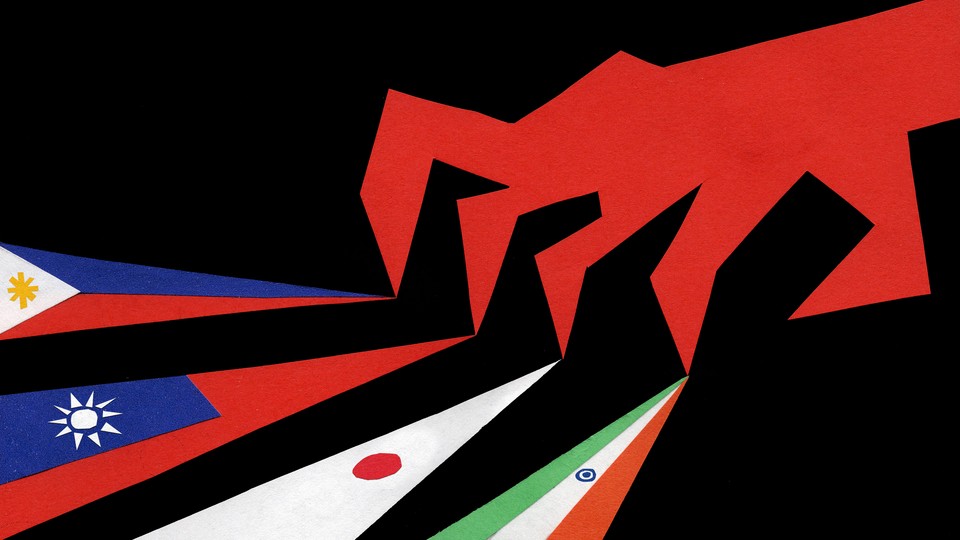
A hand reaches out to grab various flags.
Ben Hickey

NOVEMBER 1, 2021SHARE

About the authors: Michael Beckley is a Jeane Kirkpatrick Visiting Fellow at the American Enterprise Institute, where his research focuses on U.S.-China competition, and is an associate professor at Tufts University. Hal Brands is a senior fellow at the American Enterprise Institute, where he studies US foreign policy and defense strategy, and is the Henry A. Kissinger Distinguished Professor of Global Affairs at the Johns Hopkins School of Advanced International Studies.

President xi jinping declared in July that those who get in the way of China’s ascent will have their “heads bashed bloody against a Great Wall of steel.” The People’s Liberation Army Navy is churning out ships at a rate not seen since World War II, as Beijing issues threats against Taiwan and other neighbors. Top Pentagon officials have warned that China could start a military conflict in the Taiwan Strait or other geopolitical hot spots sometime this decade.

Analysts and officials in Washington are fretting over worsening tensions between the United States and China and the risks to the world of two superpowers once again clashing rather than cooperating. President Joe Biden has said that America “is not seeking a new cold war.” But that is the wrong way to look at U.S.-China relations. A cold war with Beijing is already under way. The right question, instead, is whether America can deter China from initiating a hot one.

SPONSOR CONTENT

A Restaurant’s Lesson in How to Build Brand Loyalty: “It’s Not Just Food and a Name.”

SQUARE, INC.

Beijing is a remarkably ambitious revanchist power, one determined to make China whole again by “reuniting” Taiwan with the mainland, turning the East and South China Seas into Chinese lakes, and grabbing regional primacy as a stepping-stone to global power. It is also increasingly encircled, and faces growing resistance on many fronts—just the sort of scenario that has led it to lash out in the past.

The historical record since the founding of the People’s Republic of China in 1949 is clear: When confronted by a mounting threat to its geopolitical interests, Beijing does not wait to be attacked; it shoots first to gain the advantage of surprise.

In conflicts including the Korean War and clashes with Vietnam in 1979, China has often viewed the use of force as an educational exercise. It is willing to pick even a very costly fight with a single enemy to teach it, and others observing from the sidelines, a lesson.

Today, Beijing might be tempted to engage in this sort of aggression in multiple areas. And once the shooting starts, the pressures for escalation are likely to be severe.

Numerous scholars have analyzed when and why Beijing uses force. Most reach a similar conclusion: China attacks not when it feels confident about the future but when it worries its enemies are closing in. As Thomas Christensen, the director of the China and the World Program at Columbia University, writes, the Chinese Communist Party wages war when it perceives an opening window of vulnerability regarding its territory and immediate periphery, or a closing window of opportunity to consolidate control over disputed areas. This pattern holds regardless of the strength of China’s opponent. In fact, Beijing often has attacked far superior foes—including the U.S.—to cut them down to size and beat them back from Chinese-claimed or otherwise sensitive territory.

Examples of this are plentiful. In 1950, for instance, the fledgling PRC was less than a year old and destitute, after decades of civil war and Japanese brutality. Yet it nonetheless mauled advancing U.S. forces in Korea out of concern that the Americans would conquer North Korea and eventually use it as a base to attack China. In the expanded Korean War that resulted, China suffered almost 1 million casualties, risked nuclear retaliation, and was slammed with punishing economic sanctions that stayed in place for a generation. But to this day, Beijing celebrates the intervention as a glorious victory that warded off an existential threat to its homeland.

RECOMMENDED READING

In 1962, the PLA attacked Indian forces, ostensibly because they had built outposts in Chinese-claimed territory in the Himalayas. The deeper cause was that the CCP feared that it was being surrounded by the Indians, Americans, Soviets, and Chinese Nationalists, all of whom had increased their military presence near China in prior years. Later that decade, fearing that China was next on Moscow’s hit list as part of efforts to defeat “counterrevolution,” the Chinese military ambushed Soviet forces along the Ussuri River and set off a seven-month undeclared conflict that once again risked nuclear war.

In the late ’70s, Beijing picked a fight with Vietnam. The purpose, remarked Deng Xiaoping, then the leader of the CCP,  was to “teach Vietnam a lesson” after it started hosting Soviet forces on its territory and invaded Cambodia, one of China’s only allies. Deng feared that China was being surrounded and that its position would just get worse with time. And from the ’50s to the ’90s, China nearly started wars on three separate occasions by firing artillery or missiles at or near Taiwanese territory, in 1954–55, 1958, and 1995–96. In each case, the goal was—among other things—to deter Taiwan from forging a closer relationship with the U.S. or declaring its independence from China.

To be clear, every decision for war is complex, and factors including domestic politics and the personality quirks of individual leaders have also figured in China’s choices to fight. Yet the overarching pattern of behavior is consistent: Beijing turns violent when confronted with the prospect of permanently losing control of territory. It tends to attack one enemy to scare off others. And it rarely gives advance warning or waits to absorb the initial blow.

SPONSOR CONTENT

The Pandemic Hurt Businesses. Here’s How They Adapted.

SQUARE, INC.

For the past few decades, this pattern of first strikes and surprise attacks has seemingly been on hold. Beijing’s military hasn’t fought a major war since 1979. It hasn’t shot at large numbers of foreigners since 1988, when Chinese frigates gunned down 64 Vietnamese sailors in a clash over the Spratly Islands. China’s leaders often claim that their country is a uniquely peaceful great power, and at first glance, the evidence backs them up.

But the China of the past few decades was a historical aberration, able to amass influence and wrest concessions from rivals merely by flaunting its booming economy. With 1.3 billion people, sky-high growth rates, and an authoritarian government that courted big business, China was simply too good to pass up as a consumer market and a low-wage production platform. So country after country curried favor with Beijing.

Britain handed back Hong Kong in 1997. Portugal gave up Macau in 1999. America fast-tracked China into major international institutions, such as the World Trade Organization. Half a dozen countries settled territorial disputes with China from 1991 to 2019, and more than 20 others cut diplomatic ties with Taiwan to secure relations with Beijing. China was advancing its interests without firing a shot and, as Deng remarked, “hiding its capabilities and biding its time.”

SPONSOR CONTENT

How the Pandemic Has Supercharged Omnichannel Growth

SQUARE, INC.

Those days are over. China’s economy, the engine of the CCP’s international clout, is starting to sputter. From 2007 to 2019, growth rates fell by more than half, productivity declined by more than 10 percent, and overall debt surged eightfold. The coronavirus pandemic has dragged down growth even further and plunged Beijing’s finances deeper into the red. On top of all this, China’s population is aging at a devastating pace: From 2020 to 2035 alone, it will lose 70 million working-age adults and gain 130 million senior citizens.

Countries have recently become less enthralled by China’s market and more worried about its coercive capabilities and aggressive actions. Fearful that Xi might attempt forced reunification, Taiwan is tightening its ties to the U.S. and revamping its defenses. For roughly a decade, Japan has been engaged in its largest military buildup since the Cold War; the ruling Liberal Democratic Party is now talking about doubling defense spending. India is massing forces near China’s borders and vital sea lanes. Vietnam and Indonesia are expanding their air, naval, and coast-guard forces. Australia is opening up its northern coast to U.S. forces and acquiring long-range missiles and nuclear-powered attack submarines. France, Germany, and the United Kingdom are sending warships into the Indo-Pacific region. Dozens of countries are looking to cut China out of their supply chains; anti-China coalitions, such as the Quad and AUKUS, are proliferating.

Globally, opinion polls show that fear and mistrust of China has reached a post–Cold War high. All of which raises a troubling question: If Beijing sees that its possibilities for easy expansion are narrowing, might it begin resorting to more violent methods?

China is already moving in that direction. It has been using its maritime militia (essentially a covert navy), coast guard, and other “gray zone” assets to coerce weaker rivals in the Western Pacific. Xi’s government provoked a bloody scrap with India along the disputed Sino-Indian frontier in 2020, reportedly out of fear that New Delhi was aligning more closely with Washington.

Beijing certainly has the means to go much further. The CCP has spent $3 trillion over the past three decades building a military that is designed to defeat Chinese neighbors while blunting American power. It also has the motive: In addition to slowing growth and creeping encirclement, China faces closing windows of opportunity in its most important territorial disputes.

China’s geopolitical aims are not a secret. Xi, like his predecessors, desires to make China the preponderant power in Asia and, eventually, the world. He wants to consolidate China’s control over important lands and waterways the country lost during the “century of humiliation” (1839–1949), when China was ripped apart by imperialist powers. These areas include Hong Kong, Taiwan, chunks of Indian-claimed territory, and some 80 percent of the East and South China Seas.

The Western Pacific flash points are particularly vital. Taiwan is the site of a rival, democratic Chinese government in the heart of Asia with strong connections to Washington. Most of China’s trade passes through the East and South China Seas. And China’s primary antagonists in the area—Japan, Taiwan, the Philippines—are part of a strategic chain of U.S. allies and partners whose territory blocks Beijing’s access to the Pacific’s deep waters.

The CCP has staked its legitimacy on reabsorbing these areas and has cultivated an intense, revanchist form of nationalism among the Chinese people. Schoolchildren study the century of humiliation. National holidays commemorate foreign theft of Chinese lands. For many citizens, making China whole again is as much an emotional as a strategic imperative. Compromise is out of the question. “We cannot lose even one inch of the territory left behind by our ancestors,” Xi told James Mattis, then the U.S. secretary of defense, in 2018.

Taiwan is the place where China’s time pressures are most severe. Peaceful reunification has become extremely unlikely: In August 2021, a record 68 percent of the Taiwanese public identified solely as Taiwanese and not as Chinese, and more than 95 percent wanted to maintain the island’s de facto sovereignty or declare independence. China retains viable military options because its missiles could incapacitate Taiwan’s air force and U.S. bases on Okinawa in a surprise attack, paving the way for a successful invasion. But Taiwan and the U.S. now recognize the threat.

President Biden recently stated that America would fight to defend Taiwan from an unprovoked Chinese attack. Washington is planning to harden, disperse, and expand its forces in the Asia-Pacific by the early 2030s. Taiwan is pursuing, on a similar timeline, a defense strategy that would use cheap, plentiful capabilities such as anti-ship missiles and mobile air defenses to make the island an incredibly hard nut to crack. This means that China will have its best chance from now to the end of the decade. Indeed, the military balance will temporarily shift further in Beijing’s favor in the late 2020s, when many aging U.S. ships, submarines, and planes will have to be retired.

This is when America will be in danger, as the former Pentagon official David Ochmanek has remarked, of getting “its ass handed to it” in a high-intensity conflict. If China does attack, Washington could face a choice between escalation or seeing Taiwan conquered.

More such dilemmas are emerging in the East China Sea. China has spent years building an armada, and the balance of naval tonnage currently favors Beijing. It regularly sends well-armed coast-guard vessels into the waters surrounding the disputed Senkaku Islands to weaken Japan’s control there. But Tokyo has plans to regain the strategic advantage by turning amphibious ships into aircraft carriers for stealth fighters armed with long-range anti-ship missiles. It is also using geography to its advantage by stringing missile launchers and submarines along the Ryukyu Islands, which stretch the length of the East China Sea.

Meanwhile, the U.S.-Japan alliance, once a barrier to Japanese remilitarization, is becoming a force multiplier. Tokyo has reinterpreted its constitution to fight more actively alongside the U.S. Japanese forces regularly operate with American naval vessels and aircraft; American F-35 fighters fly off of Japanese ships; U.S. and Japanese officials now confer routinely on how they would respond to Chinese aggression—and publicly advertise that cooperation.

For years, Chinese strategists have speculated about a short, sharp war that would humiliate Japan, rupture its alliance with Washington, and serve as an object lesson for other countries in the region. Beijing could, for instance, land or parachute special forces on the Senkakus, proclaim a large maritime exclusion zone in the area, and back up that declaration by deploying ships, submarines, warplanes, and drones—all supported by hundreds of conventionally armed ballistic missiles aimed at Japanese forces and even targets in Japan. Tokyo then would either have to accept China’s fait accompli or launch a difficult and bloody military operation to recapture the islands. America, too, would have to choose between retreat and honoring the pledges it made—in 2014 and in 2021—to help Japan defend the Senkakus. Retreat might destroy the credibility of the U.S.-Japan alliance. Resistance, war games held by prominent think tanks suggest, could easily lead to rapid escalation resulting in a major regional war.

What about the South China Sea? Here, China has grown accustomed to shoving around weak neighbors. Yet opposition is growing. Vietnam is stocking up on mobile missiles, submarines, fighter jets, and naval vessels that can make operations within 200 miles of its coast very difficult for Chinese forces. Indonesia is ramping up defense spending—a 20 percent hike in 2020 and another 16 percent in 2021—to buy dozens of fighters, surface ships, and submarines armed with lethal anti-ship missiles. Even the Philippines, which courted Beijing for most of President Rodrigo Duterte’s term, has been increasing air and naval patrols, conducting military exercises with the U.S., and planning to purchase cruise missiles from India. At the same time, a formidable coalition of external powers—the U.S., Japan, India, Australia, Britain, France, and Germany—are conducting freedom-of-navigation exercises to contest China’s claims.

From Beijing’s perspective, circumstances are looking ripe for a teachable moment. The best target might be the Philippines. In 2016, Manila challenged China’s claims to the South China Sea before the Permanent Court of Arbitration and won. Beijing might relish the opportunity to reassert its claims—and warn other Southeast Asian countries about the cost of angering China—by ejecting Filipino forces from their isolated, indefensible South China Sea outposts. Here again, Washington would have few good options: It could stand down, effectively allowing China to impose its will on the South China Sea and the countries around it, or it could risk a much bigger war to defend its ally.

SQUARE, INC.

Get ready for the “terrible 2020s”: a period in which China has strong incentives to grab “lost” land and break up coalitions seeking to check its advance. Beijing possesses grandiose territorial aims as well as a strategic culture that emphasizes hitting first and hitting hard when it perceives gathering dangers. It has a host of wasting assets in the form of military advantages that may not endure beyond this decade. Such dynamics have driven China to war in the past and could do so again today.

If conflict does break out, U.S. officials should not be sanguine about how it would end. Tamping or reversing Chinese aggression in the Western Pacific could require a massive use of force. An authoritarian CCP, always mindful of its precarious domestic legitimacy, would not want to concede defeat even if it failed to achieve its initial objectives. And historically, modern wars between great powers have more typically gone long than stayed short. All of this implies that a U.S.-China war could be incredibly dangerous, offering few plausible off-ramps and severe pressures for escalation.

The U.S. and its friends can take steps to deter the PRC, such as drastically speeding the acquisition of weaponry and prepositioning military assets in the Taiwan Strait and East and South China Seas, among other efforts, to showcase its hard power and ensure that China can’t easily knock out U.S. combat power in a surprise attack. At the same time, calmly firming up multilateral plans, involving Japan, Australia, and potentially India and Britain, for responding to Chinese aggression could make Beijing realize how costly such aggression might be. If Beijing understands that it cannot easily or cheaply win a conflict, it may be more cautious about starting one.

Most of these steps are not technologically difficult: They exploit capabilities that are available today. Yet they require an intellectual shift—a realization that the United States and its allies need to rapidly shut China’s windows of military opportunity, which means preparing for a war that could well start in 2025 rather than in 2035. And that, in turn, requires a degree of political will and urgency that has so far been lacking.

China’s historical warning signs are already flashing red. Indeed, taking the long view of why and under which circumstances China fights is the key to understanding just how short time has become for America and the other countries in Beijing’s path.Michael Beckley is a Jeane Kirkpatrick Visiting Fellow at the American Enterprise Institute, where his research focuses on U.S.-China competition, and is an associate professor at Tufts University.Hal Brands is a senior fellow at the American Enterprise Institute, where he studies US foreign policy and defense strategy, and is the Henry A. Kissinger Distinguished Professor of Global Affairs at the Johns Hopkins School of Advanced International Studies.

October 8, 2021

(Bodissey & Numan’s first post)

Filed under: Political Commentary — justplainbill @ 8:14 pm

Main menu

Skip to primary contentSkip to secondary content

Post navigation

← PreviousNext →

Our Chinese Woes Get Ever Grander

Posted on  by Baron Bodissey

Our Dutch correspondent H. Numan takes a look at the current crises in China.

Our Chinese woes get Ever Grander

by H. Numan

Seems like the only real quality items coming from China are pandemics and crises. We can’t blame them for the Black Death. However, the Chinese Communist Party (CCP) denied any responsibility for SARS and now again for Covid-19. They added something new to that deadly duo, as if the Covid-19 pandemic weren’t enough. The Chinese real estate developer Evergrande is going bankrupt. With it, China. And the rest of the world as well. Don’t believe for a minute the crisis can be contained to China only.

Imagine the biggest real estate developer in America goes bust. Add to it a real estate bubble running for decades. All of a sudden, the value of houses drop by 75%. Would that impact the economy of America? Of course it would. Not just America, but the rest of the world as well. It’s Lehman Brothers all over again.

By now you surely have heard of Evergrande. Two weeks ago it all of a sudden popped up in the news. It’s the second biggest Chinese real estate developer, going bankrupt. Evergrande doesn’t do just real estate; it’s a huge conglomerate doing much more. However, real estate is the core — and there isn’t enough money to pay the bills. At the moment the total outstanding is $300 billion. With 200,000 jobless employees and +1.5 million highly unsatisfied customers.

How did that happen? The Chinese have very little opportunity to invest their savings. It’s a communist country, after all. Chinese money may be internationally recognized and a world reserve currency; internally it’s more like coupons to buy goods with. You can’t invest on the stock exchange, the only thing you can do is to invest it in leasing real estate. I stress leasing, because you can’t buy land or properties in China. It all belongs to the CCP. You can lease it for 70 years. Provided you’re really nice to the local party bosses who grant those leases. That’s what everybody in China did.

Local governments (provinces, cities) don’t get much money from Beijing. Most of their income they get out of selling leases to real estate developers. Those developers happily pay the price, plus a nice fat bonus to the local CCP boss, and start selling properties from the drawing. Nothing has been developed yet. Not a stone has been laid. In many countries buying based on a drawing is illegal. In China you have to pay in full upfront for a house. That money they used to buy more leases. And so on. That’s the basic concept of a Ponzi scheme.

Another factor is the failed one-child policy. Chinese prefer boys over girls. If they are allowed only one child, it better be a boy. Many parents had girls aborted. Which resulted in a surplus of boys. Do the math. The policy started in 1979, and ended in 2015. That means a lot of baby boys are now grown man desperately seeking a wife. Each possible wife can pick whoever she wants. They can literally say: for you? Ten others! A man really needs at least one house plus a nice car to be considered for marriage. Having two or more houses is even better. The demand for houses outstrips supply by a huge margin.

The third factor is the lack of spendable income. The average Chinese middle-income worker earns considerably less than his American or European counterpart, about ⅓. Add to that horrendously high real estate prices in China. He makes one third of what you earn, but has to spend at least ten times as much on buying a house. To the Chinese, houses in California are ridiculously cheap.

Something made of quality died long before the Great Leap Forward. Those hugely expensive apartments are shoddily build at best. It’s quite common for large buildings and bridges to wobble or even collapse. That doesn’t get into the news often, as it is local news. China doesn’t allow bad news to go worldwide.

The authorities use building regulations simply to extort money from developers. Developers didn’t care. What you can’t see doesn’t matter. Cover things up with a bit of plaster, and pay whatever is demanded. Real estate prices rose at least 10% per year, so who cares?

The basic interest doubling rule works like this: If the interest rate is 7%, it takes 7 years to double the original amount. Lower rates take longer, higher rates work faster. It means that Chinese real estate doubles in price roughly every 5-6 years. After another 5-6 years, it doubles again. And again: 2-4-8-16-32-64. That is unsustainable. Even the Chinese government knows that.

So this year they set three rather simple rules to curb the bubble a bit: a developer has to have some financial reserves other than real estate. Houses can no longer be sold from the drawing; the property must be in a certain stage of development. And lastly, a house must be delivered ready for occupancy. Meaning: not an empty shell without a roof, windows or facilities. Pretty basic rules. However, even those very light rules proved to be way too much for Evergrande.

Evergrande tried to play a very dangerous card: they told the government they would be forced to sell all their assets to cover their debts, for whatever they can fetch. No investor will swap debt one on one. Evergrande started by offering 25% discount, but that’s just for starters. Investors might consider a debt swap at +75% discount. That means ALL real estate in China will drop accordingly, wiping out the entire middle class, and a lot of the upper class.

Why is that playing a very dangerous card? Because they are backing the wrong man. You see, in China there is only one party. That doesn’t mean everybody thinks exactly the same. Every political party has at least three wings: left, center and right. Even the NSDAP. The SA represented the extreme left wing, the SS the extreme right wing. That goes for every political party, wherever on the world. Your DNC has it; the Reps have it; every party has it.

Instead of joining a separate party you join a faction under a CCP big shot. Evergrande joined the Li Keqiang faction. That’s the faction of the prime minister. Not the faction of Xi Jinping, the president for life. Xi doesn’t like Li, to put it mildly. So he’s very happy to see Evergrande falling into the abyss. That’s one enemy fewer to worry about.

Xi’s position is not — yet — undisputed ruler of China. For now, he’s satisfied being president for life. He still has to consolidate his position. When you read about corruption trials in China, that’s Xi replacing highly corrupt enemies with his own equally corrupt people. Has nothing to do with fighting corruption. Hitler used long knives. Xi uses corruption trials.

So, Xi will very happily let Evergrande die. All he cares about, as any dictator and every socialist party does, is how to remain in power. That is the primary goal of the CCP. It doesn’t matter what happens with the population, as long as it can stay in power.

As you saw last year during the Covid-19 crisis in China, draconian measures were taken to control it, or try to control it. We really don’t know what’s happening in China. It is a closed country. Those who do know what’s going on (foreign intelligence services) don’t tell. Data coming from China is notoriously unreliable. According to Chinese — in other words CCP — economic data, China survived the Covid-19 crisis relatively unscathed. Where the rest of the world is deep in crisis, China reported economic growth. Not a lot, but some. We don’t know how many people died there. That information is kept strictly secret. China isn’t allowing an investigation of the Wuhan laboratory where the virus was developed. Eventually they will, but they have at least two full years for a cover up. We will never know what really happened there.

If China doesn’t care a lot about what happens to its own citizens, they care a lot less about the rest of the world. If Xi orders state businesses — all businesses in China — to bail Evergrande out, that will be for his own survival. Foreign businesses, especially the Hong Kong and Shanghai Bank, will get no support.

Will Xi bail Evergrande out? Possibly. He can’t do that directly, as that goes against all party doctrines. But he can easily circumvent that by whispering the word. We don’t know if he will, but he has very little option to do otherwise. Unless he really wants to see his own country literally go bankrupt. Together with the rest of the world, who then will demand compensation. So far not much has been said about the responsibility of Covid-19. But another, even bigger crisis, will be too much.

Do mind that Xi has a LOT of power already. Jack Ma was the founder of alibaba.com, and became a multi-billionaire. His wealth was estimated at 15 billion. He said something in public that displeased Xi, and disappeared for three months. When he reappeared, he was a completely changed man. Everything the party said was right, he was all in for the people, and donated part of his wealth to charities. His wealth now is estimated less than half. All taken over by Xi and the CCP. Imagine that happening to one of our billionaires, like Zuckerberg, Bezos or Gates.

There are more economic problems I didn’t address: a few weeks ago China closed all private schools. That used to be a multi-billion-dollar industry. Closed down overnight, especially foreign language teaching (English). Why? Xi Jinping wants Chinese children to be educated as their grandparents were under Mao.

China has enormous problems getting into the microchip business. The financial losses there make the Evergrande bankruptcy look almost benign. The Belt and Road Initiative is also a costly failure.

There is a huge chance China will look abroad to ease its problems. Germany did it in 1939. Italy and Japan a bit earlier. Argentina did it in 1982. Fortunately, the Chinese army isn’t ready for anything but a parade. In fair weather, that is.

Not that we have to worry about that. General Mark Milley will no doubt call his Chinese superiors if Biden wants to attack China. Let’s hope his superiors return the favor.

— H. NumanThis entry was posted in ChinaEconomicsFinancial crisisLegal actionLife in a dystopiaNewsPlaguesPolitics by Baron Bodissey. Bookmark the permalink.

20 THOUGHTS ON “OUR CHINESE WOES GET EVER GRANDER”

Why is China so Dangerous, by H. Numan/ Baron Bodissey

Filed under: Political Commentary — justplainbill @ 7:56 pm

Main menu

Skip to primary contentSkip to secondary content

Post navigation

← PreviousNext →

Why is China so Dangerous?

Posted on  by Baron Bodissey

H. Numan sends this follow-up to his earlier essay about China.

Why is China so dangerous?

by H. Numan

A response from a reader encouraged me to continue my essay about China. His points are valid, and will be exploited to the max by the Chinese Communist Party (CCP) in the near future. China is a dangerous dragon, despite having fairly blunt teeth and very short claws. It remains a terrible danger, simply because of its size. 1.4 billion people can’t be wrong, though they may not have it right.

Let’s look at the People’s Liberation Army. The whole lot of them, army, navy, air force, rocket force and the auxiliary navy. The last are civilian registered ships, operated by navy personnel under military command disguised as fishing trawlers. Yes, the PLA is a powerful force on first glance. However, first looks are deceiving. What they lack is combat experience. They have no veterans. None whatsoever.

You can train someone to become a soldier, easily. But you can’t train someone to become a veteran soldier. Only combat does that. No matter how hard you try. Lots of very promising cadet officers proved to be worthless under fire. Not just freshly-minted lieutenants; it happens to generals, too. Especially if they themselves avoided any hazardous duties, managing desks from as far away as possible, and got promoted based on their relatives, not on experience. In other words: all Chinese generals, admirals and air-marshals.

The current price for three stars (lieutenant general) is 2.5 million dollars. Any Chinese with the right connections and at least that amount of money can become a general. That kind of corruption seeps through down below. A corrupt general (that’s all of them) isn’t going to promote a bright keen honest colonel over his not so bright but corrupt and therefore controllable colleagues. That would be suicide. That bright keen incorruptible colonel cannot be influenced, and makes everybody look bad. Imagine that pest becoming general! What hell can he unleash? Corruption breeds corruption. Only officers with enough money get promoted. Almost the same goes down the line: you need $25,000 to enter the cadet school. Even joining as a humble private costs you hefty $2,500. Which is good news for us: if need be, you simply buy a few generals! It happened in the past. Sun Tzu wrote about it, as a valid strategy in The Art of War [pdf].

Next, almost as bad, is the total lack of experience. China hasn’t fought a war since 1979. A war they lost. All officers, noncoms and soldiers with any kind of experience have since retired. And… they are treated like dogs**t Chinese civilians. Veterans regularly don’t get their retirement. It’s pocketed by the Veterans Administration. So often, that veterans have to demonstrate to get something. Demonstrating is not something you do for fun and games in China. High-ranking officers have often complained about it to the party leadership. With zero results. You think US veterans have it bad? That’s nothing compared with Chinese veterans.

The only reason one joins the People’s Liberation Army is career advancement and material profits. If a bright ambitious officer cadet longing to die for China doesn’t realize that when his parents shell out $25,000 to get him into the academy, he will long before graduation. He’s got two choices: either he coughs up $75,000 for a nice comfy posting in Beijing. Or he doesn’t, and will be posted to the dark side of the moon (Tibet). Where he remains a second lieutenant, until either he finds the required $75,000, resigns or dies. Whichever comes first. The PLA is truly democratic: the same applies to all ranks. With progressively lower fees, of course. Loyalty does not exist in China, least of all within the PLA.

Remember when Germany invaded Austria, in 1938? People were lining the streets with flowers and cheering the invading Wehrmacht. It was even better than a walk in the park! Of course the official poll where 99.75% voted in favor of unification was rigged. It was not only stupid; it wasn’t even necessary. Almost every party was in favor of unification anyway. At least 60% would have voted yes. Probably a lot more.

However, the Wehrmacht couldn’t take that for granted. It was possible (though unlikely) some units of the Austrian army might resist. Or that parts of the crowd might turn hostile. What do you do then? What if a truck or an armored car breaks down? Do you leave it there or repair it on the road? Or do you tow it? Do you need to post guards around it? Fair questions they simply couldn’t answer in advance. Something you have to experience, and decide on the spot. Only then you can write a combat manual about it. The peaceful invasion of Austria gave the Wehrmacht its first real combat experience since 1919. Something that’s worth gold.

Notice the utter lack of PLA units operating in UN peacekeeping forces. Asians don’t like losing face. That’s worse than stepping into a fat smelly turd with your bare feet. Why do Western units participate? Simply to gain valuable experience. Sure, you’ll make mistakes. Lots of them. Some of them even tragic. But overall they gain lots of combat experience with very little fighting.

Last on the list is equipment. It’s adequate. That’s all I can say about it. Copying and reverse engineering can only get you so much. It will never get you anything better than adequate. Never superb or outstanding. Chinese aircraft are reverse engineered Russian aircraft. They couldn’t reverse engineer the engines. Those aircraft have half the range of the Russian originals. That goes for just about everything. It isn’t really bad, but nothing better than barely adequate. Be it a combat rifle or an airplane.

The navy is even worse. Yes, they have nuclear submarines. Those subs are so noisy a blind man on an Allied warship can point them out. The HMS Queen Elisabeth currently on operations in the South China Sea faced a dilemma: of course they spotted the PLA sub sent to scout them. The question was: how far out would they let them know? A few days later the Japanese navy faced the same problem in the East China Sea. Chinese subs are anything but silent killers. When they move to sea, it’s almost like Barnum & Bailey Brothers moving to another town.

China currently has three aircraft carriers, with three super-carriers under various stages of construction. It’s questionable if those three will be finished. China ran out of money. Why do two of the three other carriers have ski jump decks? Otherwise those under-powered (and performing) aircraft can’t take of. They can take of either with a full combat and half a fuel load, or the other way around. But not both at the same time.

Last item is the proof of the pudding. The eating, in other words. Who buys Chinese arms? Only very desperate nations who cannot buy anything else. Either vile despotic regimes that are under Western boycotts, or dirt-poor nations that have to accept mafia-like sales conditions. Nobody else. Even Argentina would rather buy third- or fourth-hand F-16s than JF-17s. The UK has blocked every sale to Argentina since the Falkland War. Argentina’s only option left over is China. At the moment they have almost nothing flying. They have been trying to buy literally anything for the last 40 years, without success. That should give you an idea how good Chinese weaponry is.

All I have said is how bad the PLA is. Now for the dangerous part. Because they aren’t just bad, China (not the PLA) is very dangerous.

Nazi Germany had to go to war in 1939, and had to invade the USSR in 1941. They had no other choice, apart from admitting defeat and having Hitler and his NSDAP resign from power. Imperial Germany had a comprehensive social system. It was even the best of the world, for the time. After the war the socialists gained power and expanded that system. From 1919 until 1933, Germany was almost exclusively governed by socialist coalitions.

Hitler gained power partly on promises of a much enlarged social welfare system. As a real socialist (yes, Hitler was definitely a socialist.) he killed the economy immediately. He stopped all exports as far as possible, and tried to convert Germany into an autarky. In other words: he slaughtered the goose that laid the eggs, and demanded that it lay a lot more at the same time.

The German army wasn’t ready in 1939. They needed much more time, materials, training and especially oil to fully mechanize. The navy didn’t get to start plan Z, let alone finish it. At the same time Hitler fulfilled his social promises. Both cost enormous amounts of money that Germany simply didn’t have. Even a genius like Hjalmar Schacht couldn’t perform miracles.

In 1939 Germany was running out of money. Not just out of money, near bankruptcy. They estimated they would run out of oil in September 1941. The attack on the West was essentially mugging on a grand scale. The prime objective was always to get to the gold reserves of the conquered nations as fast as possible. They mostly failed in that. Second objective was to milk the occupied territories for all they were worth. In that they succeeded with an army and an economy not fully geared for war.

The Blitzkrieg was a stunning success. It stunned even the Germans themselves. During the Battle of Britain Hitler was already focused on the coming conquest of the USSR. Operation Barbarossa was more a deception plan than a real invasion. When Hitler realized the UK wasn’t going to fold, he concentrated on what we now know as Operation Barbarossa. Which had to start in June 1941.

Why? He simply had no other choice. He needed oil, badly. Germany didn’t have any. They only could get it from Romania, and that wasn’t enough. Not even remotely. His only other oil source was the USSR, and that was not a reliable source. Arab oilfields were either under development or too far away. America and Venezuela were also too far away. The only oil within reach was in the USSR. He couldn’t attack in 1940; it was far too late for that. The army needed to recover from that campaign.

So the attack had to come in 1941. What most people probably don’t know is that the muddy season in Russia, Rasputitsa, is not one but two seasons. We know about the autumn rains that turned bad roads into mud pools. The other season is the spring thaw, which does exactly the same. Hitler couldn’t attack any earlier, as the roads weren’t ready yet.

Let’s get back on track. We aren’t too much interested in National Socialist Germany here, but in International Socialist China. At the moment they face almost exactly the same problems as Germany back then. A lack of nearly everything. No money. Failing businesses. No oil. Not enough coal. Inclement weather destroyed the harvests. So, not enough food. The Chinese population was already warned before last year not to let food spoil, minimize portions and limit the number of dishes. (Nobody gives a hoot so far.)

The worldwide pandemic was caused by the CCP. The coal shortage is entirely Chinese. The CCP embargoed Australia when it asked questions about what China would do to compensate for the pandemic. They hoped to beat Australia into submission. It didn’t work, and now major industries and half the country face enormous blackouts. The winter (-20 C) has yet to come. Incidentally, the embargo also covers Australian grain. Really clever, when you already have severe food shortages.

The Chinese long-term policy is equally bad. The Belt and Road Initiative proved to be a very costly failure. For two very obvious reasons: shipping goods by rail isn’t going to replace shipping by sea. One single container ship can carry more freight than a rail link between Beijing and Rotterdam can carry in a full year, at a much lower cost. The cutthroat negotiations and mafia tactics warned some nations not to fall for it. Sri Lanka lost a port they had build by the Chinese to the Chinese when they defaulted on payment. Piraeus in Greece and the port of Darwin are/were Chinese owned. Piraeus still is, Darwin was canceled. They even tried to buy the port of Rotterdam.

Right now China is in the same position as Germany was before starting WW2. Not enough money, and too many ambitious goals that cannot be met. There are more than enough grudges from the past that only need a little kindling before becoming a raging fire. The Unequal Treaties. The Opium Wars. The Boxer Rebellion. The fact that China is the oldest existing and continuous civilization in existence. Being subjugated by an upstart of less than 250 years old.

It’s not the Chinese army that is dangerous. The auxiliary fleets are far more dangerous. They sail to the coasts of Northern Africa, Peru and Ecuador (the Galapagos Islands, to be exact) where they empty the seas of life. Anything edible is fished. The local coastguards cannot do anything about it. They are overwhelmed by fleets of more than 200 ships at the same time. Their navies don’t have 20 ships, let alone the guts to send the full fleet. What do you do? Shoot? Risk a war with China? Some of those Chinese trawlers are armed, just in case.

That’s part of the salami slicing tactic. A tactic also used by Germany in the past. The problem with salami slicing is that you do get what you want, but it is very expensive and takes a very long time. And you run the real risk of losing it all. Germany sliced itself into Austria, Czechoslovakia, and lost everything when they tried to slice the Danzig corridor.

China sort of has the same problems. And it ran out of peaceful options. We’re in a very dangerous situation with Chinese characteristics.

— H. NumanThis entry was posted in ChinaCrazy SocialismEconomicsHistoryLife in a dystopiaNational defenseNationalismNewsPlaguesPolitics by Baron Bodissey. Bookmark the permalink.

0 THOUGHTS ON “WHY IS CHINA SO DANGEROUS?”

October 5, 2021

Thoughts for 5 Oct 2021

Filed under: Political Commentary — justplainbill @ 8:17 pm

[my thoughts are noted as justplainbill jpb]

Declaration of Independence, approved in Cmte June 1776:

We hold these truths to be self-evident, that all men are created equal; that they are endowed by their Creator with certain unalienable Rights, that among these are Life, Liberty and the pursuit of Happiness. – That to secure these rights, Governments are instituted among Men, deriving their just powers from the consent of the governed, — that whenever any Form of Government becomes destructive of these ends, it is the Right of the People to alter or to abolish it; and to institute new government, laying its foundation on such principles and organizing its powers in such form, as to them shall seem most likely to effect their Safety and Happiness. [emphasis added]


Thomas Jefferson to William Stephens Smith, Paris, Nov. 13th, 1787:

The tree of liberty must be refreshed from time to time with the blood of patriots & tyrants. It is the natural manure.


Thomas Jefferson to Edward Carrington, Paris, May 27th, 1788:

The natural progress of things is for liberty to yield, & government to gain ground.


P. J. O’Rourke:

If we want something, we should pay for it, with our labor or our cash. We shouldn’t beg it, steal it, sit around wishing for it, or euchre the government into taking it by force.


Ludwig von Mises:

The two pillars of democratic government are the primacy of the law and the budget.


There is no other planning for freedom and general welfare than to let the market system work.


Lazerus Long:

TANSTAAFL

[there ain’t no such thing as a free lunch]

David Boaz: There are still plenty of people seeking to take our liberty, to force us into collectivist schemes, to promise us security or handouts in return for our freedom, or to impose their agendas on the rest of us.

Henry Hazlitt: Precisely because the State has the monopoly of coercion it can be allowed the monopoly only of coercion. Only if the modern State can be held within a strictly limited agency of duties and powers can it be prevented from regimenting, conquering, and ultimately devouring the society which gave it birth.[1]

            Arnold Toynbee: The Fall of a great nation is always a suicide.

            Ludwig von Mises: The first socialists were the intellectuals; they, and not the masses, are the backbone of Socialism.”

            Lee Robinson: It is much cheaper and enormously more profitable for the special interests to purchase the regulatory favors of Washington’s political harlots than to compete in a fair, unsubsidized marketplace.

            Gandhi: Government control gives rise to fraud, suppression of Truth, intensification of the black market and artificial scarcity. Above all, it unmans the people and deprives them of initiative, it undoes the teaching of self-help.

            Marc Geddes: The root source of wealth is human ingenuity. This has no known bounds, so the amount of wealth in existence can always be increased. That’s why capitalism is called ‘making money.’

            Frank Chodorov: We cannot restore traditional American freedom unless we limit the government’s power to tax. No tinkering with this, that, or the other law will stop the trend toward socialism. We must repeal the 16th Amendment.

Justplainbill (jpb): Government is the social contract between the citizens of a given jurisdiction who delegate a portion of their inherent power to an institution that is both created and defined by this social contract; and that social contract is organic and called, constitution.

            Thomas Jefferson to Edward Rutledge, Monticello, Dec. 27th, 1796: There is a debt of service due from every man to his country, proportioned to the bounties which nature & fortune have measured to him.

            Justplainbill (jpb): Government is an institution of rules, called “laws”, ideally, but rarely, administered by a bureaucracy in accordance with the will of the citizens.      

Justplainbill (jpb): Citizens are a sub-set of the set of residents within that specified jurisdiction. Citizens are wholly and totally responsible for the government.            

Justplainbill (jpb): Residents are wholly and totally responsible to the government. You cannot separate the citizen from the government but you can separate the resident from the government but not his responsibility to the government nor the resident’s responsibility to the citizen.[2]

            Justplainbill (jpb): The forms of government are varied. They include: monarchy, tyranny, democracy, republic, anarchy, and a host of others including the theological, commonly referred to as a theocracy. Marxist Socialism and Pure Communism, because of their atheistic philosophy, may also be considered as forms of theological government, that is, they are both founded on faith in the unprovable and unknowable[3].    

Justplainbill (jpb): Regardless of the form of government, government policy is always executed by a bureaucracy created by the government.

            Justplainbill (jpb): This definition fits all human organizations regardless if they be true government, a fraternal organization, or a business organization. All organizations are defined by their laws which are agreed to by their members thereby creating a social contract. This holds true whether or not this organization is secular or sacred. In a unit as small as a family, there is still government and bureaucracy, though they may be embodied in one and the same person.

Justplainbill (jpb): Government and its citizens are inseparable.

            Justplainbill (jpb): Government is an identifiable entity which manifests the will of the citizenry and is inseparable from that will. It matters not whether it be tyranny, anarchy, criminal, theocratic, democratic, socialist, beneficial or destructive. Every government is the way that it is because the citizen allows it to be that way either through active participation or apathetic inaction.       

            Justplainbill (jpb): The United States legitimized this when they held the citizens of Germany and Japan responsible for the actions of their governments between 1929 and 1945 in the various War Crimes Tribunals, one in Nuremberg and one in Tokyo, wherein even local policemen were held accountable for their behavior.

Justplainbill (jpb): The defense of, “I was only following orders,” was rejected based on the social axiom of citizen accountability.

Justplainbill (jpb): Accountability, or responsibility, is one side of the power coin. The other side is power or legitimate authority.

Justplainbill (jpb): These citizens accepted their responsibility as shown by their continued payment of reparations to the victims of their governments’ aggressions and acknowledged this legitimacy by acquiescing to judicial proceedings against citizens and businesses as well as government officials[4]

Justplainbill (jpb): Lawsuits are still being filed against the Japanese, who have yet to admit to starting their war much less apologize for it, none the less, legal actions continue. Consider as well, Saddam Hussein’s first defense to the court was lack of jurisdiction, to which the court was forced to respond and prove.

            Justplainbill (jpb): As demonstrated by the manner in which all jurisdictions accept this axiom, consider your family.

Justplainbill (jpb): In a unit as small as a family, the parents are the citizens and both the parents and the children are the residents. 

Justplainbill (jpb): The parents make the rules, pay the taxes, enforce the laws, and spend the taxes, albeit, usually, with the input of the children/ residents. Note how the parents are often responsible for the behavior of their children and, to balance that responsibility, they have authority over those children. Note how this is a basic in every country and in every religion.

            Justplainbill (jpb): Government may be legal or illegal. During the Viet Nam Conflict, the legal government was elected and in the open in Saigon, even though there may have been irregularities in the elections – consider how elections were held in the former soviet republics and everyone’s acceptance of them as legal by dealing with the government emplaced by them and by the honoring of treaties and contracts entered into with and by them!

            Justplainbill (jpb): The illegal Viet Cong government was hidden in the jungle, directed by the powers in Hanoi, and was not elected. It was, in fact, appointed by those in Hanoi, those who were neither citizens nor residents as they had agreed to this split jurisdiction freely and willingly back in 1956, when the French left. Their illegitimacy can be further shown by the fact that during the treaty negotiations, over 100,000 people fled south, while less than 10,000 people fled north. This phenomenon is commonly referred to as one, “voting with one’s feet”.  Contained within the southward flood was the illegal government.

            Justplainbill (jpb): The process of democratic election had no bearing on the existence of either Vietnamese government. Both taxed the citizens and residents, both dictated policy and both fielded armies.

Justplainbill (jpb): To be a government, as demonstrated historically, one must have access to, influence over, and recognition by, the citizenry it purports to represent. This recognition need only be a fear that the government in exile will become the government in fact.

Justplainbill (jpb): Note the actions and reactions to the various pretenders to the English Crown over the centuries, how Czarist pretenders influenced the Soviet Union, and how Khomeini returned to Iran to see this principle in context as well as the history of the Black Hand, or Mafia, in Sicily and now everywhere.

            Justplainbill (jpb): Governmental philosophies can-not be successfully mixed. Once an imbalance occurs, all governments fail through internal oppression or external forces capitalizing on the internal oppression[5] if the imbalance either becomes static or grows.

Justplainbill (jpb): To survive, all governments must follow the centrist path and provide for the long term survival and prosperity of its citizens.  

            Justplainbill (jpb): A government which swings between the poles, denoted as “left” and “right” as shown below, eventually shakes itself and a large portion of its citizens, to death.

            Patrick Henry: The Constitution is not an instrument for the government to restrain the people, it is an instrument for the people to restrain the government – lest it [the government] come to dominate our lives and interests.


[1] Keep in mind that the 1787 constitution’s precepts and standards are modifications of Thomas Jefferson’s The Virginia Plan, his proposal for a state constitution replacing the colony’s Crown Charter.

[2] Better than a book to reference, get your hands on the BBC series, Yes, Minister and its sequel Yes, Prime Minister. Not only are they funny, but they actually serve as a primer on government.

[3] The government becomes the church and the party the priesthood. Just look to Cuba, Venezuela, the USSR, &c. for confirmation.

[4] No, I’m not forgetting that they were occupied by a bunch of angry soldiers, just remember that after statehood was restored to Germany, they continue to pay reparations as opposed to after Appomattox, the CSA NEVER accepted or acknowledged any wrongdoing.

[5] Look at the final barbarian invasion of Rome. The invasion was justified because there was a marriage contract between the barbarian and a “wronged” princess!

October 2, 2021

It ain’t just Milley & Austin, from 10/2 TWSJ

Filed under: Political Commentary — Tags: , — justplainbill @ 4:43 pm

The Man at the Center of a Shocking U.S. Navy Scandal

Procurer, protector, supplier for all needs: Leonard Francis claims that he made himself indispensable to the U.S. Navy. Then he became the star witness in a sweeping corruption probe.

Leonard Francis surrounded by Gurkha soldiers aboard his ship, the BraveheartPHOTO: LEONARD FRANCIS

By Tom WrightSept. 30, 2021 11:00 am ETSAVEPRINTTEXTListen to articleLength9 minutesQueue

On May 22, 2008, six U.S. Navy officers allegedly piled into the presidential suite of the Shangri-La hotel in a posh suburb of the Philippine capital of Manila. The men, among the most powerful military officers in the Pacific, were on shore leave from the U.S.S. Blue Ridge, the flagship of the Seventh Fleet, based in Japan. They were there to indulge in 36 straight hours of drinking, accompanied by a “carousel” of sex workers, according to U.S. federal court documents.

The organizer of this bacchanal was Leonard Glenn Francis, a Malaysian contractor for the Navy who would come to occupy the center of a sweeping criminal probe. The “Fat Leonard” scandal—known by the 350-pound Mr. Francis’s nickname—would lead to the investigation of hundreds of Navy personnel and the indictment of dozens on charges related to corruption and the endangerment of national security.

Mr. Francis, now in his mid-50s, has spent eight years in prison and home detention in San Diego. Having pleaded guilty to charges of bribery and conspiracy, he has yet to be sentenced and is now the star witness in the cases of seven Navy officers, some of whom allegedly attended the party in Manila. Their trials for bribery and obstruction of justice, among other charges, are set to begin in February in federal court in San Diego.

In recent months, in contravention of his plea deal, Mr. Francis has been talking to me for a podcast, disclosing new details of the events behind the scandal. He told me just how deeply he was embedded with the Navy, helping to protect the fleet after the attacks of Sept. 11 and going on secret missions to fight al Qaeda affiliates. He also claimed that he videotaped orgies involving Navy officers and was courted by Russian and Chinese spies—a serious national security risk.

“I played professional. I played sexual. Whatever you needed, anything,” Mr. Francis said.

During our 20 hours of recorded conversation, Mr. Francis indicated that he was eager to tell his story because he was sick with kidney cancer and furious with the Navy for what he saw as a coverup. He claimed that the Navy targeted only junior officers and failed to prosecute Navy admirals who he says took prostitutes and other gifts from him. “They didn’t want to charge any of their senior leadership,” Mr. Francis insisted. “That’s how the military is.”


NEWSLETTER SIGN-UP

Grapevine

A weekly look at our most colorful, thought-provoking and original feature stories on the business of life.PREVIEWSUBSCRIBE


The Navy and Justice Department declined to comment for the story, citing ongoing investigations. But former Navy Secretary Ray Mabus said in 2019 that the Navy had taken the probe seriously: “It took in a huge percentage of flag officers, and it really hamstrung the Navy in terms of promotions, in terms of positions,” he said.

Born into a commercial shipping family in Malaysia, Mr. Francis is a superficially charming man who speaks English with an American accent and punctuates his conversation with an uproarious laugh. He told me that he grew up with an abusive father who hit his mother and brought other women home, a likely precursor to Mr. Francis’s own extremely troubling treatment of women.

Leonard Francis, right, with Commander David Morales, left, at the Navy Ball in Singapore, Sept. 1, 2011. In 2018, Morales was cleared of three charges but found guilty of conduct unbecoming an officer and failure to report foreign contacts on his security clearance renewal.PHOTO: NAVY TIMES

His Singapore-based company, Glenn Defense Marine Asia, or GDMA, was a trusted partner of the Navy for three decades, providing fuel, food and security for Navy ships in the Pacific and Indian Oceans starting in the 1990s. For nearly a century, the U.S. had operated a Navy base at Subic Bay in the Philippines, but the base closed in 1992, creating logistics and security needs that Mr. Francis’s operation deftly filled. The bombing of the USS Cole in 2000 in Yemen, and the Sept. 11 attacks the following year, led to a surge in U.S. military spending that opened still more opportunities. Mr. Francis offered to protect warships, anchoring steel barges as a cordon around them, and he started to make hundreds of millions of dollars in annual revenues. By the late 2000s he had a near monopoly on supplying the Navy in the Pacific.

He also became a pimp for Navy officers. In return, they overlooked inflated bills and helped him win multimillion-dollar contracts, ensuring that U.S. ships docked at ports that Mr. Francis controlled, according to Justice Department indictments. In our conversations, he boasted of the power he came to wield over the Navy. “I’m nonmilitary, I’m just a civilian, I’m not a U.S. citizen, and all these senior naval officers would just snap on my command: ‘Do this,’ and they’ll move the ships for me,” Mr. Francis said.

The sex that Mr. Francis procured—and the constant flow of Michelin-starred dinners, paid vacations, Cohiba cigars and Dom Pérignon—became perks of the job for scores of Navy officers, according to 34 federal indictments, of which 26 led to guilty pleas. “Everybody has their needs,” Mr. Francis noted shrewdly, and he was there to provide for them: “And it was safe, and they could trust me, and I never let them down. I played professional. I played sexual. Whatever you needed, anything,” he said.

In fact, however, he wasn’t to be trusted. Mr. Francis told me that he regularly videotaped sex involving Navy officers. He said that he hid cameras in karaoke machines, including that night in the Shangri-La hotel in Manila, and that he still has the tapes under lock and key. He claimed that he took the videos for fun and never handed over compromising material to U.S. adversaries. But he was a prized target for foreign intelligence services and said that the Chinese and Russian military attachés courted him as an informant.

Whether or not Mr. Francis ultimately used the kompromat he says he collected on these officers, he had made himself a powerful man—a foreign national who possessed both classified information about U.S. military movements and material that could be used to blackmail senior officers.

The U.S.S. Blue Ridge arrives in Manila Bay, Mar. 13, 2019.PHOTO: NOEL CELIS/AFP/GETTY IMAGES

He had also made himself rich. He rented a mansion in Singapore valued at $130 million and owned a fleet of 20 luxury cars, paid for almost entirely by the U.S. taxpayer, he said. “I mean, if you’ve got a defense contract, you’re good for life,” Mr. Francis explained, because the military “doesn’t do due diligence, because it’s not their money. It’s Uncle Sam’s money.”

In fact, over the years, Navy whistleblowers did periodically complain about Mr. Francis’s high costs and fake invoices. But they were ignored. Reporting for my podcast has revealed that finally, in 2012, the estranged wife of a Navy commander made a complaint to the Naval Criminal Investigative Service, or NCIS, about her husband’s connection to Mr. Francis. NCIS agents pored through the commander’s personal emails, which revealed that he had been passing classified ship schedules to Mr. Francis and enjoying parties full of sex workers, court documents show. They lured Mr. Francis to San Diego and arrested him there in 2013.

Mr. Francis pleaded guilty and began to cooperate, providing the names of hundreds of people with whom he was involved over the years. The Justice Department has indicted more than 30 Navy officers, enlisted men, contracting specialists and employees of Mr. Francis’s firm, many of whom are in prison or have already served terms. Eight holdouts, including some of the attendees at the Shangri-La hotel, continue to plead not guilty. Their lawyers haven’t responded to requests for comment.The Navy has also investigated more than 400 other people, disciplining a handful of admirals, pushing some into early retirement and issuing written reprimands. One admiral, Robert Gilbeau, was sentenced to 18 months in prison for lying to investigators, the first serving admiral in U.S. Navy history to be incarcerated.

MORE IN IDEAS

But Mr. Francis wasn’t satisfied. His relationship with the military ran deep, he insisted to me. He had his own fleet of more than 180 boats, including a warship, the “Braveheart,” which he deployed to keep the Navy safe. One former Navy officer I talked to corroborated Mr. Francis’s claim that he used his fleet to refuel Navy SEAL Mark V boats during missions to help fight al Qaeda affiliates in the Philippines. According to both Mr. Francis and former officers I spoke with, when the U.S.S. Nimitz, one of the world’s largest nuclear-powered aircraft carriers, wanted to dock in India, signaling U.S. supremacy in the region to China, the Navy relied on Mr. Francis for logistics.

“So we were a part of the auxiliary,” as Mr. Francis recalled the relationship: “I come under the flag of the United States.”

—Mr. Wright is the co-founder of Project Brazen, a journalism-focused content studio. “Fat Leonard,” a weekly nine-part podcast, debuts Oct. 5.

Copyright ©2021 Dow Jones & Company, Inc. All Rights Reserved. 87990cbe856818d5eddac44c7b1cdeb8

Appeared in the October 2, 2021, print edition.

September 29, 2021

Fortune Favors the Bold, by Briton Ryle

Wealth Daily logo
Rich and IncompetentBriton Ryle PhotoBy Briton Ryle
Written Sep 29, 2021I guess “histrionics” is a good way to describe what’s been going on in Congress the last few days. Wrangling over raising the debt limit to pay for THEIR spending, calling the Fed chief a “dangerous man”…You gotta love how these shameless senators — who are mostly millionaires — get on their soapboxes and pretend that massive debt load is somebody else’s fault. It’s truly the theater of the absurd. As for Chairman Powell, I’m not sure any senator should be calling him dangerous without taking a good long look in the mirror first. The way I see it, the hyperdrive to make quarterly profit numbers that really got cooking in the 1980s (thanks a lot, Jack Welch) drove corporations to gut their pension plans and now all of our retirements are sitting in the stock market. So if Captain Powell tries to keep a little wind in that sail, well, that’s just fine by me. At least he’s trying. Perhaps the good senator would like to explain to all of us where our Social Security money went…Of course, Powell isn’t getting off the hook so easily. He just had two of his governors quit cuz I guess somebody leaked their brokerage statements that detail their trading activity. Very frequent, very large and, huh, whaddya know, very profitable.It’s almost as if knowing what the Fed is going to do ahead of time could be useful information. Like maybe in March of 2020, when the pandemic hit and the stock market plunged faster than it ever had before. I always wondered who was stepping in to buy that freakin dip…Nancy Pelosi’s $100 MILLION SecretDid you know that between 2008 and 2018, Nancy Pelosi made nearly $100 million?But not from her congressional salary… Think secret investments instead.In fact, U.S. politicians from across the aisle have been using this little-known investment secret to build generational wealth for decades.We’re talking about a former American vice president who has a $200 million fortune largely thanks to this investment secret…A U.S. senator who’s made a $250 million fortune…And let’s not forget the American governor with a net worth of $3.5 billion…This investment secret is so powerful that former U.S. politicians use it regardless of party lines and fought for decades to keep it “off-limits” to investors like you. But for the first time in almost 80 years, you too can make money like an ex-president.Our in-house private investment guru, Jason Williams, has all the tools for you to get started with as little as $100.Click here for full details.When an Insider Isn’t an “Insider” I mean, we all knew there was going to be an opportunity to pick up stocks on the cheap. Check the Wealth Daily archives and you’ll find plenty of articles saying that there would be a great opportunity to buy when there was blood in the streets…And there were plenty of suggestions about which stocks would offer the most upside when the market did indeed turn higher…It was even reasonable to expect that there would be action from Powell and his Fed cronies at some point. But it was the “when” that was difficult to nail down. At least for those of us who aren’t insiders at the Fed. You may not recall, but Powell’s first pandemic rate cut took place on March 3, 2020. That was a Tuesday. The cut was 50 basis points. And the market didn’t respond well. At all. In fact, in the two weeks after that (deliberately?) tepid response, the S&P 500 fell another thousand points, about 30%.It was March 14 when Powell pulled out the really big guns. Now, March 14, 2020, was a Sunday. Investors couldn’t respond right away. Of course, if you had some way of seeing the future, like a magic crystal ball or a seat at the Fed table, you could’ve been ready. This New Battery Could Dethrone TeslaA brand-new type of battery is about to flood the markets and dethrone Tesla forever. This battery is up to 10 times more powerful than Tesla’s famed lithium-ion battery and is absolutely tiny — roughly the size of a drop of water. This is a rare second chance to take part in a world-shifting innovation. Click here to see the details.“Let’s Have Drinks at the Club”I know, the market didn’t bottom for another week after Powell cut rates to zero. Nevertheless, it seems to me that if you’re an insider at the Fed and make investment decisions based on information that only you and a handful of others have, that constitutes insider trading.But of course, for that to be a law, Congress would have to make it a law. And then Congress would have to abide by that law. And then they’d have to stop trading based on information that hadn’t been made public yet or perhaps face some consequences that you can bet your behind would be a lot milder than anything you or I would face. And then it would suddenly get harder for those in Congress to become millionaires.What a travesty that would be! The Founding Fathers would be rolling over in their graves if elected officials suddenly had to actually serve the country instead of doing nothing and getting rich in the process, as Jefferson and his buddies clearly intended. So two Fed governors quit their jobs and promised to sell their stock to prevent any investigations. You gotta admit, it takes some stones to suggest that converting your paper wealth into actual dollars is some kind of punishment.The really funny part is, you know any investigation would be led by Congress. And those senators would bitch and moan about the conflict of interest, do nothing, and then meet their Fed buddies at the club and laugh about over some 50-year-old scotch.What a country.Until next time,brit''s sigBriton Ryle

September 25, 2021

A new take on Tolkien’s Ring, by Dr. Polleit

Filed under: Political Commentary — justplainbill @ 3:49 pm

MISES WIRE

GET NEWS AND ARTICLES IN YOUR INBOXPrintA AHome | Wire | A Global Fiat Currency: “One Ring to Rule Them All”

A Global Fiat Currency: “One Ring to Rule Them All”

  • one ring

12 COMMENTS

TAGS Money and Banks09/24/2021Thorsten Polleit

1.

Human history can be viewed from many angles. One of them is to see it as a struggle for power and domination, as a struggle for freedom and against oppression, as a struggle of good against evil.

That is how Karl Marx (1818–83) saw it, and Ludwig von Mises (1881–1973) judged similarly. Mises wrote:

The history of the West, from the age of the Greek Polis down to the present-day resistance to socialism, is essentially the history of the fight for liberty against the encroachments of the officeholders.1

But unlike Marx, Mises recognized that human history does not follow predetermined laws of societal development but ultimately depends on ideas that drive human action.

From Mises’s point of view, human history can be understood as a battle of good ideas against bad ideas.

Ideas are good if the actions they recommend bring results that are beneficial for everyone and lead the actors to their desired goals;

At the same time, good ideas are ethically justifiable, they apply to everyone, anytime and anywhere, and ensure that people who act upon them can survive.

On the other hand, bad ideas lead to actions that do not benefit everyone, that do not cause all actors to achieve their goals and/or are unethical.

Good ideas are, for example, people accepting “mine and yours”; or entering into exchange relationships with one another voluntarily. Bad ideas are coercion, deception, embezzlement, theft.

Evil ideas are very bad ideas, ideas through which whoever puts them into practice is consciously harming others. Evil ideas are, for example, physical attacks, murder, tyranny.

2.

With Lord of the Rings, J. J. R. Tolkien (1892–1973) wrote a literary monument about the epic battle between good and evil. His fantasy novel, published in 1954, was a worldwide success, not least because of the movie trilogy, released from 2001 to 2003.

What is Lord of the Rings about? In the First Age, the deeply evil Sauron—the demon, the hideous horror, the necromancer—had rings of power made by the elven forges.

Three Rings for the Elven-kings under the sky,

Seven for the Dwarf-lords in their halls of stone,

Nine for Mortal Men doomed to die,

One for the Dark Lord on his dark throne

In the Land of Mordor where the Shadows lie.

One Ring to rule them all, One Ring to find them,

One Ring to bring them all, and in the darkness bind them.

In the Land of Mordor where the Shadows lie.

But Sauron secretly forges an additional ring into which he pours all his darkness and cruelty, and this one ring, the master ring, rules all the other rings.

When Sauron puts the master ring on his finger, he can read and control the minds of everyone wearing one of the other rings.

The elves see through the dark plan and hide their three rings. The seven rings of the dwarves also fail to subjugate their bearers. But the nine rings of men proved to be effective: Sauron enslaved nine human kings, who were to serve him.

Then, however, in the Third Age, in the battle before Mount Doom, Isildur, the eldest son of King Elendils, severed Sauron’s ring finger with a sword blow. Sauron is defeated and loses his physical form, but he survives.

Now Isildur has the ring of power, and it takes possession of him. He does not destroy the master ring when he has the opportunity, and it costs him his life. When Isildur is killed, the ring sinks to the bottom of a river and remains there for twenty-five hundred years.

Then the ring is found by Smeagol, who is captivated by its power. The ring remains with its finder for nearly five hundred years, hidden from the world.

Over time, Sauron’s power grows again, and he wants the Ring of Power back. Then the ring is found, and for sixty years, it remains in the hands of the hobbit Bilbo Baggins, a friendly, well-meaning being who does not allow himself to be seduced by the power of the One Ring.

Years later, the wizard Gandalf the Gray learns that Sauron’s rise has begun, and that the Ring of Power is held by Bilbo Baggins.

Gandalf knows that there is only one way to defeat the ring and its evil: it must be destroyed where it was created, in Mordor.

Bilbo Baggins’s nephew, Frodo Baggins, agrees to take the task upon himself. He and his companions—a total of four hobbits, two humans, a dwarf, and an elf—embark on the dangerous journey.

They endure hardship, adversity, and battles against the dark forces, and in the end, they succeed at what seemed impossible: the destruction of the ring of power in the fires of Mount Doom. Good triumphs over evil.

3.

The ring in Tolkien’s Lord of the Rings is not just a piece of forged gold. It embodies Sauron’s evil, corrupting everyone who lays hands or eyes on it, poisons their soul, and makes them willing helpers of evil.

No one can wield the cruel power of the One Ring and use it for good; no human, no dwarf, no elf.

Can an equivalent for Tolkien’s literary portrait of the evil ring be found in the here and now? Yes, I believe so, and in the following, I would like to offer you what I hope is a startling, but in any case entertaining, interpretation.

Tolkien’s Rings of Power embody evil ideas.

The nineteen rings represent the idea that the ring bearers should have power over others and rule over them.

And the One Ring, to which all other rings are subject, embodies an even darker idea, namely that the bearer of this master ring has power over all other ring bearers and those ruled by them; that he is the sole and absolute ruler of all.

The nineteen rings symbolize the idea of establishing and maintaining a state (as we know it today), namely a state understood as a territorial, coercive monopoly with the ultimate power of decision-making over all conflicts.

However, the One Ring of power stands for the particularly evil idea of creating a state of states, a world government, a world state; and the creation of a single world fiat currency controlled by the states would pave the way toward this outcome.

4.

To explain this, let us begin with the state as we know it today. The state is the idea of the rule of one over the other.

This is how the German economist, sociologist, and doctor Franz Oppenheimer (1864–1946) sees it:

The state … is a social institution, forced by a victorious group of men on a defeated group, with the sole purpose of regulating the dominion of the victorious group over the vanquished and securing itself against revolt from within and attacks from abroad…. This dominion had no other purpose than the economic exploitation of the vanquished by the victors.2

Joseph Stalin (1878–1953) defined the state quite similarly:

The state is a machine in the hands of the ruling class to suppress the resistance of its class opponents.3

The modern state in the Western world no longer uses coercion and violence as obviously as many of its predecessors.

But it, too, is, of course, built on coercion and violence, asserts itself through them, and most importantly, it divides society into a class of the rulers and a class of the ruled.

How does the state manage to create and maintain such a two-class society of rulers and ruled?

In Tolkien’s Lord of the Rings, nine men, all of them kings, wished to wield power, and so they became bearers of the rings, and because of that, they were inescapably bound to Sauron’s One Ring of power.

This is quite similar to the idea of the state. To seize, maintain, and expand power, the state seduces its followers to do what is necessary, to resort to all sorts of techniques: propaganda, carrot and stick, fear, and even terror.

The state lets the people know that it is good, indispensable, inevitable. Without it, the state whispers, a civilized coexistence of people would not be possible.

Most people succumb to this kind of propaganda, and the state gets carte blanche to effectively infiltrate all economic and societal matters—kindergarten, school, university, transport, media, health, pensions, law, security, money and credit, the environment—and thereby gains power.

The state rewards its followers with jobs, rewarding business contracts, and transfer payments. Those who resist will end up in prison or lose their livelihood or even their lives.

The state spreads fear and terror to make people compliant—as people who are afraid are easy to control, especially if they have been led to believe that the state will protect them against any evil.

Lately, the topics of climate change and coronavirus have been used for fear-mongering, primarily by the state, which is skillfully using them to increase its omnipotence: it destroys the economy and jobs, makes many people financially dependent on it, clamps down on civil and entrepreneurial freedoms.

However, it is of the utmost importance for the state to win the battle of ideas and be the authority to say what are good ideas and what are bad ideas.

Because it is ideas that determine people’s actions.

The task of winning over the general public for the state traditionally falls to the so-called intellectuals—the people whose opinions are widely heard, such as teachers, doctors, university professors, researchers, actors, comedians, musicians, writers, journalists, and others.

The state provides a critical number of them with income, influence, prestige, and status in a variety of ways—which most of them would not have been able to achieve without the state. In gratitude for this, the intellectuals spread the message that the state is good, indispensable, inevitable.

Among the intellectuals, there tend to be quite a few who willingly submit to the rings of power, helping—consciously or unconsciouslyto bring their fellow men and women under the spell of the rings or simply to walk over, subjugate, dominate them.

Anyone who thinks that the state (as we know it today) is acceptable, a justifiable solution, as long as it does not exceed certain power limits, is seriously mistaken.

Just as the One Ring of power tries to find its way back to its lord and master, an initially limited state inevitably strives towards its logical endpoint: absolute power.

The state (as we know it today) is pushing for expansion both internally and externally. This is a well-known fact derived from the logic of human action.

George Orwell put it succinctly: “The object of power is power.”4 Or, as Hans-Hermann Hoppe nails it, “[E]very minimal government has the inherent tendency to become a maximal government.”5

Inwardly, the state is expanding through all sorts of interventions in economic and social life, through regulations, ordinances, laws, and taxes.

Outwardly, the economically and militarily strongest state will seek to expand its sphere of influence. In the most primitive form, this happens through aggressive campaigns of conquest and war, in a more sophisticated form, by pursuing political ideological supremacy.

In recent decades the latter has taken the form of democratic socialism. To put it casually, democratic socialism means allowing and doing what the majority wants.

Under democratic socialism, private property is formally upheld, but it is declared that no one is the rightful owner of 100 percent of the income from their property.

People no longer strive for freedom from being ruled but rather to participate in the rule. The result is not people pushing back the state, but rather coming to terms and cooperating with it.

The practical consequence of democratic socialism is interventionism: the state intervenes in the economy and society on a case-by-case basis to gradually make socialist ideals a reality.

All societies of the Western world have embraced democratic socialism, some with more authority than others, and all of them use interventionism. Seen in this light, all Western states are now acting in concert.

What they also have in common is their disdain for competition, because competition sets undesirable limits to the state’s expansive nature.

Therefore, larger states often form a cartel. Smaller, less powerful states are compelled to join—and if they refuse, they will suffer political and economic disadvantages.

But the cartel of states is only an intermediate step. The logical endpoint that democratic socialism is striving for is the creation of a central authority, something like a world government, a world state.

5.

In Tolkien’s Lord of the Rings, the One Ring, the ring of power, embodies this very dark idea: to rule them all, to create a world state.

To get closer to this goal, democracy (as we understand it today) is proving to be an ideal trailblazer, and that’s most likely the reason why it is praised to the skies by socialists.

Sooner or later, a democracy will mutate into an oligarchy, as the German-Italian sociologist Robert Michels pointed out in 1911.

According to Michels, parties emerge in democracies. These parties are organizations that need strict leadership, which is handed to the most power-hungry, ruthless people. They will represent the party elite.

The party elite can break away from the will of the party members and pursue their own goals and agendas. For example, they can form coalitions or cartels with elites of other parties.

As a result, there will be an oligarchization of democracy, in which the elected party elites or the cartel of the party elites will be the kings of the castle. It is not the voters who will call the tune but oligarchic elites that will rule over the voters.

The oligarchization of democracy will not only afflict individual states but will also affect the international relations of democracies.

Oligarchical elites from different countries will join together and strengthen each other, primarily by creating supranational institutions.

Democratic socialism evolves into “political globalism”: the idea that people should not be allowed to shape their own destiny in a system of free markets but that it should be assigned and directed by a global central authority.

The One Ring of power drives those who have already been seduced by the common rings to long for absolute power, to elevate themselves above the rest of humanity. Who comes to mind?

Well, various politicians, high-level bureaucrats, court intellectuals, representatives of big banking, big business, Big Pharma and Big Tech and, of course, big media—together they are often called the “Davos elite” or the “establishment.”

Whether it is about combating financial and economic crises, climate change, or viral diseases—the one ring of power ensures that supranational, state-orchestrated solutions are propagated; that centralization is placed above decentralization; that the state, not the free market, is empowered.

Calls for the “new world order,” the “Great Transformation,” the “Great Reset” are the results of this poisonous mindset inspired by the one ring of power.

National borders are called into question, property is relativized or declared dispensable, and even a merging of people’s physical, digital, and biological identities—transhumanism—is declared the goal of the self-empowered globalist establishment.

But how can political globalism be promoted at a time when there are (still) social democratic nation-states that insist on their independence? And where people are separated by different languages, values, and religions?

How do the political globalists get closer to their badly desired end of world domination, their world state?

6.

Sauron is the undisputed tyrant and dictator in his realm of darkness. He operates something like a command economy, forcing his subjects to clear forests, build military equipment, and breed Orcs.

There are neither markets nor money in Sauron’s sinister kingdom. Sauron takes whatever he wants; he has overcome exchange and money, so to speak.

Today’s state is not quite that powerful, and it finds itself in economies characterized by property, division of labor, and monetary exchange.

The state wants to control money—because this is one of the most effective ways to gain ultimate power.

To this end, the modern state has already acquired the monopoly of money production; and it has replaced gold with its own fiat money.

Over time, fiat money destroys the free market system and thus the free society. Ludwig von Mises saw this as early 1912. He wrote:

It would be a mistake to assume that the modern organization of exchange is bound to continue to exist. It carries within itself the germ of its own destruction; the development of the fiduciary medium must necessarily lead to its breakdown.6

Indeed, fiat money not only causes inflation, economic crises, and an unsocial redistribution of income and wealth. Above all, it is a growth elixir for the state, making it ever larger and more powerful at the expense of the freedom of its citizens and entrepreneurs.

Against this backdrop, it should be quite understandable why the political globalists see creating a single world currency as an important step toward seizing absolute power.

In Europe, what the political globalists want “on a large scale” has already been achieved “on a small scale”: merging many national currencies into one.

In 1999, eleven European nation-states gave up their currencies and merged them into a single currency, the euro, which is produced by a supranational authority, the European Central Bank.

The creation of the euro provides the blueprint by which the world’s major currencies can be converted into a single world currency.

This is what the 1999 Canadian Nobel laureate in economics, Robert Mundell, recommends: Fixing the exchange rates between the US dollar, the euro, the Chinese renminbi, the Japanese yen, and the British pound against each other and also fixing them against a new unit of account, the INTOR. And hocus pocus: here is the world fiat currency, controlled by a cartel of central banks or a world central bank.

7.

Admittedly, creating a single world fiat currency seems to have little chance of being realized at first glance. But maybe at second glance.

First of all, there is a good economic reason for having a single world currency: if all people do business with the same money, the productive power of money is optimized. From an economic standpoint, the optimal number of monies in the world is one.

What is more, nation-states have the monopoly of money within their respective territory, and since they all adhere to democratic socialism, they also have an interest in ensuring that there is no currency competition—not even between different state fiat currencies. This makes them susceptible to the idea of reducing the pluralism of currencies.

Furthermore, one should not misinterpret the so-called rivalry between the big states such as the US and China and between China and Europe, which is being discussed in the mainstream media on a regular basis.

No doubt that there is a rivalry between the national rulers: they do not want to give up the power they have gained in their respective countries; they want to become even more powerful.

But the rivalry between the oligarchic democracies of the West has already weakened significantly, and there are great incentives for the oligarchic party elites to work together across borders.

In fact, it is the oligarchization of democracy in the Western world that allowed for the rapprochement with a socialist-communist regime: the state increasingly taking control of the economic and societal system.

This development could be called “the Chinacization of the West.”

The way the Western world has dealt with the coronavirus—the suspension, perhaps the termination of constitutional rights and freedoms—undoubtedly shows where the journey is headed: to the authoritarian state that is beyond the control of the people—as is the case in Communist China. The proper slogan for this might be “One System, Many Countries.”

Is it too farfetched to assume that the Western world will make common cause with Communist China not only on health issues but also on the world currency issue? The democratic socialists in the West and the Chinese Communist Party have a great deal of common ground and common interest, I would think.

It is certainly no coincidence that China has pushed hard for the Chinese renminbi to be included in the International Monetary Fund’s special drawing rights, and that the IMF already agreed in November 2015.

8.

The issue of digital central bank money, something the world’s major central banks are working on, could be a catalyst in the creation of a single world currency.

The issue of digital central bank money not only heralds the end of cash—the anonymous payment option for citizens and entrepreneurs.

Once people start using digital central bank money, it will be easy for the central bank and the state to spy on people’s transactions.

The state will not only know who pays what, when, where, and what for. It will also be in a position to determine who gets access to the deposits: who gets them and who doesn’t.

China is blazing the trail with its “social credit system”: behavior conforming to the Communist regime is rewarded, behavior that does not is punished.

Against this backdrop, digital central bank money would be particularly effective at stifling unwanted political opposition.

Digital central bank money will not only replace cash, but it will also increasingly compete with money from commercial banks.

Why should you keep your money with banks that are exposed to the risk of default when you can keep it safe with the central bank that never goes bankrupt?

Once commercial bank deposits can be exchanged one to one for digital central bank money—and this is to be expected—the credit and monetary system is de facto fully nationalized.

Because under these conditions, the central bank transfers its unlimited solvency to the commercial banking sector.

This completely deprives the financial markets of their function of determining the cost of capital—and the state-planned economy becomes a reality.

In fact, this is the type of command and control economy that emerged in National Socialist Germany in the 1930s. The state formally retained ownership of the means of production.

But with commands, prohibitions, laws, taxes, and control, the state determines who is allowed to produce what, when, and under what conditions, and who is allowed to consume what, when, and how much.

In such a command and control economy, it is quite conceivable that the form of money production will change—away from money creation through lending toward the issue of helicopter money.

The central bank determines who gets how much new money and when. The amount of money in people’s bank accounts no longer reflects their economic success. From now on, it is the result of arbitrary political decisions by the central banks, i.e., the rulers.

The prospect of being supplied with new money by the state and its central bank—that is, receiving an unconditional basic income—will presumably drive hosts of people into the arms of the state and bring any resistance to its machinations to a shrieking halt.

9.

Will the people, the general public, really subscribe to all of this?

Well, government-sponsored economists, in particular, will do their very best to inform us about the benefits of having a globally coordinated monetary policy; that stabilizing the exchange rates between national currencies is beneficial; that if a supranational controlled currency—with the name INTOR or GLOBAL—is created, we will achieve the best of all worlds. And as the issuance of digital central bank money has shut down the last remnants of a free capital market, the merging of different national currencies into one will be relatively easy.

The single world currency creature that the political globalists want to create will be a fiat money, certainly not a commodity money.

Such a single world fiat currency will not only suffer from all the economic and ethical defects which weigh on national fiat currencies.

It will also exacerbate and exponentiate the damages a national fiat currency causes. The door to a high inflation policy would be pushed wide open—as nobody could escape the inflationary single world fiat currency.

The states are the main beneficiaries: they can get money from the world central bank at any time, provided they adhere to the rules set out by the world central bank and the special interest groups that govern it.

This creates the incentive for national states to relinquish sovereignty rights and to submit to supranational rules—for example, in taxation and financial market regulation.

It is therefore the incentive resulting from a single world currency that paves the way toward a world government and a world state.

In this context, please note what happened in the euro area: the starting point was not the creation of the EU superstate, which was to be followed by the introduction of the euro. It was exactly the opposite: the euro was introduced to overcome national sovereignty and ultimately establish the United Nations of Europe.

One has good reason to fear that the idea of issuing a world fiat currency—which the master ring relentlessly pushes for—would bring totalitarianism—that would most likely dwarf the regimes established by Joseph Stalin, Adolf Hitler, Mao Zedong, Pol Pot, and other criminals.

10.

In Tolkien’s Lord of the Rings, evil is eventually defeated. The story has a happy ending. Will it be that easy in our world?

The ideas of having a state (as we know it today), of tolerating it, of cooperating with it, of giving the state total control over our money, of accepting fiat money, are deeply rooted in people’s minds as good ideas.

Where are the forces supposed to come from that will enlighten people about the evil that the state (as we know it today) brings to humanity?

Particularly when in kindergartens, schools, and universities—which are all in the hands of the state—the teachings of collectivism-socialism-Marxism are systematically drummed into people’s (especially impressionable children’s) heads, when the teachings of freedom, free market and free society, and capitalism are hardly or not at all imparted to the younger generation?

Who will explain to people the uncomfortable truth that even a minimal state will become a maximal state? That states’ monopolies over money will lead to a single world currency and thus world tyranny?

It does not take much to become bleak when it comes to the future of the free economic and social order.

However, it would be rather shortsighted to get pessimistic.

Those who believe in Jesus Christ can trust that God will not fail them. If we cannot think of a solution to the problems at hand, the believers can trust God. Because “[e]ven in the darkest night, there is a bright light shining somewhere.”

Or: please remember the Enlightenment movement in the eighteenth century. At that time, the Prussian philosopher Immanuel Kant explained the “unheard of” to the people, namely that there is such a thing as “autonomy of reason.”

It means that you and I have the indisputable right to lead our lives independently; that we should handle it according to self-imposed rules, rules that we determine ourselves based on good reason.

People back then understood Kant’s message. Why should such an intellectual revolution—triggered by the writings and words of a free thinker—not be able to repeat itself in the future?

Or: the fact that people have not yet learned from bad experience does not mean that they won’t eventually learn from it.

When it comes to thinking about changes for the better, it is important to note that it is not the mass of people that matters, but the individual.

Applied to the conditions in today’s world, among those thinkers who can defeat evil and help the good make a breakthrough are Ludwig von Mises, Murray Rothbard, and Hans-Hermann Hoppe—and all those following their teachings and fearlessly disseminating them—as scholars or as fans.

They are—in terms of Tolkien’s Lord of the Rings—the companions. They give us the intellectual firepower and the courage to fight and defeat evil.

I don’t know if Ludwig von Mises knew Tolkien’s Lord of the Rings. But he was certainly well aware of the struggle between good and evil that continues throughout human history.

In fact, the knowledge of this struggle shaped Mises’s maxim of life, which he took from the verse of the Roman poet Virgil (70 to 19 BC):

“Tu ne cede malis, sed contra audentior ito,” which means “Do not give in to evil but proceed ever more boldly against it.”

I want to close my interpretation with a quote from Samwise Gamgee, the loyal friend and companion of Frodo Baggins.

In a really hopeless situation, Sam says to Frodo: “There is something good in this world, Mr. Frodo. And it’s worth fighting for.”

So if we want to fight for the good in this world, we know what we have to do: we have to fight for property and freedom and against the darkness that the state (as we know it today) wishes to bring upon us, especially with its fiat money.

In fact, we must fight steadfastly for a society of property and freedom!

Thank you very much for your attention!

Presented at the Property and Freedom Society in Bodrum, Turkey, Sept. 17, 2021.

  • 1.Ludwig von Mises, The Ultimate Foundation of Economic Science: An Essay on Method (Princeton, NJ: D. Van Nostrand, 1962), p. 98.
  • 2.Franz Oppenheimer, The State: Its History and Development Viewed Sociologically (B.W. Huebsch, 1922), p. 15.
  • 3.Joseph Stalin, The Foundations of Leninism (Moscow: Pravda, 1924).
  • 4.George Orwell, Nineteen Eighty-Four (London: Secker and Warburg, 1949), p. 353.
  • 5.Hans-Hermann Hoppe, Democracy: The God That Failed (New Brunswick, NJ: Transaction Publishers, 2001), p. 229.
  • 6.Ludwig von Mises, The Theory of Money and Credit, trans. J.E. Batson (Auburn, AL: Ludwig von Mises Institute, 2009), p. 409.

Author:

Thorsten Polleit

Dr. Thorsten Polleit is Chief Economist of Degussa and Honorary Professor at the University of Bayreuth. He also acts as an investment advisor.

[Like this one, BTW, today’s Wall Street Journal has an article on China’s central bank banning all crypto currencies except its own. How’s that for control of your economy and population? (For those of you who have not been following the currency issues, China has recently required that all citizens/slaves use its ‘new’ crypto currency and that everything be convertible into renminbi! CHINA JOE WINS AGAIN!)]

September 23, 2021

Imprimis, 8/2021, V 50 #8

Filed under: Political Commentary — justplainbill @ 3:43 pm

Support Imprimis

Imprimis

The Disaster at Our Southern Border

 • Volume 50, Number 8 • Mark Morgan

Mark Morgan
Former Acting Commissioner, U.S. Customs and Border Protection


Mark Morgan is a visiting fellow at the Federation for American Immigration Reform and at the Heritage Foundation. He served as acting commissioner of U.S. Customs and Border Protection and acting director of U.S. Immigration and Customs Enforcement in the Trump administration and as chief of U.S. Border Patrol in the Obama administration. A Marine veteran and a former officer in the LAPD, he served for over 20 years in the FBI, including as the assistant section chief of the National Center for the Analysis of Violent Crime Branch; deputy on-scene commander in Baghdad, Iraq; special agent in charge of the El Paso Division; and assistant director in charge of the FBI Academy in Quantico, Virginia. He has a B.S. in engineering from Central Missouri State University and a J.D. from the University of Missouri, Kansas City.


The following is adapted from a speech delivered on July 22, 2021, at Hillsdale College’s Allan P. Kirby, Jr. Center for Constitutional Studies and Citizenship in Washington, D.C., as part of the AWC Family Foundation Lecture Series.

In just a few short months, the Biden administration has created a disaster on the southern border of the United States. It did so by methodically—and by all indications intentionally—undoing every meaningful border security measure that had been in place. As a result, we have had five straight months of over 170,000 illegal immigrants apprehended at the border. The number in June was the highest in over 20 years. And Immigration and Customs Enforcement (ICE) has been effectively shut down.

Our national discussion of border security is generally misleading, and it is designed to be misleading by those who favor open borders. They frame the issue as if the American people face a binary choice: either let all immigrants in because they are “looking for a better life” or close our borders completely and inhumanely. But this is a false choice. The unspoken alternative is to enforce the law, taking in immigrants who enter the U.S. legally while securing our borders against those who attempt to enter illegally—particularly those meaning to do us harm.

Illegal immigration is, of course, nothing new. It has been a problem in our country for many decades. What is relatively new is the total lack of concern we see in the Biden administration, especially in terms of the national security aspect of border control.

Unbelievable as it may seem to us today, it was only 15 years ago—with the 9/11 terrorist attacks still fresh in our minds—when Congress came together in a bipartisan effort to pass the Secure Fence Act of 2006. The Secure Fence Act directed the Department of Homeland Security to take appropriate actions to achieve “operational control” over U.S. land and maritime borders to “prevent unlawful entry.” It defined operational control as the prevention of all unlawful entries into the U.S., including terrorists, instruments of terrorism, narcotics, and other contraband. And it specifically set the goal of “provid[ing] at least two layers of reinforced fencing, installation of additional physical barriers, roads, lighting, cameras, and sensors.” It added thousands of Border Patrol personnel, mandated the acquisition of new technologies, and resulted in the construction of more than 650 miles of physical barrier along the southern border of the U.S. between 2006 and 2011. 

To repeat, this legislation was passed in a bipartisan spirit, with 80 members of the U.S. Senate voting to approve it. This included Senator Barack Obama, who said in 2005: “We simply cannot allow people to pour into the United States undetected, undocumented, unchecked, and circumventing the line of people who are waiting patiently, diligently, and lawfully to become immigrants in this country.” It included Senator Chuck Schumer, who said in 2009: “Illegal immigration is wrong, plain and simple. . . . People who enter the United States without permission are illegal aliens and illegal aliens should not be treated the same as people who enter the U.S. legally.” And it included Senator Joe Biden, who said in 2006: “Let me tell you something, folks, people are driving across that border with tons, tons—hear me, tons—of everything from byproducts from methamphetamine to cocaine to heroin, and it’s all coming up through corrupt Mexico.”

Some attribute the breakdown of the bipartisan consensus on securing the border to the fact that Democrats came to look on illegal immigrants as much-needed Democrat voters. For whatever reason, a decade later these same Democratic leaders were lambasting President Trump’s border wall policy as “immoral and ineffective,” even “racist,” and fiercely opposing any and every serious proposal aimed at enforcing immigration law.

***

When I say that the Biden administration methodically undid every meaningful border security policy that it inherited, what specifically do I mean? I’ve mentioned the border wall. And it is a demonstrable fact that border walls, placed in strategic locations, act as effective impediments and improve the ability of law enforcement to drive and dictate the behavior of criminal organizations rather than being driven and dictated to themselves. One of the most ridiculous criticisms I’ve heard is that the wall is “a fourteenth century solution for a twenty-first century problem.” The same could be said of the wheel, which also still works pretty well. 

In any case, the first bullet point of President Biden’s budget for the Department of Homeland Security this year trumpets the fact that not a cent will go towards the construction of border walls. 

Yet despite the amount of intense debate the border wall engendered, it was not the only or even the most important border security measure instituted under the Trump administration. Let me outline two other key game changers.

Prior to Trump’s presidency, a combination of three things had the effect of forcing the Department of Homeland Security to institute a “catch and release” policy for illegal immigrants: the Trafficking Victims Protection Reauthorization Act of 2008, which mandated that the U.S. detain all unaccompanied minors from non-contiguous countries (countries other than Mexico and Canada); Deferred Action for Childhood Arrivals, an executive policy adopted in 2012 to allow some of the migrants brought into the country illegally as children to receive a renewable deferred action from deportation; and the Flores Settlement Agreement, a 1997 court decree that was reinterpreted in 2015 to prevent the U.S. from detaining migrant families and unaccompanied minors for more than 20 days. In addition to catch and release, these things combined to bring about a demographic shift in illegal immigration that was immediately exploited by smuggling organizations—a shift from the influx of predominantly single adult males from Mexico to an explosive influx of families and unaccompanied minors from far and wide, and particularly from Central America. By 2016, the message had been sent and received that America’s southern border was wide open.

In response to this, the Trump administration negotiated the Migrant Protection Protocol, a bilateral agreement with Mexico more commonly known as the Remain in Mexico Program. Under this agreement, people illegally entering or being smuggled into the U.S. with a minor would no longer be able to stay simply by asking for asylum. It was chiefly this Remain in Mexico Program that ended catch and release, removing the greatest incentive for people to try to enter the U.S. illegally. 

Prior to the full implementation of the Remain in Mexico Program—at the height of the 2019 border crisis when Department of Homeland Security facilities were overwhelmed—the Flores Settlement Agreement had forced Border Patrol to release illegal alien families, often just hours after they were apprehended. In May of that year, Customs and Border Protection were apprehending over 5,000 illegals per day. After full implementation of Remain in Mexico, illegals who applied for asylum were returned to Mexico to await their hearings. This resulted in a dramatic reduction in the flow of illegal immigrants, especially of families and unaccompanied minors. By February 2020, we had seen a 75 percent reduction in families attempting to enter illegally. Many chose to return home—either on their own or with the assistance of the Mexican government—since catch and release was no longer in effect. It was a big victory for the rule of law.

The current out-of-control surge at the border stems chiefly from the fact that the Biden administration acted quickly to halt the Remain in Mexico Program and return to catch and release. In response to a lawsuit brought by the Texas Attorney General, a federal judge has recently ruled that Remain in Mexico must be reinstated, and the U.S. Supreme Court has refused to overturn that ruling. How this will play out remains to be seen.

Another game-changing development under the Trump administration was a series of Asylum Cooperative Agreements made between the U.S. and the Central American countries of Guatemala, Honduras, and El Salvador. These Asylum Cooperative Agreements codified accepted international practices governing asylum seekers, which encourage migrants to seek relief from the first safe country able to assist them. Migrants from these countries seeking asylum in the U.S. were traversing thousands of miles, across multiple countries, and our policies were encouraging that. The Agreements not only encouraged migrants to obtain immediate assistance closer to home, they also served as a deterrent to those with fraudulent claims. 

Less than three weeks after President Biden took office, Secretary of State Antony Blinken announced that “in line with the President’s vision” the U.S. had suspended, and was in the process of terminating, the Asylum Cooperative Agreements with Guatemala, Honduras, and El Salvador. In the same announcement, Blinken said that the new U.S. approach to the problem of migration from these countries would be to address the “root causes” of that migration—especially economic underdevelopment and poverty, although, oddly enough, climate change has been mentioned as a root cause as well. 

We are hearing more and more subsequently about root causes—especially from Vice President Harris, who President Biden charged with developing a “Root Causes Strategy.” But what we are hearing is bunk. The fact is that when the U.S. opens its borders—which is what it amounts to when we return to a catch and release policy—illegal immigrants flock to the U.S. That’s the root cause of the crisis on our southern border. Compare the numbers in April of last year to those of this April: there was a 900 percent increase in illegal immigration. The economic conditions in Central America didn’t markedly change during that period. The climate didn’t markedly change. Our policies changed! That’s the root cause.

There is a second important point to make in this regard. The basic legal premise of asylum is that the migrant must have a valid claim to be the victim of persecution in his or her home country due to race, religion, nationality, political affiliation, or membership in a protected class. Under current law, a desire to improve one’s economic status is not a valid asylum claim. If it were, the overwhelming majority of people in the world would have a valid claim to seek asylum here. Open borders advocates, including those in the Biden administration who harp on root causes, cultivate the myth that a desire for economic betterment is a valid reason by itself to seek asylum. That would require a radical change in U.S. law that I don’t think the American people would accept.

***

The incoming Biden team received exhaustive briefings on the situation at the border and was warned about the consequences of undoing the security policies they inherited. They were told clearly that Border Patrol stations didn’t have adequate capacity to handle the surge of illegal immigrants that would follow a reversal of policy; they were told clearly that the Department of Health and Human Services did not have the detention capacity to handle it. They were told that smuggling organizations and other criminal groups would exploit a return to catch and release. 

Despite this, they rushed to dismantle the entire system. And with the results becoming evident to the public, they resorted to deception. I’ve served in federal law enforcement in various capacities for more than 35 years, under six different administrations. And while I’ve become numb to the spin and misdirection that is commonplace in Washington, I have never seen as blatant a disinformation campaign as this one. 

Initially, this campaign involved outright denial: “Our message has been straightforward—the border is closed,” said Secretary of Homeland Security Alejandro Mayorkas on March 21, in the midst of a surge across the border of families and unaccompanied minors. There was also deflection: Mayorkas blamed the surge on the Trump administration, which he claimed had “torn down” the “entire [immigration] system” that had been in place. This took a lot of gall, given that the surge was so obviously a direct response to the termination of Trump’s Remain in Mexico Program and Asylum Cooperative Agreements and the revival of catch and release.

We were also treated to a fictitious narrative according to which the surge was the reflection of seasonal trends. A “significant increase” in migration “happens every year” in the winter months, President Biden claimed at his first presidential press conference, since that is when migrants “can travel with the least likelihood of dying on the way.” The problem is that this year’s winter numbers dwarfed those of 2020—not to mention the fact that the surge has continued unabated into the spring and summer. The June apprehension number exceeded 180,000, and in July it exceeded 210,000. Year-to-date apprehensions are over one million, including more than 100,000 unaccompanied minors—a 444 percent year-to-year increase.

At the point when the administration could no longer deny the dangerously overcrowded conditions at Border Patrol facilities, some operating at more than 400 percent capacity, it adopted a shell game strategy, first moving migrants into newly-constructed facilities and then surreptitiously flying families and unaccompanied minors to cities throughout the U.S. The point of this ongoing shell game is not to stem the flow of illegal immigrants into our country, but to improve the political “optics” of the crisis.

***

Make no mistake, criminal organizations—which are adept at exploiting weak and ambiguous U.S. immigration policies—are paying close attention to what’s happening and will adapt their tactics and procedures accordingly. The commonsense reality is that by incentivizing and facilitating illegal immigration, the Biden administration is making it easier for drugs to pour into the U.S., for human trafficking to expand, and for criminal aliens to infiltrate our society. Simply consider that between 40 and 50 percent of Border Patrol and other Customs and Border Protection enforcement resources have been pulled off the front lines to provide humanitarian aid, leaving large areas of the border unmonitored and unsecured. 

It is estimated that the number of “got aways”—not the illegal immigrants being relocated around the country, but those who have successfully entered undetected—already surpasses 260,000, more than the population of the city of Arlington, Virginia. And we can safely assume that not all of them are good upstanding people.

In the past decade, the Border Patrol has apprehended tens of thousands of criminal aliens and gang members. It is estimated that just this year, the Border Patrol has apprehended 8,000 criminal aliens—including 46 murderers, 393 sex offenders, and 880 assailants. Over the July 4 weekend, it apprehended several members of MS-13, the most violent transnational gang operating in the U.S. It also recently apprehended two Yemeni nationals who were listed on the U.S. Terrorist Screening Database. In 2020, ICE made more than 100,000 arrests, with 90 percent of those arrested having a criminal conviction or pending criminal charges. 

In addition to utilizing illegal immigration as a distraction technique, smuggling organizations often force migrants to carry drugs across the border as a means of payment. And they use their profits from human smuggling activities to finance increasingly more sophisticated drug smuggling techniques that involve tunnels, drones, ultra-light aircraft, and maritime operations. So far this year, Customs and Border Protection assets have participated in the seizure of more than 600,000 pounds of drugs. Fentanyl seizures have skyrocketed in 2021, with more than 6,000 pounds being seized by Border Patrol and Customs and Border Protection—a 300 percent increase over this time last year.

Let me end by saying something about what is bureaucratically called the 287(g) program—it is called that because it was established in Section 287(g) of the Immigration and Nationality Act in 1996. This is the program that makes it possible for local law enforcement to work with ICE in removing illegal criminal aliens. A majority of Americans oppose the idea of so-called sanctuary cities, which are disastrous in terms of public safety. What they might not realize is that every city is now threatened with becoming a sanctuary city. Why? Because the Biden administration has effectively shut down ICE. So today, for instance, a sheriff’s department can arrest a known gang member who is in the U.S. illegally for a non-violent felony such as burglary or drunk driving. But if that sheriff calls ICE, he will be told that is not a priority and that he should release the criminal gang member back into the community.

Thomas Feeley—until recently the director of ICE in New York State—resigned from ICE out of frustration that the Biden administration is, in his words, “doing everything [it] can to cripple [enforcement and removal operations].” In an interview following his resignation, Feeley related an incident where he was told to release an illegal immigrant who was a convicted arsonist. The rationale for releasing the illegal was that he hadn’t been arrested in the past ten years. He hadn’t been arrested, Feeley pointed out, because he had been in prison during that period. But that didn’t matter. He was released into the community anyway.

***

In conclusion, it is simply common sense to view border security as national security. If you make this point today, you risk being called a racist or worse. But it needs to be said over and over until we fight our way back to the point where we have a bipartisan consensus that immigration laws should be enforced. This is not going to be easy. Even as the acting commissioner of Customs and Border Protection, I had my official government Twitter account blocked prior to the 2020 election for posting a photograph of the border wall and explaining that it is an integral part of effective border security. The powers-that-be eventually reversed this decision, but it is an indication of what the American people—who overwhelmingly support border security—are up against.

What we need is widespread active public involvement. Illegal immigration, border security, the erosion of the rule of law, and the loss of our nation’s sovereignty are interconnected, and should be debated as important issues in local and state politics as well as national. When I was the chief of U.S. Border Patrol in the Obama administration, Secretary of Homeland Security Jeh Johnson told us that 1,000 illegal immigrants a day is a bad day. Today that number is approaching 7,000, and nothing is being done about it. This can’t be allowed to continue. A country that cannot control its borders is not a country, and I’m sad to say that we are facing that eventuality. 

Subscribe to Imprimis Now

About Imprimis

Imprimis is the free monthly speech digest of Hillsdale College and is dedicated to educating citizens and promoting civil and religious liberty by covering cultural, economic, political, and educational issues. The content of Imprimis is drawn from speeches delivered at Hillsdale College events. First published in 1972, Imprimis is one of the most widely circulated opinion publications in the nation with over 5.9 million subscribers.

Get your FREE print subscription to Imprimis now!

Find out how you can help Hillsdale promote civil and religious liberty by supporting Imprimis.

Recent Issues

Topics

Contributors

Author selection Select Author… Abigail Shrier Adam Meyerson Al Hassenzahl Alan Keyes Alan Reynolds Aleksandr Solzhenitsyn Alex Berenson Alexander Capron Alexander Haig, Jr. Alexandra York Allan Carlson Allan Guelzo Allum Bokhari Amity Shlaes Amy Wax Andrei Illarionov Andrew C. McCarthy Andrew Napolitano Andrew Roberts Anthony Daniels Arianna Huffington Arianna Stassinopoulos Arlan Gilbert Arnaud de Borchgrave Arthur Shenfield Avi Nelson B. A. Rogge Balint Vazsonyi Barbara Keating-Edh Barry Asmus Beatrice Muchman Benazir Bhutto Benjamin Netanyahu Benjamin Rogge Bernard David Bernard F. Link Bernard H Siegen Bernard Lewis Bishop Emrick Bob Barr Bob Beltz Bob Thomas Bob Williams Bradley Smith Brian T. Kennedy Brit Hume Bruce Herschensohn Burton Folsom, Jr. C. John Miller C. Lowell Harriss Cal Thomas Carl Henry Carol Ann Barker Casey Mulligan Caspar Weinberger Chamberlain Charles Colson Charles Koch Charles Krauthammer Charles Leerhsen Charles Lichenstein Charles Murray Charles R. Kesler Charles Sykes Charlton Heston Christina Hoff Sommers Christopher Caldwell Christopher DeMuth Christopher F. Rufo Christopher Flannery Christopher Manion Clarence Thomas Claude Koch Craig Chester Cynthia Grenier D James Kennedy D.T. Armentano Dan Coats Dan Quayle Daniel Dreiisbach Daniel Graham Daniel Young Dave Thomas David Brooks David Crane David French David McCullough David P. Goldman Dean Kleckner Dick Armey Dinesh D’Souza Dixy Lee Ray Don Paarlberg Donald Devine Donald R. Mossey Donald Reynolds Dr Edward J Epstein Duncan Williams Earl Butz Ed Rubenstein Edmund Fairfield Edmund Opitz Edward J. Erler Edward Krug Edward Lowe Edward Teller Edwin Feulner Edwin Meese III Elena Bonner Elizabeth Whelan Erik von Keuhnelt Ernest van den Haag F. A. Hayek F. Lee Bailey F.A. Harper Forrest McDonald Foster Friess Francis Steiner Frank Buckley Frank J. Gaffney Frank Shakespeare Fred Barnes Fred Chappell Fritz Steiger Gary Bauer Gaylord K Swim George F. Will George Gilder George Nash George Roche Gerhart Niemeyer Gilbert Meilaender Girda Bikales Glenn Loury Grover G Norquist H. Norman Schwarzkopf Hans Sennholz Harry Browne Harry Jaffa Harry Summers Harvey C. Mansfield Heather Mac Donald Henry Hazlitt Henry Regnery Herbert E. Meyer Herbert Markley Hugh Newton Humberto Belli Ira Corn, Jr. Irving Kristol J. Clifford Wallace J. Patrick Rooney J. Peter Grace J.C. Watts, Jr. Jack Faris Jack Forrest Jack Kemp Jake Garn James Buchanan James Buckley James Dornan, Jr. James E Rogan James Gattuso James Hitchcock James Kilpatrick James McKenna James Payne Jason L. Riley Jason Whitlock JasonBarney Jay Bhattacharya Jay Van Andel Jean Yarborough Jean-Francois Revel Jeane Kirkpatrick Jeb Bush Jeff Kemp Jeffrey Coors Jeffrey Hart Jennifer Grossman Jeremy Rabkin Jesse Helms Jim DeMint John Aldridge John Andrews John Bolton John Coonradt John Correnti John Coyne, Jr. John Davenport John Engler John Fund John Goodman John Howard John Marini John Miller John Muller John O’Sullivan John R Lott Jr John Sloan John Steele Gordon John Stossel John Willson Jose Maria Azna Joseph Broadus Joseph E. diGenova Joseph Sobran Joseph White Judson Bemis Juliana Pilon K.E. Grubbs, Jr. Karl Zinsmeister Kay C James Keith Butler Kemmons Wilson Ken Cuccinelli Kenneth Giddens Kenneth Tomlinson Kenneth W. Starr Kent C Nelson Kevin Phillips Kimberley Strassel Kimberly Dennis Larry P. Arnn Larry Woiwode Lawrence W. Reed Lee Ann Baron Lemuel Boulware Leonard Read Leopold Tyrmand Lewis Engman Libor Brom Liebe Cavalieri Linda Chavez Lindley Clark Lino Graglia Lucas E. Morel Luigi Zingales Lyn Nofziger Lynne Cheney M Stanton Evans M. E. Bradford M. J. Sobran Madsen Pirie Malcolm Forbes, Jr. Malcolm Muggeridge Malcolm Toon Malcolm Wallop Manuel Ayau Margaret Thatcher Marianne Jennings Mark Helprin Mark Mix Mark Morgan Mark Steyn Marvin Olasky Matthew Continetti Matthew Franck Matthew Glavin Maurice P McTigue Meghan Gurdon Melanie Kirkpatrick Melvyn Krauss Michael Bauman Michael Goodwin Michael Joyce Michael Kovalchik Michael Ledeen Michael Lewis Michael Medved Michael Mukasey Michael Novak Michael Ward Micheal Flaherty Michelle Malkin Mickey Edwards Midge Decter Mike Pence Milton Friedman Mollie Hemingway Murray Weidenbaum Myron Magnet Nat Hentoff Nathan Harden Nikolai Tolstoy Norman Podhoretz Oskar Seidlin Otto Scott Patricia Coyne Patrick F Fagan Patrick L. Sajak Patrick Toomey Paul F. Oreffice Paul Harvey Paul Johnson Paul Mariani Paul Marshall Paul McCracken Paul Ryan Pete du Pont Peter Flanigan Peter Gibbon Peter James Peter Wallison Petr Beckmann Phil Gramm Philip Crane Philip Hamburger Phillip F Anschutz Phillip K Howard Polly Williams R. R. Reno Rabbi Joseph Telushkin Ralph Reed Raymond Pentzell Rebecca Hagelin Reed E. Larson Rev. Robert A Sirico Rhodes Boyson Richard Brookhiser Richard Duesenberg Richard John Neuhaus Richard Lowry Richard M Ebeling Richard Vedder Richard Willard Robert Bartley Robert Blackstock Robert Bleiberg Robert C Hanna Robert Dee Robert Ernst Robert J Herbold Robert L Woodson Sr. Robert Lefevre Robert Mylod Robert Novak Robert P George Robert Poole, Jr. Roger Freeman Roger Kimball Roger W. Robinson, Jr. Roland R Witte Ronald Berman Ronald de Valderano Ronald Nash Ronald Reagan Ronald Trowbridge Ross Terrill Rousas Rushdoony Roy Moore Rush Limbaugh Russell Kirk S Fred Singer Sallie Baliunas Samuel Blumenfeld Sarah Palin Scot Hicks Scott Pruitt Scott W. Atlas Seth Lipsky Shelby Steele Sidney Hook Sky Dayton Spencer Abraham Stanton Evans Stephen Bertman Stephen Hayes Stephen Markman Stephen Moore Stephen Schwartz Stephen Tonsor Steve Forbes Steve Mariotti Steven L. Kwast Sung-Yoon Lee Susan Leeson Ted Cruz Tendzin Choegyal Theodore Forstmann Theodore J Forstmann Thomas Burke, Jr. Thomas Conner Thomas Howard Thomas Landess Thomas Sowell Thomas West Tom Cotton Tom McClintock Tom Throckmorton Tom Wolfe Tony Snow Trent England Vaclav Klaus Victor Davis Hanson Victor Herman Virginia Gilder Wade F Horn Walter Berns Walter Olson Walter Williams Ward Connerly Warren Brookes Wendy Shalit Wilfred McClay William Allen William Ball William Bennett William Campbell William Dennis William Kirk Kilpatrick William Kristol William McGurn William Pendley William Ralston William Raspberry William Simon William Stanmeyer William Tucker William Voegeli Zell Miller 

Archived Imprimis Issues

Archive selection Select Year  2021   2020   2019   2018   2017   2016   2015   2014   2013   2012   2011   2010   2009   2008   2007   2006   2005   2004   2003   2002   2001   2000   1999   1998   1997   1996   1995   1994   1993   1992   1991   1990   1989   1988   1987   1986   1985   1984   1983   1982   1981   1980   1979   1978   1977   1976   1975   1974   1973   1972  

The opinions expressed in Imprimis are not necessarily the views of Hillsdale College.

RSS Feed

RSS Feed
Copyright © 2021 Hillsdale College. All rights reserved.

September 22, 2021

Filed under: Political Commentary — justplainbill @ 2:45 pm

Misinformation And Lies About The Safety of Test Inoculations, FDA Vaccine Approval, Immunity, The Booster, Masks, Ivermectin, Etc.3Yahoo/Inbox

  • Capt Joseph R. John, USN (Ret)Part1; Misinformation And Lies About The Safety of Test Inoculations, FDA Vaccine Approval, Immunity, The Booster, Masks, Ivermectin, Etc. By Capt Joseph R. John, September 20, 2021: Op Ed # 564 The Federal Drug Administration (FDA) has a division that specializes in vaccines, the Office of Vaccine Research and Review (OVRR). It has always been up to the OVRR to give the final approval for a vaccine after specific testing. The procedures to green light one of the three Test Inoculations that were operating under the Special Emergency-Use Provision were violated by passing the FDA’s own regulations. The FDA Vaccine Advisory Panel should have been allowed the time to analyze the tests and given the authority for final approval for the booster inoculation for the Delta Variant, being demanded by Anthony Fauci at the NIH, and being eyed by big pharma-despots hungry for billions in more profits. The FDA’s bureaucratic culture and many-decades-old penchant for testing and keeping drugs in the approval process for multiple trials, was violated in the Pfizer’s sleight-of-hand approval for its experimental drug, because of heavy-handed political pressure exerted on the FDA by the Biden/Obama administration. The FDA-approved an inoculation, labeled Comirnaty, that is different from the Pfizer Test Inoculation used to inoculate millions of Americans under Emergency Use Authorization over the last 9 months. On the same day the Pfizer-Comirnaty Test Inoculations was approved by the FDA, the two top senior career scientists in charge of approving vaccines at the FDA turned in their resignations. Resigning from the FDA were Director of the Office of Vaccines Research and Review, Marion Gruber, and the Deputy Director, Phillip Krause. An international group of vaccine experts, including senior officials at the FDA in charge of regulating and approving vaccines, and scientists at the World Health Organization (WHO), published a paper on September 13, 2021, in The Lancet MedicaMon, Sep 20 at 7:35 PM
  • Bill Klocekyou, me, and Tucker Carlson. LOL We got Foxnation and have been viewing some of his interviews. Some good stuff there. Bill Klocek, J.D., U.S.M.C. http://www.justplainbill.wordpress.com Greenwood Village COTue, Sep 21 at 10:23 AM
  • Joseph R. John <jrjassoc@earthlink.net>To:‘Bill Klocek’Wed, Sep 22 at 4:48 AMBill,     I hope you give the two parts to the Op Ed wide distribution, we need help in getting the word out. Respectfully,Joe Joseph R. John, USNA ‘62Capt    USN(Ret)/Former FBIChairman, Combat Veterans For Congress PAC2307 Fenton Parkway, Suite 107-184San Diego, CA 92108 Cell: (310) 989-8778Fax: (619) 220-0109 https://www.CombatVeteransForCongress.org https://www.facebook.com/combatveteransforcongress?ref=hl Then I heard the voice of the Lord, saying, “Whom shall I send, and who will go for Us?” Then I said, “Here am I. Send me!” -Isaiah 6:8 Hide original messageFrom: Bill Klocek <klocekws@sbcglobal.net>
    Sent: Tuesday, September 21, 2021 7:24 AM
    To: Capt Joseph R. John, USN (Ret) <jrjassoc@earthlink.net>
    Subject: Re: Misinformation And Lies About The Safety of Test Inoculations, FDA Vaccine Approval, Immunity, The Booster, Masks, Ivermectin, Etc. you, me, and Tucker Carlson. LOL  We got Foxnation and have been viewing some of his interviews. Some good stuff there. Bill Klocek, J.D., U.S.M.C.www.justplainbill.wordpress.comGreenwood Village CO  On Monday, September 20, 2021, 07:35:00 PM EDT, Capt Joseph R. John, USN (Ret) <jrjassoc@earthlink.net> wrote:                 Part1; Misinformation And Lies About The Safety of Test Inoculations, FDA Vaccine Approval, Immunity, The Booster, Masks, Ivermectin, Etc.
      By Capt Joseph R. John, September 20, 2021: Op Ed # 564

    The Federal Drug Administration (FDA) has a division that specializes in vaccines, the Office of Vaccine Research and Review (OVRR).  It has always been up to the OVRR to give the final approval for a vaccine after specific testing.  The procedures to green light one of the three Test Inoculations that were operating under the Special Emergency-Use Provision were violated by passing the FDA’s own regulations.  The FDA Vaccine Advisory Panel should have been allowed the time to analyze the tests and given the authority for final approval for the booster inoculation for the Delta Variant, being demanded by Anthony Fauci at the NIH, and being eyed by big pharma-despots hungry for billions in more profits. 
     
    The FDA’s bureaucratic culture and many-decades-old penchant for testing and keeping drugs in the approval process for multiple trials, was violated in the Pfizer’s sleight-of-hand approval for its experimental drug, because of heavy-handed political pressure exerted on the FDA by the Biden/Obama administration.  The FDA-approved an inoculation, labeled Comirnaty, that is different from the Pfizer Test Inoculation used to inoculate millions of Americans under Emergency Use Authorization over the last 9 months.  On the same day the Pfizer-Comirnaty Test Inoculations was approved by the FDA, the two top senior career scientists in charge of approving vaccines at the FDA turned in their resignations.  Resigning from the FDA were Director of the Office of Vaccines Research and Review, Marion Gruber, and the Deputy Director, Phillip Krause.
     
    An international group of vaccine experts, including senior officials at the FDA in charge of regulating and approving vaccines, and scientists at the World Health Organization (WHO), published a paper on September 13, 2021, in The Lancet Medical Journal, stating that there is no evidence to suggest that the general population needs the Delta Variant booster shot.  The co-authors, Marion Gruber, and Phil Krause, who were the two top FDA vaccine experts who resigned, warned that if booster shots are introduced too soon without proper testing, they may cause more serious medical side effects in the general population, including creating myocarditis or Guillain-Barre syndrome.  Should that occur, Gruber and Krause said, it would create even more problems with acceptance within the general population for getting the two Test Inoculation for the Wuhan Virus.

    With the Biden/Obama administration set to roll out its booster shot for the Delta Variant this week, the U.S. Food and Drug Administration (FDA) Vaccine Advisory Panel voted 18-0 on September17, 2021 to reject inoculations of Pfizer’s booster shot in people ages 16 to 65.  The panel said there is insufficient data to judge the risks to younger groups, including the possible increased risk for heart inflammation, or myocarditis, particularly among males ages 16-17.  The hearing was 8 hours long and it included SHOCKING testimony from American doctors.  Dr. Joseph Fraiman, MD told the FDA “Many of my nurses refuse the COVID test vaccine despite seeing more COVID deaths and devastation than most people have.”  Dr. Fraiman went on to say he cannot assure a nurse associate who is 30 that the vaccines are safer than catching the virus is for a healthy woman her age.

    Steve Kirsch, the Executive Director of the COVID-19 Early Treatment Fund was up next to testify before the FDA.  Kirsch argued the vaccines kill more people than they save (further down in this report you will see that the Vaccine Adverse Events Reporting System (VAERS) in the US and Europe reported over 29,000 people died from the Test Inoculations).  Kirsch pointed out that their patients were 71 times more likely to suffer a heart attack after taking the vaccine than those taking other vaccines.  Kirsch argued that the vaccine killed more people than saved lives.  Steve Kirsch also pointed out that early medical treatments are more successful than boosters, noting that cases in Israel are at an all-time high and cases in Uttar Pradesh, India where they administer Ivermectin, the cases are nearly non-existent todayIvermectin has been approved and is being used in 79 countries to eradicate the Wuhan Virus. 
     
    The Test Inoculations, according to the CDC’s own database of Vaccines Adverse Events Reporting System (VAERS), has documented that there has already been over 2.8 million Americans severely injured, and there have been 14,701 deaths of Americans following the injection of the Test Inoculations.  According to the European Union’s database of Adverse Drug Reactions (VAERS) there have been 2,317,495 Europeans severely injured and 24,526 deaths of Europeans following injections of the Test Inoculations.  The Test Inoculations for the Wuhan Virus now have the highest death rate of any vaccines in world history. 
     
    In the past, individual vaccines have been taken off the market for as little as 12 to 50 reported deaths.  Wuhan Virus Teat Inoculations deaths are catastrophic and, worse yet, reported deaths reflect only a small fraction of what is believed to be the actual vaccine death count in the US; many deaths have been covered up by hospital administrators that have been focusing more on getting large payments from the CDC for every death from the Wuhan Virus, and for employing failed protocols such as the improper use of a ventilator, giving patients the dangerous drug remdesivir, refusing to give patients Ivermectin, refusing to provide hydroxychloroquine early on, failing to give patients Monoclonal Antibodies, etc.
     
    The Biden/Obama administration is requiring private businesses with 100 or more employees to have their workers injected with two Test Inoculations for the Wuhan Virus.  Ignoring the fact that 100 million Americans have recovered from the Wuhan Virus and have natural immunity; those Americans have no need to get the Test Inoculations.  Biden stated, “We’re going to protect vaccinated workers from unvaccinated coworkers”.  By doing so, Biden was admitting that the Test Inoculations have failed in providing immunity for people who have already been injected with two Test Inoculations for the Wuhan Virus.   
     
    Florida Republican Gov. Ron DeSantis warned that cities and counties in his state that comply with the Biden Virus Mandate and force employees to get two Test Inoculations will be fined $5,000 per infraction.  Gov. DeSantis said, “We are not gonna let people be fired because of a Vaccine Mandate.”  On September 14, 2021, a Federal Judge granted an emergency injunction blocking the state of New York from enforcing the Biden/Obama administration Vaccine Mandate for healthcare workers.

    If it is so important that every American must get the two Test Inoculations, then why are the members of Congress and their staffs, Federal Judges, and their staffs, 640,000 US Postal workers, NBA professional football players & coaches, 1.5 million Illegal Aliens who have been flooding across the wide-open southern border being exempted by the Biden/Obama administration from the Unconstitutional Vaccine Mandate that is being imposed on 100 million American Citizens with natural immunity?  Americans are being told to either get the two Test Inoculation and the booster shot, or they will be prevented from exercising certain basic freedoms guaranteed by the US Constitution.  They are ordered to get the inoculations regardless of whether they have natural immunity, have medical reasons, religious reasons, or are pregnant and intend to avoid the miscarriages many other pregnant women experienced.    

    Biden has ordered the Department of Veterans Affairs to withhold healthcare benefits from Veterans who are not injected with the Test Inoculation, to penalize them, as part of the Biden/Obama administration’s aggressive Vaccine Mandate.  Beginning on November 1st any Veteran seeking medical care at a VA Facility must have at least one Test Inoculation.  Over 1.5 million Illegal Aliens are NOT required to be injected with Test Inoculation, have no masking, no distancing, but they are receiving medical treatment as needed!  Hundreds of thousands of hungry homeless Veterans are sleeping in the streets, with no funding for food.  Yet 1.5 million Illegal Aliens who have already flooded across the wide-open southern border are being flow to 50 states, being initially put up in hotels, provided housing at their destination, and provided with funding for food.
     
    To date, 98 % of the 100 million Americans who survived an infection with the Wuhan Virus have developed natural Immunity.  Medical experts worldwide agree that there is no argument that natural immunity is much more effective; it lasts longer than the protection obtained from the three different manufactured Test Inoculations; those three Test Inoculations do not provide long lasting protection, and now are requiring a booster shot. 
     
    Dr. Hooman Noorchashm, a prominent immunologist and former assistant professor of surgery at the University of Pennsylvania School of Medicine, blasted Biden/Obama’s new sweeping Vaccine Mandate, charging that to “Mandate Vaccination” of any COVID-recovered American with natural immunity, against his/her will, is unscientific, unethical, and illegal”!
     
    The CDC, Dr Fauci, and the Biden/Obama Administration refuse to explain why they are demanding that 100 million Americans who have survived an infection from the Wuhan Virus and have developed natural immunity, must now get two Test Inoculations and the booster shot or lose their jobs?
     
    The Biden/Obama administration is blaming the spread of the Wuhan Virus on Americans with natural immunity, not on hundreds of thousands of Illegal Aliens infected with the Wuhan Virus who should have been refused entry or quarantined.  Hundreds of thousands Illegal Aliens infected with the Wuhan Virus continue to flood into the US (1/3 of the over 200,000 Illegal Aliens illegally entering the US each month have the Wuhan Virus), yet they are exempt from the Vaccine Mandate, are not being quarantined, but instead they are being flown to 50 states to spread their infections.
     
    It was reported on the evening of September 7th on The Tucker TV Show on the Fox News Network (by Brian Kilmeade substituting for Tucker) that the Biden/Obama administration recently started giving Ivermectin pills to hundreds of thousands of Illegal Aliens flooding across the wide-open Southern border, while restricting Ivermectin’s use to treat hospitalized Americans infected with the Wuhan Virus.
     
    Americans don’t want to have their bodies injected with an experimental gene therapy Test Inoculation that may result in future unknown medical risks.  The CDC Vaccine Adverse Event Reporting System (VAERS) has reported an astonishing explosion in the number of problems it is seeing with Test Inoculations, that have been aggressively pushed by the Biden/Obama administration; injuries and deaths have multiplied exponentially.  In a video from Idaho state government’s “Capitol Clarity” project, Dr Ryan Cole, a Board-Certified Anatomic Pathologist, expert in Immunology and Virology in 12 states, who owns and runs the largest independent diagnostic laboratory in Idaho, reported on people who received the Test Inoculations that “Since January 1, in the laboratory, I’m seeing 20 times the increase of endometrial cancers over what I see on an annual basis, and 200 times increase in irreversible heart damage to young males”.

    The Test Inoculations have frightening long term unknown health risks that may affect many apprehensive Americans who have refused to be injected.  Pizer, Johnson & Johnson, and Moderna refuse to reveal the composition of each Test Inoculation.  There have never been any consent forms provided to inoculated people which would have to have revealed the composition of the Test Inoculations; consent forms with full disclosure should have been executed by millions of Americans before they were injected.  A 2017 study of manufacturers of leading global vaccine companies, has uncovered a very troubling and previously unreported fact, that many vaccines are heavily contaminated with a variety of nanoparticles, many of those particles are metals.
     
    Dr. Robert Young, an expert in microscopy revealed that the Test Inoculations for the Wuhan Virus include graphene oxide, stainless steel, dangerous parasites, aluminum, copper, etc. that are highly magnetic, as explained by Dr. Jane Ruby who can be watched and listened to by clicking on the following link: https://www.bitchute.com/video/rSkIesDPNM0k/  Every American should have been fully informed of the ingredients in the Test Inoculations, prior to being injected.
     
    Part 2 of Op Ed 564 will be continued in a day or so.

    Copyright by Capt Joseph R. John.  All Rights Reserved.  The material can only be posted on another Web site or be distributed on the Internet by giving full credit to the author.  It may not be published, broadcast, or rewritten without the permission from the author.

    Joseph R. John, USNA ‘62
    Capt  USN(Ret)/Former FBI
    Chairman, Combat Veterans For Congress PAC
    2307 Fenton Parkway, Suite 107-184
    San Diego, CA 92108

     https://www.CombatVeteransForCongress.org

     https://www.facebook.com/combatveteransforcongress?ref=hl
     
    Then I heard the voice of the Lord, saying, “Whom shall I send, and who will go for Us?” Then I said, “Here am I. Send me!” -Isaiah 6:8Copyright © 2021 Joseph R. John All rights reserved.


    Our mailing address is:
    Combat Veterans For Congress PAC
    2307 Fenton Parkway, Suite 107-184
    San Diego, CA 92108

    Want to change how you receive these emails?
    You can update your preferences or unsubscribe from this list.

    Add us to your address book

[Earlier post about forced experimentation of untested drugs on humans being a war crime applies. Read the definition of forced experimentation, and y’all will see that it EXACTLY fits what the feds are doing with COVID. Why, and this is just one example, aren’t those who’ve already had COVID and are now naturally immune, and this is better protection than the vax, not exempted?]

September 19, 2021

Epitaph for the ‘War on Terror’, by Angelo Codevilla

Filed under: Political Commentary — justplainbill @ 3:40 pm
American Greatness logo
E


SearchSearch for:Winston 84FacebookTwitterParlerGREATNESS AGENDA

Epitaph for the ‘War on Terror’

Avenging 9/11 and preventing its recurrence was justification for putting enormous effort and money into unrelated or even counterproductive activities the ruling class sold to us as antiterrorism. By Angelo Codevilla

September 16, 2021

Twenty years after the U.S. government declared war on terrorism, it consummated its own defeat in Kabul and Washington, in a manner foreseeable, foreseen, and foreshadowed in 9/11’s immediate aftermath. Fixation on itself and unseriousness about war are the twin habits of heart and mind that disposed the ruling class to defeat. The practical explanation for why and how it accepted defeat is found in the overriding interest each part of the ruling class has in doing what it wants to do. 

On the night of September 11, 2001, Muslim governments strictly forbade public celebrations of the carnage. The Palestinian Authority, anticipating that outraged Americans would destroy them to avenge the day’s events, even called the attacks al nachba—“the disaster.” But as the U.S. ruling class made clear that it was accepting defeat, the Muslim world’s media and streets celebrated.

Two decades later, after that defeat’s logic had worked its way through and transformed American life, and as the government’s self-humiliating exit from Afghanistan consummated it, much of mankind followed Muslim crowds in celebrating—including prominent Americans. 

At the “War On Terror’s” end as at its beginning, the same authoritative Americans—including Republican President George W. Bush as well as leading Democrats—blamed fellow Americans at least as much as foreign powers for it. 

Bush’s first post 9/11 act (other than to sequester information about Saudi Arabia and Iraq’s role in terrorism) was to declare Islam the “religion of peace” and to declare illegitimate any American who thought otherwise. Fast forward to September 11, 2021 and Bush said that these Americans, many of whom had gone to war for him, losing life or limb, are “children of the same foul spirit, and it is our continuing duty to confront them.” 

Similarly, in Joe Biden’s view the American people had shown “Fear and resentment of . . . true and faithful followers of a peaceful religion.” He called them “the dark forces of human nature.”

Shirking the Reality of War To Promote Ruling Class Interests

Progressive thought had always looked away from the reality of war as the midwife of nations and the gravedigger of decadences. Kissinger wrote that America should only fight “wars that it could afford to lose”—as if there were such things. Thus it blurred distinctions between war and peace. Intellectually crippled in this way, U.S. military forces therefore have not aimed for victory. about:blankabout:blank

Instead and because of this, military operations have been planned and executed on the basis of what will fulfill our foreign policy establishment’s personal and institutional interests, as well as its evolving ideological criteria. Contact with reality, having produced results very different from those the ruling class envisions, that class explains defeat in terms of its most fundamental animosities—toward its domestic competitors. 

Thus as the Afghan Taliban celebrated with the armament the ruling class left behind for them, making them the world’s fourth best armed force, our ruling class turned to its next primary objective. 

Treating the American people, especially conservatives, as the main threat results from the growth and clarification of attitudes endemic to Progressivism and already translated into policy and lack thereof by such luminaries as Dean Acheson, William Fulbright, Robert McNamara, Jimmy Carter, Anthony Lake, (Obama’s original mentor on national security,) and even by Henry Kissinger. Many among them identified with William Appleman Williams’s thesis (The Tragedy of American Diplomacy, 1959) that America was on the wrong side of the Cold War. America’s defeat by foreigners does not threaten these progressives’ prerogatives and identities as do their domestic rivals. 

Blaming domestic rivals to deflect defeat’s consequences in foreign wars is all too usual. Nevertheless, statements by Joe Biden’s Secretary of Defense Lloyd Austin and Joint Chiefs Chairman Mark Milley that “domestic extremists,” whom they functionally define as whomever opposes the ruling class, pose the greatest danger of terrorism—especially if they are white—is egregious in history. The official reorientation of the U.S. armed forces’ focus on fighting what is arguably the American people’s majority, is even more so. A grassroots progressive group called the Democratic Coalition leaves no doubt about the ruling class’s 2021 practical agenda: “we cannot rest until all of Trump’s traitorous, insurrectionist foot soldiers face justice.” Insofar as they are serious, and even if they are not, this augurs civil war.

How did this happen?about:blank

Having blurred the distinction between peace and war ab initio, and caring less than they should about national integrity, the ruling class never saw terrorism as war—as anything that should interfere with their agendas. But there is no such thing as a small war, any more than a small pregnancy. All war, all political violence, is about whether a body politic lives or dies. No post-9/11 statement is more mistaken than that these attacks “changed everything” in America. On the contrary. They accelerated the growth of trends deeply rooted in the ruling class. 

The ruling class’ blurring of distinction between peace and war had already disposed it to tolerate what Kamal Nasser and the PLO were doing to Israel and what the Soviet Union was doing all over the world. Were we not doing similar things in the Cold War world? Well, not really. Our national security establishment relished the game, but was neither authorized nor ready to play the indirect-warfare game for blood. They had few if any independently recruited foreign sources. The closest they came to the game was in supporting the likes of Saddam Hussein and Fidel Castro, neglecting that these had their own agendas. 

Besides, in the 1960s it was all too easy to turn a blind eye to the airplane hijackings, bombings, and bank robberies that Americans in league with Castro and the Soviets were perpetrating in the United States. But as America’s acceptance of defeat in Vietnam loomed, the terrorist threat increased. By the mid-1990s, after the U.S. government had misfired in Iraq, it was becoming hard to ignore.  

Why Should a Little War Interrupt Their Good Time?

The ruling class’ first and enduring reaction to 9/11 was to safeguard its relationships with the “Third World” operatives in whom it had invested so many hopes, and in whose support and management its members were spending billions of dollars and and reaping millions. That is why when the American people demanded the heads of everybody and anybody who had a hand in terrorism, it was essential for CIA director George Tenet officially to identify the terrorist problem with one man, one organization, and with non-political religious zeal. The point was: don’t even think of fighting against anyone else. 

And, within the ruling class, all rejected even considering “Why have we Americans been targeted more and more by all manner of terrorists? What must we do to put a stop to that?” “Whoever suggests that we hold foreign governments responsible for inciting violence against Americans wants war with the world. Can’t have that.” That is why, in the aftermath of a defeat that indicts the whole class’ conception and execution of policy for two decades, the lead editorials of the leading establishment publications, the New York Times and the Wall Street Journal pleaded: “We don’t recall good alternatives being offered over the last 20 years.” Correct! Groupthink stood guard lest reality intrude. 

Calling what happened next “strategy” does violence to the English language and to whomever cares to peruse the newspapers circa 2001-3, which reported who in the government’s various parts and among their supporters wanted to do or not to do, plus what labels they might use and what information should be withheld to manage public opinion. But you will search in vain for any discussion of why so many people in so many places were finding it attractive to kill Americans, and how we might make it unattractive. 

Instead, the U.S. government/ruling class wanted to get closer to foreign countries to improve them and their attitudes, and it wanted to impose restrictions on Americans. Because that is what it always wanted and did whenever it could. Avenging 9/11 and preventing its recurrence served as justification for putting enormous effort and money into unrelated or even counterproductive activities the ruling class sold to Americans as antiterrorism. about:blankabout:blank

The force behind these absurd-on-their-face, focus-grouped sales pitches came from the unanimity and lack of discussion with which the ruling class media pushed them. Twenty years later, the same media repeated the same tropes as if events had confirmed them. The Wall Street Journal editorialized that the occupations of Iraq and Afghanistan had “largely succeeded” in keeping the terrorists “on defense so they found it harder to attack us at home.” A few days earlier Condoleezza Rice, as responsible for these occupations as anyone, had written that “We took the fight to the terrorists so that they could never again bring it home to us.” 

On what planet? Afghanistan and Iraq were awash in ethnic militias intent on oppressing or killing one another. Few of the combatants had ever heard of the United States. But our ruling class wants us to believe that hatred for America had so crazed them that, instead of slipping across our porous borders and feasting on undefended civilians, they threw themselves at the U.S armed forces in their country. They really think we are stupid. 

Cui Bono?

Estimates of the “War on Terror’s” cost in money start at $8-10 trillionCui bono? To whom did that money go? Yes, millions, maybe even billions, went to rent the cooperation of Iraqis, Afghans, etc. But the trillions went chiefly to Americans—to the national security establishment; the armed forces and intelligence community, for enhanced careers and operations, and to their contractors; plus to the horde of civilian specialists employed to improve health, education, welfare, and social practices in foreign lands; our transportation network; and all manner of manufacturing and servicing. The consultant class also took it to the bank, and the people who run the conferences. 

Think of all the reputations, careers, retirements on the golf course, second homes, fancy cars and vacations all this made possible. 

Think also of how fast and far the “War on Terror” advanced the ruling class’ perennial objective to limit the freedoms of Americans outside its orbit, and perhaps shut down domestic opposition. about:blank

When leftist Americans (alumni of Americans for a Democratic Society, a covert CIA subsidiary) hijacked airliners to Cuba, the ruling class would not hear of ending the problem by forcing Castro to give them up. Instead, they made it a crime for ordinary air travelers to defend themselves. After 9/11, the Department of Homeland Security set about establishing a new way of life in America, based on badges and regulations about what clearance would be needed to go where. The ruling class cares nothing of their effect (or, overwhelmingly, the lack thereof) on terrorism, just as it does not care what effect its shifting, contradictory mandates concerning COVID have on public health. And it does not even try to explain how adding minuscule amounts of CO2 to the atmosphere adversely affects the planet’s climate. No. The ruling class takes any and all occasions to advance its overriding objective in its own domination. 

Terrorism, however, is especially useful. The premise that since we cannot know who is most likely to pose threats, that hence we must refrain from focusing on (profiling) Muslims and assume that the folks next door are as capable of mayhem as anyone shouting Allahu Akbar, has done much to make America what it is today. Especially because it is an in-your-face lie. The lie serves to free the ruling class to absolve or indict for terrorism whomever it chooses. 

Surprise, surprise! Turns out that not everyone is as likely a source of terrorism as anyone else. The real, congenital, terrorists are conservative white folks. U.S intelligence properly profiles them to prevent the worst of them from taking part in society. And if anyone suggests that this relates to the fact that these white folks don’t vote for the Democratic Party, the Wall Street Journal tells us that the U.S. justice system is fair and competent: “The privacy of Americans hasn’t been threatened, while the Patriot Act has provided the feds with tools to break up domestic terror cells.” You must believe that, or else! 

That is why the New York Times formulated the “War on Terror’s” official epitaph: “A War on Terror Accounting Since 9/11. The fall of Kabul shouldn’t obscure the successes over 20 years. Experts say it is the success of a multilateral effort that extends to as many as 85 countries.”

Who are you to disagree, white man?TwitterFacebookParlerShare onTwitterFacebookParler

About Angelo Codevilla

Angelo M. Codevilla is a distinguished fellow of the Center for American Greatness. He is professor emeritus of international relations at Boston University and the author of To Make And Keep Peace (Hoover Institution Press, 2014).ArchivePhoto: Morteza Nikoubazl/NurPhoto via Getty Images

Content created by the Center for American Greatness, Inc. is available without charge to any eligible news publisher that can provide a significant audience. For licensing opportunities for our original content, please contact licensing@centerforamericangreatness.com.

[Mostly agree. Would point out that Col. Petrokhin, KGB, in a history of the KGB, “The Sword and the Shield,” the KGB had a significant role in fostering and growing the SDS and other Viet Nam era leftist groups and activities. A point to make on cui bono, who has profited from all of the social welfare programs since 1967? Certainly the people of South Chicago have not benefited from the 3+Trillion Dollars spent there on their behalf, nor those in Queens County NYC nor Los Angeles County in CA. Note how Jeremiah Wright, a ‘Christian’ minister, ended up with a ten million dollar pension and a house on a golf course on the North Shore of Chicago. And, so it goes … .

Poke through the blog, check out the post on the Q’Ran, on secession, and the one on the inbreeding of Muslims and how it has affected the various European national healthcare systems, to which Obamacare is heading us.]

September 18, 2021

War on Currency and your savings, by Daren Fonda (Barron’s reporter)

[With stablecoin, my position on blockchains has changed. The following is why everyone with more than $600 in savings should be subscribing to both The Wall Street Journal and to Barron’s. Bill]

Barron’s

TopicsMagazineDataAdvisorPenta100 Years

William

Inside the Coming War Over Digital Currencies—and What It Means for Your Money

  •  
  •  
  •  
  •  

By 

Daren Fonda

Updated September 18, 2021 / Original September 17, 2021

  • Order Reprints
  • Print Article

BARRON’S NEWSLETTERS

Hi William, get the latest from The Barron’s Daily

A morning briefing on what you need to know in the day ahead, including exclusive commentary from Barron’s and MarketWatch writers.

SIGN UP

Illustration by Glenn Harvey

Text size

Listen to article

Length18 minutes

The war over money is heating up: For the first time in more than a century, the dollar’s supremacy is being challenged. The rise of cryptocurrencies and “stablecoins” has spurred a rethinking of what a currency is, who regulates it, and what it means when it’s no longer controlled by a national government. The dollar itself may be getting an overhaul, transformed into a digital currency that can travel instantly around the world, holding up against Bitcoin or any other token.

The old battle lines between national currencies are being redrawn by an onslaught of crypto insurgents. These privately issued currencies are fragmenting monetary systems, banking, and payments. The landscape calls to mind the “wildcat” money era of the mid-1800s, when a scrum of banks supplied their own notes—prompting the Federal Reserve to establish a national currency. Commerce doesn’t run as efficiently without a “no questions asked” currency, and governments risk losing control over fiscal and monetary policies if multiple currencies vie for economic activity.

READ THESE TOO

Illustration by Glenn Harvey

What kind of upheaval will the new currencies wreak? No one knows. And there are plenty of legitimate use-cases for cryptos and applications built on top of blockchain networks. But the technology is so disruptive that it’s triggering calls for a cascade of new regulations, and it’s spurring governments around the world to think about digitizing their currencies, at least partly to remain relevant and maintain control over their economic interests. The Fed itself is expected to weigh in with its own report in coming days.

“The advent of digital currencies may allow people and businesses to get around banks,” says Thomas Hoenig, a former president of the Federal Reserve Bank of Kansas City. “If cryptos become a substitute for the dollar, they could create a separate money environment that would make monetary policies more difficult to implement.”

Cryptos are now worth $2.1 trillion, doubling in value this year alone. Bitcoin, worth nearly $900 billion, recently became legal tender in El Salvador—a controversial monetary shift in the country, but one that may pave a path for other developing nations. Capital is flooding into companies that are building everything from trading platforms to exchanges for trading new digital assets like non-fungible tokens, or NFTs. Investors are also trading tokens on decentralized exchanges like Uniswap, and they’re earning high yields by “staking” their tokens to network operators.

RELATED MARKET DATA

Currencies

Cryptos and other tokens aren’t (yet) close to denting the $19.4 trillion U.S. money supply or the 50% of international trade that’s invoiced in dollars. One measure of the dollar’s hegemony—its share of central bank reserves—has been declining for 25 years, but at 60% it remains three times that of its closest rival, the euro. Vast markets of global commodities are priced in the dollar. Trillions of dollars in sovereign and commercial debt are pegged to the “risk free” rate of Treasuries.

But challenges to the dollar posed by blockchain technologies aren’t so easy to dismiss.

Cryptos, stablecoins and NFTs are becoming the native tokens of gaming and e-commerce platforms. Virtual-reality platforms are being designed to incorporate NFTs or other private currencies. As economic activity shifts to these walled gardens, banks and government-backed money could wind up on the outskirts.

The Trillion Dollar ClubCryptocurrencies have surged in value, led by Bitcoin and EthereumMarket Value of CryptosSource: CoinMarketCap

billionOct. 2019Sept.05001000150020002500$3000

Challenging the Incumbents

Big money is at stake, especially for banks and other companies that effectively charge “rents” for moving dollars around. North American banks, card networks, and nonbank “fintechs” earn huge sums for payment and credit-card services—$500 billion a year, according to data from consultancy McKinsey. That amounts to an estimated 2% toll on U.S. gross domestic product—much of it in credit card fees.

Many banks and financial companies, including Visa (ticker: V) and JPMorgan Chase (JPM), are working to integrate cryptos and stablecoins, aiming to capture fees on brokerage, custodial, and payment services. But they face technologies that threaten their revenues—and, perhaps more important, access to data.

Solana, for instance, is a relative newcomer in crypto. Developed by a former software engineer at Qualcomm, the network claims to handle 65,000 transactions per second at a cost of $0.00025 per transaction, making it far faster and cheaper than bigger rivals like Ethereum. It’s taking off for stablecoins and NFTs—new digital playthings for art, video, and music. Solana’s blockchain network is also attracting high-frequency trading firms that see it as a platform for ultrafast data feeds and trading applications for cryptos, stocks, and other securities.

BTIG analyst Mark Palmer calls Solana the “biggest blockchain breakout of 2021,” noting that it’s powering a much-anticipated “metaverse” game called Star Atlas that uses NFTs for in-game assets. “The speed that Solana’s architecture facilitates is a literal game-changer in the NFT gaming world,” he wrote in a recent report. The network crashed this past week as usage surged, pulling its token down. But its fall may also reflect some profit-taking after a 9,166% rally this year, pushing the token from $1.50 to $139, giving it a $41 billion market value.

The Battle for a Digital Dollar

One of the biggest financial-policy battles that’s shaping up in Washington is over digitizing the dollar—turning it into a token that may be issued directly to consumers by the central bank. A much-anticipated report is expected soon from the Fed, outlining its perspective on a central-bank digital currency, or CBDC. Other countries, led by China, have already launched CBDCs in pilot programs, putting pressure on the Fed to develop a rival.

A digital dollar could take many forms. The basic idea is that the central bank would issue a new digital instrument for transactions and deposits, alongside physical cash or entries on a bank ledger (essentially deposits). Payments could settle in real time, proponents argue, and fees could fall sharply since the Fed doesn’t have a profit incentive. That could be a huge win for the 6% of the population that’s “unbanked” and pays steep fees for check-cashing. People sending money overseas could also pay much lower fees for “remittances,” cutting out middlemen like Western Union (WU) and MoneyGram.

International pressure is building as China and other countries take the lead in CBDCs. “The time has passed for central banks to get going,” said Benoît Coeuré, head of innovation at the Bank for International Settlements, in a speech in September. “We should roll up our sleeves and accelerate our work on the nitty-gritty of CBDC design.”

Fed officials seem split on the idea, however, let alone the specifics. Governor Lael Brainard, who may be in line for Chairman Jerome Powell’s job next year, has indicated support for a CBDC. But governor Christopher Waller is a skeptic, describing a digital dollar as a “solution in search of a problem.” As he sees it, commercial banks and the Fed are already developing real-time settlement; stablecoins may put pressure on banking fees, he argues, and most of the unbanked don’t even want accounts, according to surveys. “The government should compete with the private sector only to address market failures…and I don’t think that CBDCs are the case for making an exception,” he said in a speech last month.

Politicians, not Fed officials, are likely to have the final word. A bill backed by Sen. Sherrod Brown (D., Ohio) envisions the Fed offering “digital dollar wallets.” Commercial banks would maintain the wallets, entitling owners to a share of the bank’s reserves held at the Fed. For consumers without access to branches, he sees the Postal Service turning into a digital-dollar bank.

None of this appeals to bankers, of course, who worry that the Fed could siphon away their deposits and undermine lending. “The drawbacks appear to be more pronounced than the benefits, at least in the U.S.,” says Rob Morgan, a senior vice president with the American Bankers Association.

JPMorgan is calling for “minimally invasive CBDCs,” according to a recent report by Joshua Younger, head of U.S. fixed-income strategy. CBDC deposits that are limited to $2,500 would mitigate the potential for the Fed to “cannibalize” deposits, he argues. He also says that U.S. banks are already “partially nationalized,” with 15% of their assets held as Fed reserves and Treasury securities, levels that may increase if the Fed got into commercial banking.

Taming the Crypto Wild West

Regulators aren’t sitting idly as digital currencies plant roots. Federal and state agencies are working on rules to keep tabs on the industry. Gary Gensler, the new chairman of the Securities and Exchange Commission, laid out an expansive agenda to regulate crypto tokens, trading, and lending platforms in a Senate hearing this past week. “Large parts of the field of crypto are sitting astride of—not operating within—regulatory frameworks,” he said. Automated exchanges could be in for more scrutiny, along with lending platforms like BlockFi, where investors can earn high yields on crypto deposits.

Congress sees plenty of opportunity to raise revenue by taxing crypto. Democrats in the House have included “digital assets” in their $3.5 trillion reconciliation bill, including a provision that would subject cryptos to “wash sale” rules, which prevent investors from claiming a tax loss if they buy the same security within 30 days (before or after) of the sale. That measure alone could raise an estimated $16 billion over a decade.

Still, it won’t be easy for regulators to tax or police the entire industry. Crypto brokerages outside the U.S. handle much of the trading volume. Exchanges like Uniswap use protocols and “smart contracts” to process transactions, operating independently of any centralized entity like a bank or brokerage firm. “The underlying protocol is operating on its own, and users can still trade the assets, irrespective of the SEC,” says Anthony Georgiades, a crypto investor with Innovating Capital. “It’s sufficiently decentralized so that even if they try to delist the assets, they couldn’t.”

Tokenizing the WorldThe number of cryptos has jumped almost140% in the past two years.Source: CoinMarketCapNote: In Oct. 2020 CoinMarketCap removedinactive cryptocurrencies from the totals.

2020’21200030004000500060007000

Washington still can’t agree on whether to classify cryptos as a currency, security, or commodity. The Internal Revenue Service calls cryptos “property,” while the Commodity Futures Trading Commission has oversight over the crypto futures market, and a patchwork of agencies oversee the banks and exchanges.

A few states aren’t waiting around for more federal rules. BlockFi is in trouble with regulators in New Jersey and Texas, states where it could soon be illegal for residents to open an account with the company. BlockFi CEO Zac Prince says uniform federal banking rules are needed. “It’s gonna come down to federal regulators…creating a path for this type of activity to happen,” he said at a conference this past week.

Stablecoins pose perhaps the biggest regulatory conundrum. The tokens have a fixed value of $1, typically pegged to the dollar. More than $110 billion are in circulation, primarily in Tether and USD Coin. Investors use the coins as dollar substitutes to transact on exchanges; they’re also gaining traction for international payments and peer-to-peer, or P2P, transactions.

A game-changing “stablecoin” may be coming from Diem, a consortium of 26 companies, originally conceived by Facebook (FB). Diem is trying to launch a “regulatory friendly” version, says Christian Catalini, chief economist of the Diem Association. Its underlying network, backed by companies including Uber Technologies (UBER), Coinbase Global (COIN), and Spotify Technology (SPOT), will levy fees expected to be less than 0.10% per transaction, far below what banks and card networks now charge.

Diem could be a blockbuster. The token could quickly gain traction for things like Uber fares, Gucci bags on Farfetch (FTCH), or subscriptions on Spotify—cutting out payment middlemen with lower transaction fees. The network is also designed for P2P transactions, including remittances, and the underlying blockchain technology could move programmable digital assets in the future. The Diem coin itself, however, might be short-lived if a digital dollar launches. “We’ve committed to phasing out the token when there is a digital dollar,” Catalini says.

Diem has pledged to hold high-quality assets as reserves for its coins, backed at least one-to-one by cash or Treasuries. It might not have much choice: Regulators are starting to view stablecoins as a source of financial instability, and they may be close to issuing new rules on capital and reserve requirements for issuers.

The concern is that coin issuers aren’t backing their tokens with 100% cash reserves, using proxies like commercial paper, bank “repo” agreements, and other securities. That might be fine in normal market conditions, but it could be destabilizing in a crisis. Money-market funds have experienced runs that spilled over into other areas, prompting the Fed to stabilize the market, most recently in March 2020. “It’s a central problem that the Fed worries about from a stability point,” says Morgan Ricks, a law professor at Vanderbilt University and former Treasury official.

Tether, the largest stablecoin, has run into legal trouble over its reserves, agreeing last February to more disclosure in a deal with the New York attorney general. But its reserve composition remains opaque. Tether, backed by the Bitfinex exchange, holds only 3.9% of the coin’s reserves in cash and 2.9% in T-bills, according to its latest disclosure, with 65% in commercial paper. Tether says its tokens are “always 100% backed by our reserves.”

The Treasury Department recently convened a task force to develop a framework for regulating stablecoins. Some leading economists say it’s overdue. “Policy makers may view stablecoins as an up-and-coming financial innovation that does not pose any systemic risk,” wrote Yale University economist Gary Gorton in a recent paper co-authored with a Fed attorney, Jeffery Zhang. “That would be a mistake because this is precisely when policy makers need to act.”

The Dollar Won’t Go Away

The dollar won’t go down easily. It has deflected multiple threats since President Richard Nixon ended its peg to gold in 1971, turning it into a free-floating “fiat” currency. A bout of inflation in the 1970s, the rise of the Japanese yen in the 1980s, and the euro’s ascent in the early 2000s all failed to knock it down.

A common marketing case for Bitcoin, the largest crypto, is that it’s “digital gold” with a fixed supply of 21 million tokens; by design, it can’t be increased, unlike fiat currencies that may be depreciated by governments for political or economic gains. Central banks have embarked on a money-printing spree—the Fed’s balance sheet has ballooned to $8.3 trillion from $1 trillion in 2008. Crypto backers argue that the dollar’s purchasing power will diminish due to inflationary forces tolerated by central banks, while cryptos will hold more of their value.

Taking a CutBanks and payment companies reap trillions of dollars for moving money aroundGlobal Payments RevenueSource: McKinsey

trillionEstimateAsia-PacificNorth AmericaEMEALatin America20102014201820192020E0.00.51.01.52.0$2.5

Yet for all the carping about currency “debasement,” or an erosion of purchasing power in the dollar, the economics are far more complex. Inflation hasn’t proved deeply problematic in North America since the early 1980s. Before the pandemic, it was so low that policy makers worried about deflation. Rising labor costs and global supply-chain disruptions pose near-term inflationary threats, but their persistence isn’t assured. The forces that have kept a lid on inflation—including aging populations in developed economies and productivity gains from technology—aren’t going away.

History is also on the dollar’s side in the sense that governments have never allowed rival currencies to usurp their authority. Technologies make the job tougher but not insurmountable, and the greater the success of currencies like Bitcoin, the more governments may try to kill it.

What It Means for Investors

What’s the impact for investors in crypto-infrastructure stocks and currencies? For now, not much. Crypto stocks and prices for digital currencies have climbed for months, despite tighter regulatory scrutiny. Capital is flooding into the industry as use-cases for cryptos, stablecoins, and decentralized-finance, or DeFi, networks expand. New rules will take months or years to be written and implemented by regulatory agencies. A digital dollar could become a partisan battle that gets bogged down in Congress.

Clarity from regulators may be welcomed, since they could open the floodgates to investment products and services, expanding the market with advisors and institutional fund managers that oversee trillions of dollars in global assets. Banks also want a level playing field to cut down on “regulatory arbitrage” that may now give pure-play crypto companies an advantage.

The crypto industry, for its part, is also becoming a lobbying force. The industry exerted its influence in August as lawmakers added tax-reporting requirements on crypto companies to the Senate infrastructure bill. The lobbying blitz failed, but the battle isn’t over—it will probably shift to regulatory agencies.

As for the dollar, the very currencies that are nipping at its heels could help preserve it. Cryptos and other tokens haven’t been tested in a crisis when investors dump anything with a whiff of risk. The diciest currencies fall the hardest during panics, and cryptos could follow precedent. “If there is a crisis, all these parallel currencies will take flight into the sovereign,” predicts Hoenig. Digital or not, the dollar will live to fight another day.

Write to Daren Fonda at daren.fonda@barrons.com

[Explains why gold, silver, and copper haven’t risen as they should. With stablecoins not being supported by trimetalicism or necessary fungible commodities, but by debt and tradable assets, the implication is a currency bubble that may lead to a bust, as all bubbles do, and market downturn, as these assets are sold to redeem stablecoins, but the attack on liberty and freedom, as shown by the Harris/Biden cabal’s pushing the IRS to have complete access to all bank accounts over $600 w/o the restrictions of the Vth Amendment or Probable Cause will lead to a Chinese style of global tyranny. Consider, we will all live in the world of Terese Xu of Beijing (WSJ Weekend 9/18-19-2021 p A8). And, of those who died incarcerated in their apartments in Wuhan to prevent the spread of the PLA-Fauci COVID bio-weapon.

Justplainbill]

September 2, 2021

Parenting

Filed under: Political Commentary — justplainbill @ 5:59 pm

Awesome Pixs

pwild7
 
pwild1
 
pwild2
 
pwild3
 
pwild4
 
pwild5
 
pwild6
 
 
pwild8
 
pwild9
 
pwild10
 
pwild11
 
pwild12
 
pwild13
 
pwild14
 
pwild15
 
pwild16
 
pwild17
 
pwild18
 
pwild19
 
pwild20
 
pwild21
 
pwild22
 
pwild23
 
pwild24
 
pwild25
 
pwild26
 
pwild27
 
pwild28
 
pwild29
 
pwild30
 
pwild31
 
pwild32
 
pwild33
 
pwild34
 
pwild35
 
pwild36
 
pwild37
 
pwild38
 
pwild39
 
pwild40
 
« Newer PostsOlder Posts »

Blog at WordPress.com.